
It takes a couple of playthroughs, before you’ve fully grasped Iki. This doesn’t necessarily have to do with its rules. Admittedly, there are quite a few of them and enough to intimidate a less experienced group, but with some attention to detail you will likely have them memorized by the end of your first playthrough. Even the deluge of symbols, arrows and markings turn out to be helpful reminders, to make sure you don’t forget a rule during play. But a game is more than its rules. This becomes apparent, as soon as you start returning to Iki for a second, third or fourth time.
Mechanically, Iki is made up of familiar tropes. Each round we determine turn order, move our main playing piece across the board to collect resources, trade resources or to simply move one of our markers around. While we don’t block each other’s paths, it’s not unheard of for a token to be removed, before you can claim it yourself. At the end of the game, we compare victory points and determine a winner. At a first, superficial glance Iki is as familiar a design as it is commonplace.

Once you’ve had a few more plays under your belt, Iki reveals an experience that’s shaped by a fundamental conflict. On the one hand, you have a rigidly strucutred turn order. On the other, you have the uncertainty of other players’ decisions. Broken down like that, this seems trivial. Of course, rules aren’t flexible and interachangable. And the appeal of multiplayer games is naturally found in how they can sometimes act in unpredictable ways. But Iki manages to keep your interest, by not resolving this inherent tension between the unyielding and the impermanent. Each of our decisions brings small, detailed changes within the game’s fixed structure, that we learn to recognize and appreciate.
Other games promise a greater sense of agency as players become more experienced, or simply can’t avoid granting more and more control, as the common card combinations and effects are eventually all found and memorized. Collectible card games try to deal with this issue by continually expanding their card pool. Other games try to introduce a high level of randomization, which is quite difficult to merge with a game that feels strategic and satisfying.
Iki manages to retain this tension through a very effective design choice. First you have to commit to how far you will move your player token. This is how you reach the action space on the board you want to use. But before you get to take your turn, other players may get their turns first, potentially changing the layout of available actions on the board. New bonus actions might be added, or some you’ve already planned on may have been removed by then.
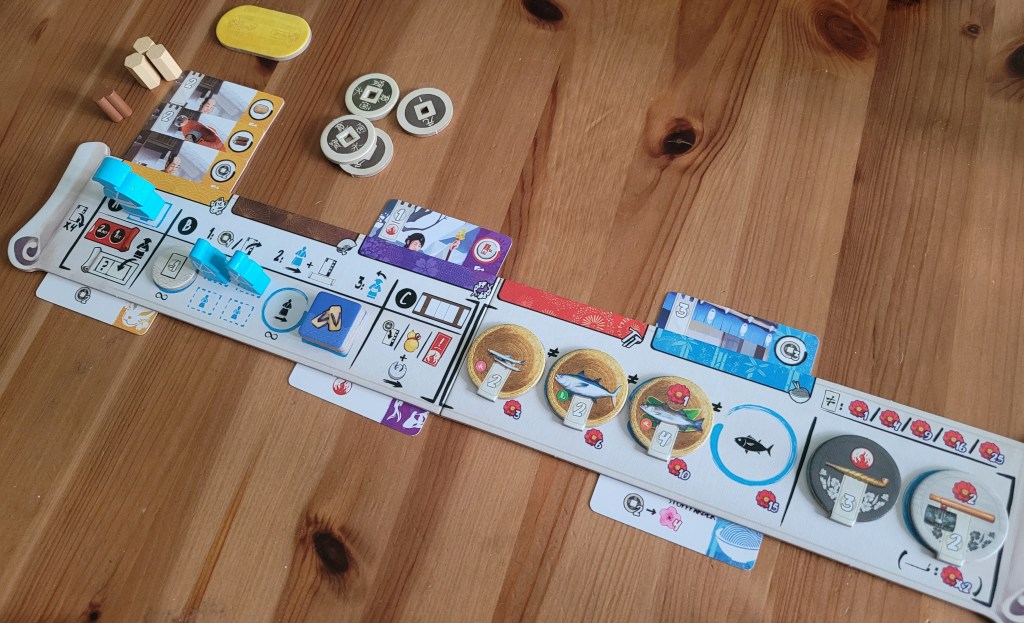
Because these changes are tied to player actions, the game’s core loop of swapping resources and collecting points feels neither dry, nor repetitive. As we better understand the rules and structures of the game, our decisions feel more layered and sophisticated. We soon realize that it is important to strike the right balance between pro-active action and flexible reaction. We want to pursue our strategies, while simultaneously seize on every opportunity that presents itself to us. Iki thrives on the constant changes on the game board, that can show up in every round.
Time and again, we offer new incentives to each other that benefit both of us. A card placed by a player will always enhance a basic action on the board. If that enhancement is used multiple times by others, it will be removed again and its owner will retain a benefit for the rest of the game. This way Iki creates a supply-and-demand setup of actions and benefits, that almost always feels constructive.
To avoid the “Catan Embargo” issue, i.e. “never trade resources with the person in the lead, or the person who could win the game on their turn”, Iki employs a fairly obvious solution. Our sources for victory points, that we add up after 13 rounds of play, are spread out over the game. It is almost impossible to deny other players their chance to score. The many options in Iki always offer an alternative to stay in the race. Even when the offered action enhancements are ignored by the rest of the table.
This way Iki manages the small but impressive feat of incorporating the dynamics of a trading game without relying on haggling or unfair deals. We purchase cards and offer them on the board, in the hopes of others using them and securing an ongoing advantage for us.
Our interaction offers benefits for both sides, written out on the card used. Their long-term benefits are spread out over the rest of game, discouraging the urge to calculate who actually got the better deal out of the exchange. Instead our decisions are gradually woven into those of our competitors. In the end victory feels both earned as well as only made possible by the choices of other players.
After years of strategy games honing in on an individualistic experience of eyeing opportunities and grabbing them fiercely, Iki is a welcome return to games as more of a social activity. Although you soon find yourself deep in thought about your next steps, the experience of playing as a group takes center stage. Even when trying to score more victory points than the rest, we need each other. We fare so much better together than we ever could on our own.
 Lest My Opinions Go Unheard