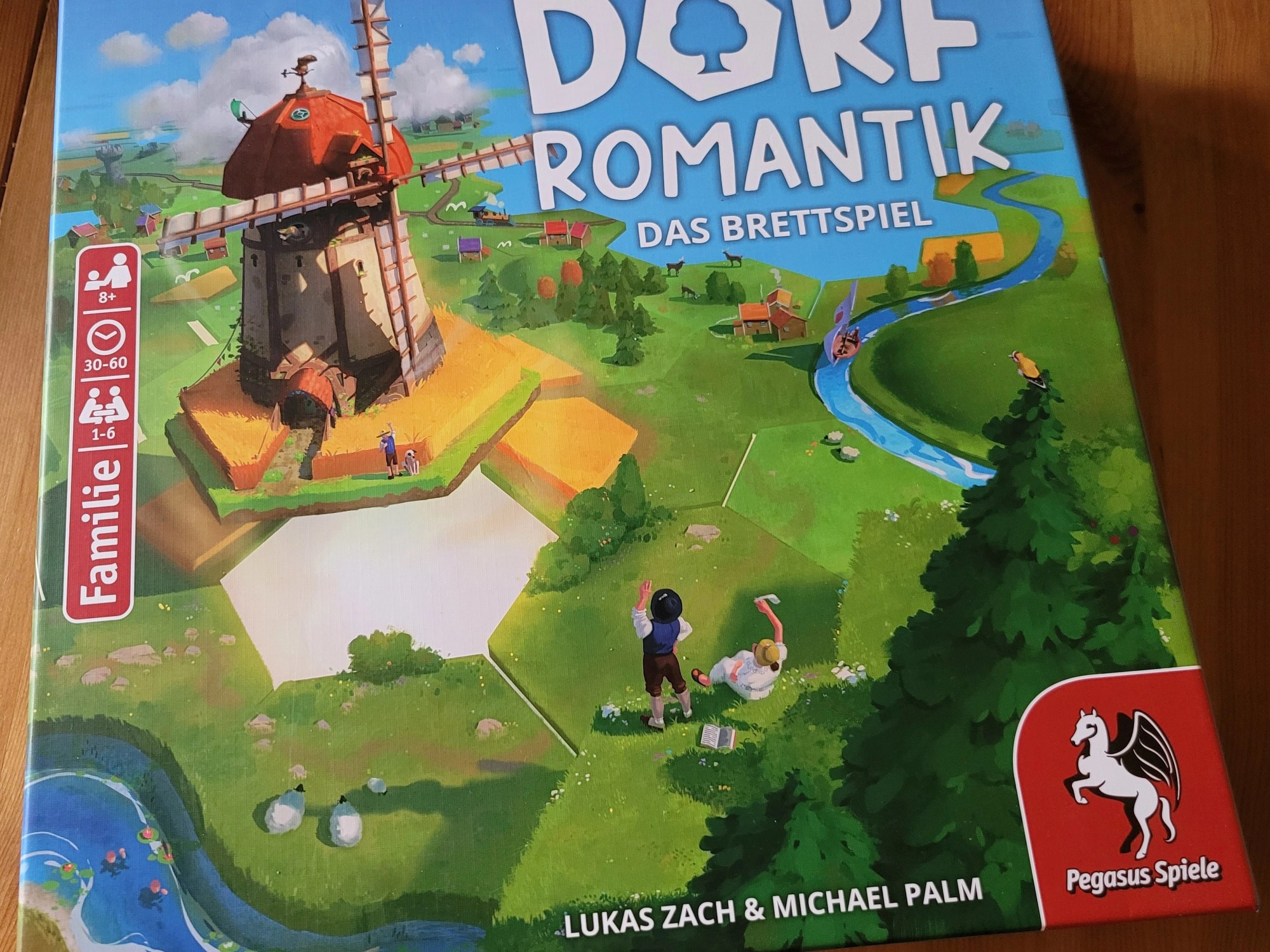
There is a sparseness to Dorfromantik: The Board Game’s feedback loops that feels almost uncouth: place a tile to score points off a token. The more points you score, the better. Once you’ve scored points, place a new tile with a new points token on it. Keep going until you run out of tiles to place. If you score enough points at the end of the game, you get to open boxes that may contain new tiles, new tokens or new goals for you to reach. All of which basically amount to new ways of making more points, under certain conditions.
This minimalist feedback loop shouldn’t come as a surprise, though. Dorfromantik: The Board Game is a board game adaptation of a video game (which in itself was heavily inspired by tile-laying games like Carcassonne), that takes most of its design principles from its digital source. And it took video games quite some time to establish themselves as a medium that offered more than just chasing after a bigger high score. While there have always been supporting features that enticed players to deeply engage with the game, whether it was new levels, new graphics or even the next chapter of a story; it took a while for world-building and the promise of immersion to become the norm in digital games.
Board games have always been half a step ahead of video games in that regard. Not because of their world-building (which is barely present) or their immersion (which is a thorny concept at the best of times), but because of their potential for intense and expansive engagement. Board games have other people to engage with, to build our magic circle with and to indulge in the fictions and fantasies that our games help prop up. We had rules that realigned our relationship to each other and let us compare our abilities and/or compete with each other. Board games always gave us more than just what was on the table.
The concept and mechanisms in Dorfromantik: The Board Game on the other hand, only seem to offer up a victory point collection towards the next achievement. This puts Dorfromantik: The Board Game on a similar level of depth as your average flip’n’write game. One of which was its main contender for the Spiel des Jahres award this year. While all of this is technically true, it does ignore the most interesting thing about playing the game itself. A feature that most veteran gamers are also all to eager to brush aside, given the recommended player count on BGG.
Dorfromantik: The Board Game only really comes alive when it’s played with more people. It does so, because we get to engage each other. We get to coordinate and cooperate, giving our social skills a decent workout. Much like how expert strategy games tend to train our ability to memorize card effects, gauge probabilities with a glance or come up with a structured plan how to achieve the next mid-way goal on our way to the game’s end. Dorfromantik: The Board Game asks us – not unlike the original Pandemic did – to find common ground with other people, who want the same thing we do, but may have a different perspective to us. It does so with a low-conflict and low-scale task, that reasonable people can have different opinions on, yet aren’t likely to escalate to get their will. It’s gaming with the intensity of deciding what to eat for dinner.

A sprawling landscape
only as pleasing
as it needs to be
Coupled with the fact that Dorfromantik: The Board Game also won the Spiel des Jahres award in 2023, this creates an interesting push to open up the mainstream understanding of what board games do. While Dorfromantik: The Board Game still presents you with a task, the game ends without distinguishing between winners and losers. In fact, even if you only end up with low scores game after game, you are going to eventually unlock new tasks and tokens. Dorfromantik: The Board Game is not obsessed with pushing its players towards excellence and “punishing” anyone who falls below its arbitrary standards of competency. It just wants you to have a good time with your friends or family. It gives you something appealing, interesting and arguably pleasant to do while putting your heads together.
Some describe Dorfromantik: The Board Game as a feel-good game, and it’s mostly due to the fact that you don’t have to be “good enough” to enjoy it. You don’t compete to get a top score, unless you personally choose to do so. You don’t have to race to unlock anything, unless you really want to. In fact, there is little to no pressure in this game, except for what you put on yourself. This is disconcerting, if not outright offensive to some players, who describe Dorfromantik: The Board Game as dull, pointless and “actually a solo game”.
When in reality, the experience of playing Dorfromantik: The Board Game is a direct response to how we’ve been conditioned to see games. If we see them as a source of tension, pressure and a way to acquire and exhibit learned expertise, we will find Dorfromantik: The Board Game only pays lip service to these ideas. Sure, you can learn to get better – there are even helpful strategy tips inside the boxes you get to open over time. But the core game is so simple, that becoming an expert in it, doesn’t feel like as big an achievement as it would in something like Brass Birmingham. If those moments do occur, they do not leave a lasting impression. What does remain, though, is a sense of accomplishment of having worked together, overcome differences of opinion and gradually solved the new tasks Dorfromantik: The Board Game lays out as your group progresses through the unlockable boxes.
And even though the game itself is fuelled by a simplistic feedback loop of placing tiles to score (more) points, the experience grows in depth as you keep going back to discuss options and find common ground before drawing the next tile.
We enjoy the challenges that games provide us with, because – assuming we are reasonably successful at them – they serve as a kind of self-affirmation: I am good at something, I can solve problems, I can improve myself. That’s why winning feels good, even when we don’t really care who we’ve won against. With Dorfromantik: The Board Game this singular “I” can easily expand to become a “we”, and that’s arguably the game’s most appealing and enduring takeaway:
We can do this.
Together.
 Lest My Opinions Go Unheard
One thought on “Game Night Verdicts #80 – Dorfromantik: The Board Game”