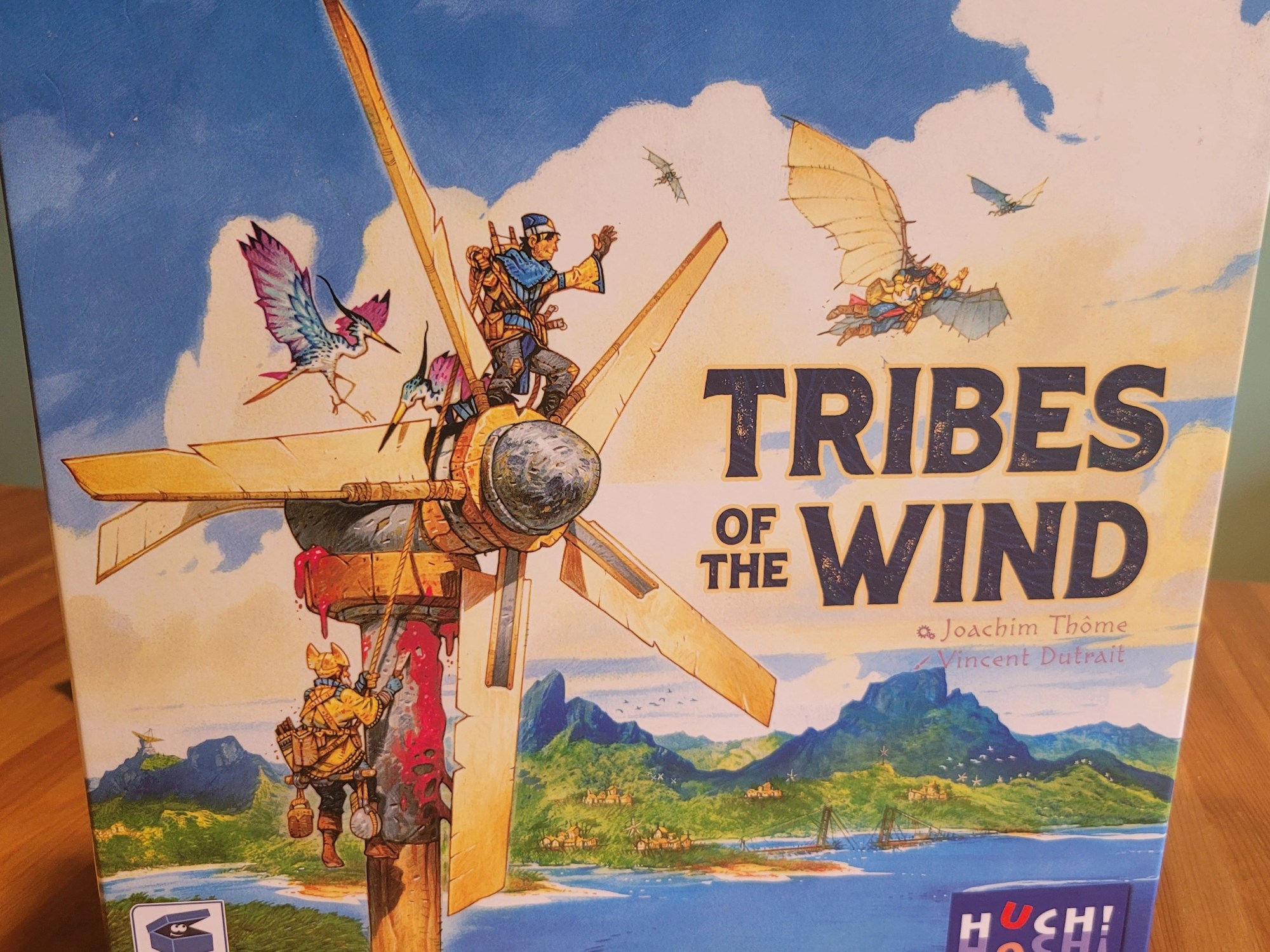
To talk about Tribes of the Wind, you first have to talk about Vincent Dutrait’s illustrations. They’re the reason the game stands out visually. The colorful palette and detailed drawings convey a sense of a lived-in, yet inviting post-apocalypse. Bright, but not childish. Full of visual treats, but not quite overcrowded. If you’re not familiar with Dutrait’s work, you will be thrilled. If you already own some of the games he’s visually enhanced with his skill, you’ll find Tribes of the Wind a representative, albeit not extraordinary examples of his style.
Tribes of the Wind is, as the rulebook points out, a race to the finish line. On the way there, you try to collect as many victory point sources as possible, or at least get there first, so nobody else scores more points than you. You collect resources, trade them in and cover your tableau bit by bit, until you can trigger the last round.
There is an interesting sense of instability at the core of its game, which we need to adapt to in order to make decisions. It’s only when certain conditions are met, that we can play an action from our card holder or get the most out of that action. Yet we don’t influence those conditions directly. We are instead dependent on the cards the players next to us hold. This makes Tribes of the Wind feel like it is in constant motion. The actions of other players can change which cards we can or want to play. If you’re familiar with modern designs, this might not strike you as particularly unusual. The execution might be different, but its effect is familiar. Our efficiency is noticeably affected by the actions of other players.

Short-, mid- and long-term goals
are open to all
Even though the visually arresting card mechanism draws your attention, the appeal of Tribes of the Wind is found elsewhere. Each turn you have to choose between short-term benefits (e.g. a particularly strong single action) and long-term goals (e.g. a weaker action that sets up a later one). This results in an experience where your mind goes back and forth, as you sink into tactical and strategic considerations. Actually executing individual actions is short and direct, which helps Tribes of the Wind feel well-paced. It’s a design that’s easy to understand. Its challenges are quickly grasped and its solutions visible, without feeling obvious.
Yet, even though Tribes of the Wind garners positive responses and appreciative nods from experienced players, it doesn’t quite lead to enthusiastic endorsements. Repeatedly, whenever veteran gamers would voice their appreciation of the game, it would come with the unprovoked addition that “it’s not my favorite game or anything”. An indication that some je-ne-sais-quoi was missing. That Tribes of the Wind struggles to wow seasoned players.

Diversity of characters and options
is very appealing
Even though, Tribes of the Wind does nothing wrong. Its rules are, despite their number and the peculiar structure of the rulebook, easy-to-follow, robust and quickly memorized. The game’s presentation is inviting and has strong Npositive connotations, provided you’re familiar with Nausicaä of the Valley of the Wind. The racing character of the game renders direct interaction meaningless. The attempt to purposefully hinder other players, is more likely to annoy players than heighten the sense of competition.
The only thing Tribes of the Wind does not have an answer to is “why this game?”. It lacks the one feature to make it stand apart from comparable designs. Dutrait’s visuals are arresting as always, but they are not unique enough. The racing feel of a tactical optimization game invites many comparisons to other games. Maybe that is the reason why it isn’t easily remembered as something of its own. The central card mechanism, while formally different, doesn’t change the game’s feel to such a degree that the game can be pinned down to it.
All this is more of a curiosity than an actual flaw of the game. A puzzling detail as opposed to an obvious inadequacy of the game. But it may be the reason why Tribes of the Wind, despite its confident design craft might not get a word-of-mouth push from veteran games. The familiarity of the game, allowing new gamers to quickly find their footing, might be what will keep Tribes of the Wind from getting wider attention in the hobby. That would be very unfortunate.
 Lest My Opinions Go Unheard