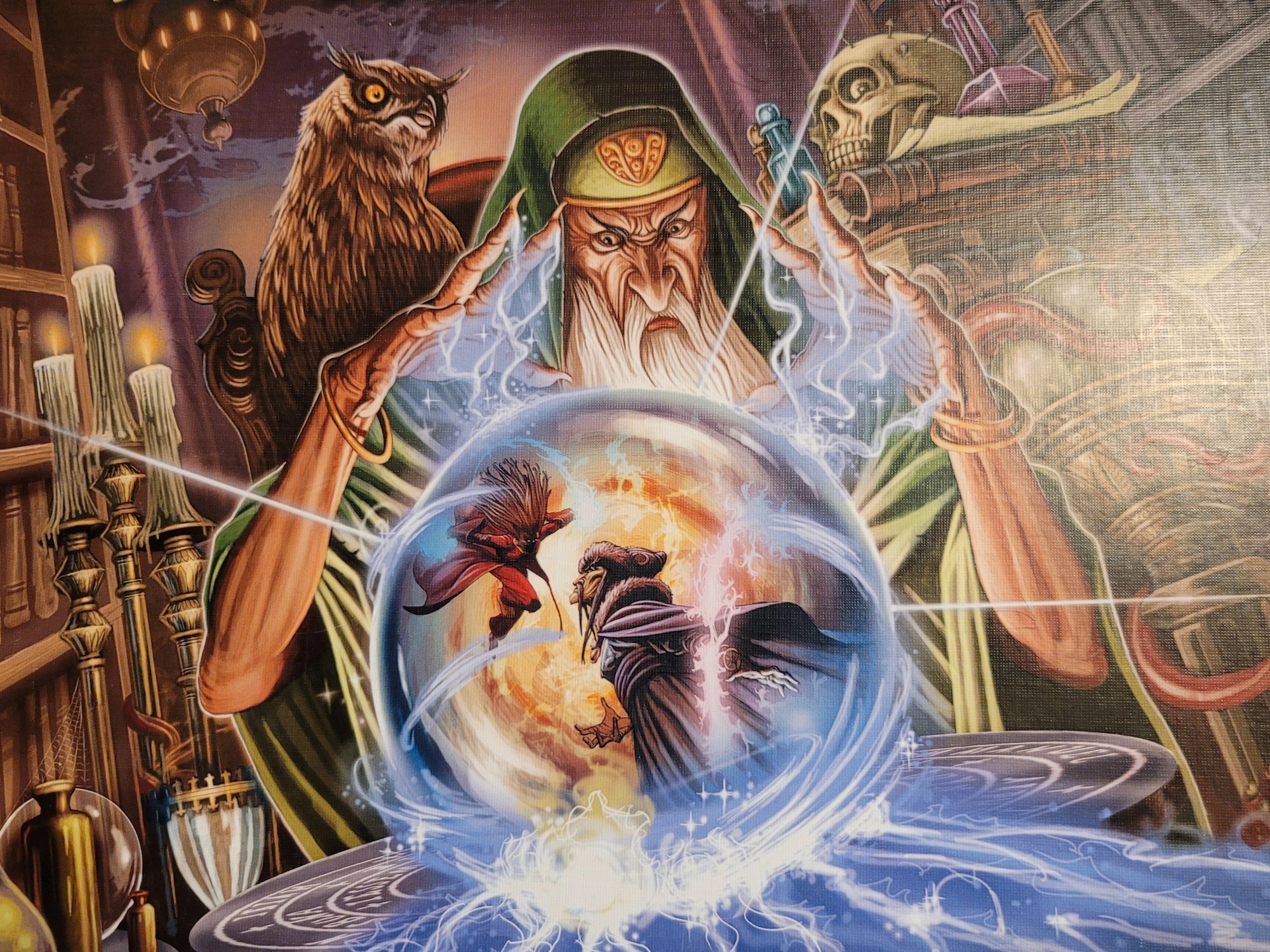
Turnsplaining is a portmanteau, coined by Tiffany Leigh. It is related to mansplaining, and transfers the behaviour that term describes into a boardgaming context. In other words, it’s about a player (generally male), who elects to analyze and breakdown the current turn or game state down to the last detail. The key characteristic of turnsplaining is that it is unsolicited advice. Turnsplaining does not describe the reply to a question like „What are the options in this situation, and how would you rate them?“.
Turnsplaining is always an explanation given out of self-interest. Much like mansplaining, it is an explanation that fulfils an additional purpose beyond being merely informative. Turnsplaining is about presenting the speaker’s intellect, analytical skill, vast experience and just general superiority in this moment. In particular when turnsplaining your own turn, it becomes a performance with a very specific purpose in mind. Everyone present must know exactly how deep the turnsplainer’s thoughts go.
But this behavior is also used to gain a game-related advantage. Turnsplaining somebody else’s turn is about influencing another player’s decision. Through careful and comprehensive explanation of the game state, it should readily become obvious what the “objectively best” action to take would be. Using information, that is apparently available to all, the turnsplainer performs a fact-based analysis. One that eventually reveals exactly how another player at the table can be stopped from winning. This results in a very blatant instruction to that player, phrased as a dispassionate recommendation.
It’s at this point, that some might want to suggest that turnsplaining is just another word for quarterbacking. Admittedly, this method can be used to become the effective group leader. But once that position has been secured, it is no longer necessary to painstakingly explain everyone’s turn, just for that quarterbacking player to decide what the group ought to do.
But what about games in which playing this way is not only common, but an arguably necessary strategy? If nobody is willing to lay out how to prevent the game from ending, we’ve already lost! Semi-cooperative moments in games, when temporary alliances are necessary to stop the leader, seem to encourage turnsplaining. It can be very tempting to lay out the game state in detail in order to convince others to make the “only correct” choice. How else can defeat be avoided? How else can the game’s end be delayed long enough, to win yourself? If such player behavior wasn’t intended by the design, why do those moments even arise in the game?
Quarterbacking is often justified in a similar way. It is seen as a necessary compromise in cooperative games. The argument goes that it is an unavoidable reality of cooperative designs. If one player can analyze the game state in detail, there is no reason not to share this analysis with their team mates.
The truth is, that it is irrelevant, whether players have the same goal in the game or not. The fault of the turnsplainer’s actions is found outside of the game. Turnsplaining takes away other players’ agency. It reduces their ability to engage with the game on their own terms, to make their own decisions and influence the game’s trajectory through their participation in it. It turns players into an extension of the turnsplainer himself, who then holds more power over the experience.
Protesting that turnsplaining simply points out options, while leaving the actual decision to others, holds no weight here. The unsolicited analysis and explanation of the turnsplainer is always a power play. It’s about claiming a dominant position within the group, by flaunting their skill and knowledge.
It has to be an inviolable tenet of playing games together, that our behavior must not limit another player’s agency. Even when a player does not recognize the action most beneficial to them on their own, no comment, analysis or “helpful” suggestion is warranted. It’s simply disrespectful. Turnsplaining somebody else’s turn is patronizing. It subtly puts down others, when play should be about treating each other as equals.
 Lest My Opinions Go Unheard