
Lacrimosa has something that many modern releases of big publishers lack: an excellent thematic hook that combines the familiar with the unusual. Mozart has died and the players are tasked to make sure his final opus is completed posthumously.
Mechanically, Lacrimosa positions itself in an unusual manner. At first glance, the level of detail seems overwhelming. The rules come across as convoluted. But during your first play, a clearly structured game flow emerges, providing players with solid footing and a clear direction to play towards. Yet, by the time the game wraps up, it becomes apparent that a lot of what you need to know to make informed decisions is only accessible through repeated plays.
Setup and presentation of Lacrimosa is intimidating at first. The board is very pleasant to look at, and the graphical design in general is expressive and coherent. There is little to complain about on an aesthetic level. The art style and visual language of the game suggest a sophisticated and tasteful experience. But that price is paid in clarity. It takes time and effort before you can easily read the game state on your turn. Which is an apt description of Lacrimosa itself.
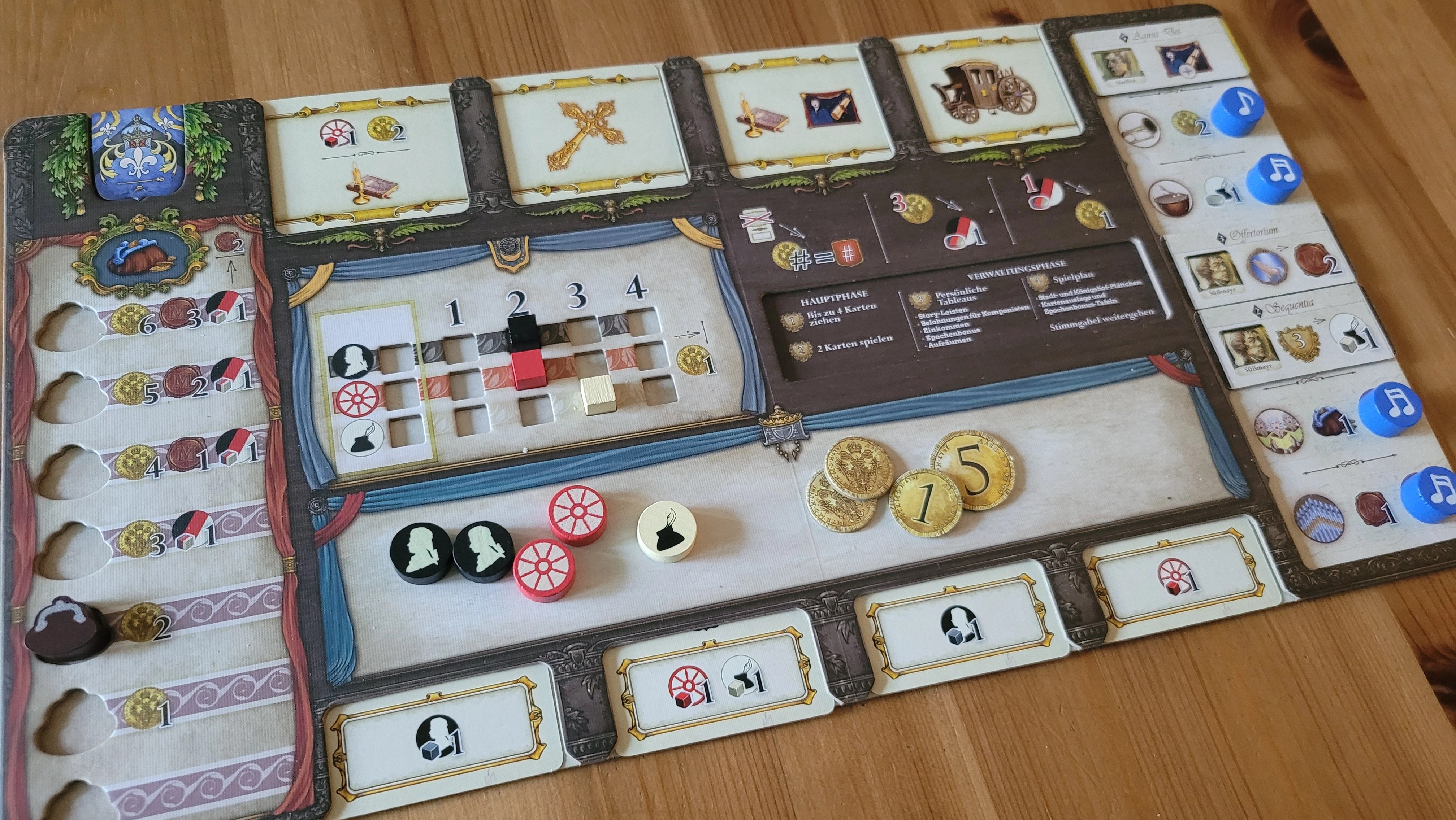
Because as you make your way through your first play, the astute design decisions pay off and help players quickly grasp the important decision points of the game and its overall structure. The player tableau offers a succinct overview of a round as well as illustrations hinting at what you’re supposed to do. There is room on the side to add tiles during play. These also offer a quick overview of any additional actions or bonus abilities you may have gained as you play.
Of the nine action cards you will use each round, no more than four will be in your hand at any one time during the game. This limits your options just enough to give you room to make decisions even before you can analyse the game state fully. Even the board itself turns out to be less chaotic than it seems, as you can soon separate it into three distinct areas. These areas in turn are directly connected to three resources, that are tracked on your player tableau. Handily, these resources are only used in their corresponding area. A detail that is only subtly communicated in the game’s visuals and only becomes apparent during play.
The same can be said about the benefits that these areas and resources provide. The white resource „composition“ gives access to one of the main sources for victory points in Lacrimosa. In addition it unlocks tiles, offering additional actions. The red resource „travel“ moves the also red Mozart token across a map of Europe to trigger situationally strong effects or unlock victory point tiles. The black resource „talent“ is needed to acquire individual works of Mozart to generate additional income. Money is, of course, the fourth resource here.
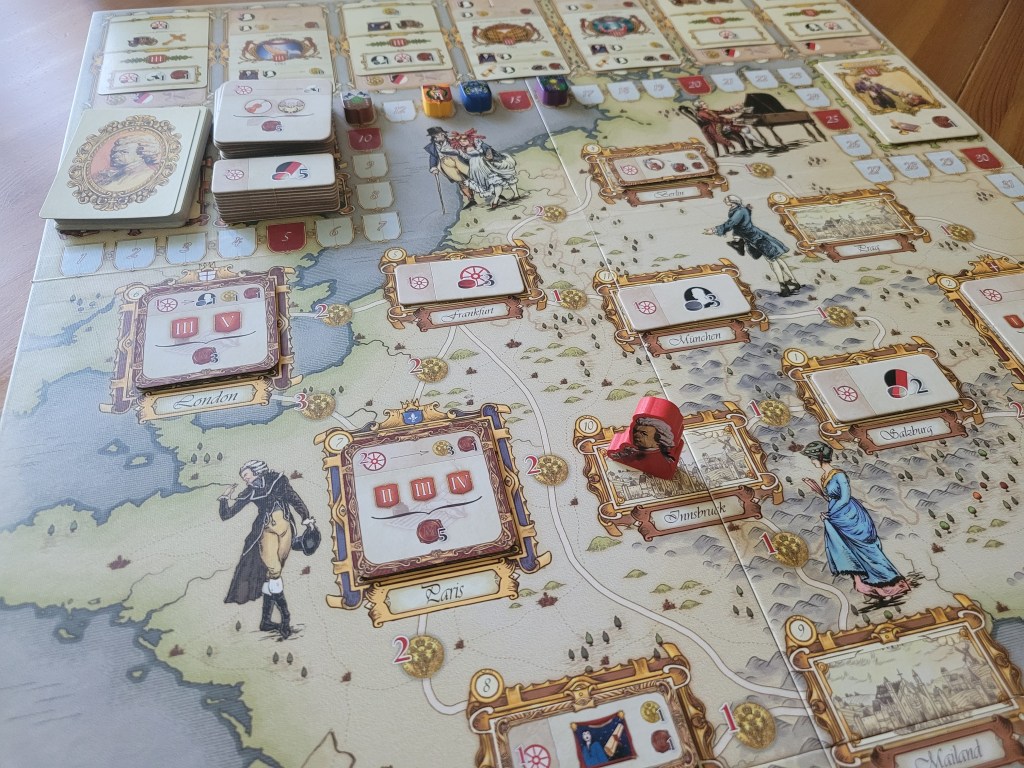
This description might suggest that the differences are clearly legible. But the tactical and strategic benefits of each area really only emerge through repeated play. This is where Lacrimosa falters somewhat. Because both on a thematic and on a visual level these connections are difficult to untangle. You have to learn them either on your own or vicariously through your fellow players. Over time you pick up on which decisions shape your strategy going forward.
It goes without saying, that this initial opaqueness is considered by some a strength of a game’s design. Lacrimosa rewards those who play it repeatedly and in short succession. The practical experience you gain immediately translates into finer tactical decision making and clearer strategic objectives.
Calling this a learning curve misses the point. After the first play the overall structure and individual rules are no longer a hindrance. You even have promising, albeit vague, direction to pivot your strategy towards. But it still feels that there is room to refine and improve your performance. That there are more tricks and combinations to discover, that will help you increase your personal high score. The area where Lacrimosa remains opaque at first are also the ones that allow for optimization.
Other designs get to this point by burying players under countless options, card combinations and rules mechanisms. This effectively keeps those players out, that play games for fun and not on a tournament level.
Lacrimosa’s unassuming strength doesn’t lie in its depth you only get to explore over multiple plays. It’s found in the design decisions that provide players with enough structure to support them in forging their own path to the end. It’s a successful design because quickly gives players enough understanding to make purposeful decisions. Before long, it feels like your decisions drive the game forward. This is in no small part due to the simple, yet effective card play mechanism. Each action you choose is complemented with a second card from your hand. This card doesn’t come into effect until the end of the round and determines the number of resources you start the next round with.
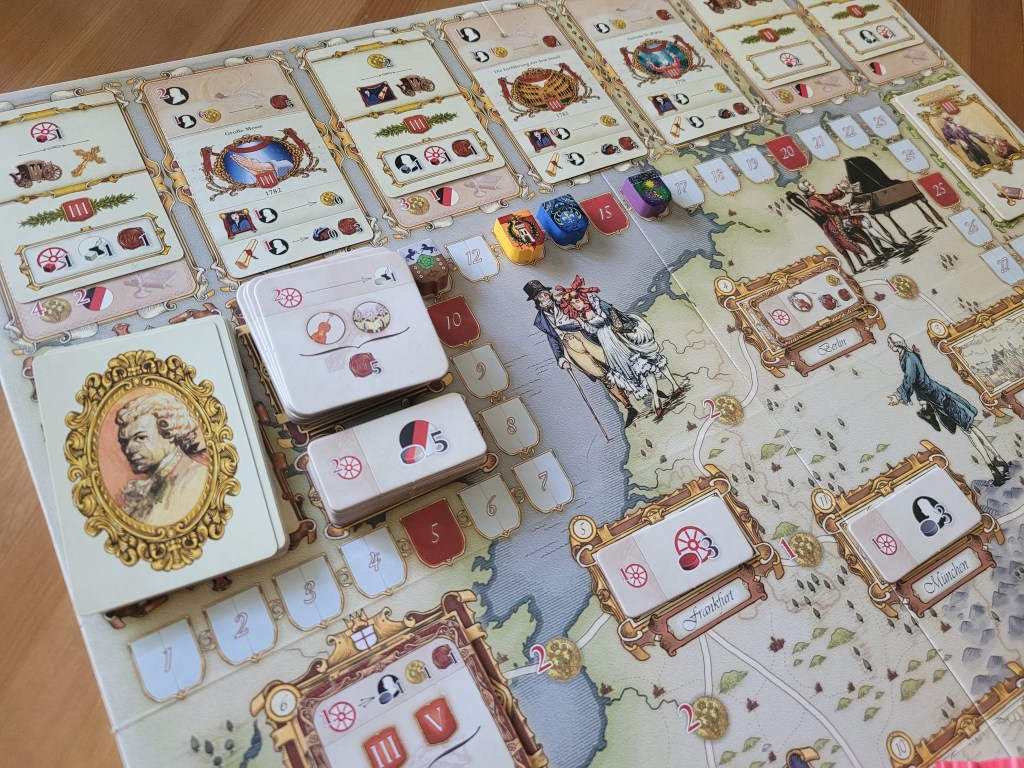
At first you might brush this off as a quirky formality of Lacrimosa. But it continuously pays off in satisfying moments when you manage to set up your resources in just the right way, to start the next round with all options available to you. This positive feedback loop that grows out of your own decisions is highly motivating. More than that, it gives players confidence to look deeper into the challenges the game offers. Even if game length will continuously exceed the 90 minutes printed on the box, Lacrimosa plays without any noticable lulls.
It’s difficult to say, if the secrets Lacrimosa holds will often meet with gaming groups who are willing and able to repeatedly get a longer game to the table. Lacrimosa requires a gaming environment in which players are motivated to play the same game over multiple evenings to really get to the bottom of it. It needs a gaming group that considers untested strategies and untried tactical moves a reason to play a game again.
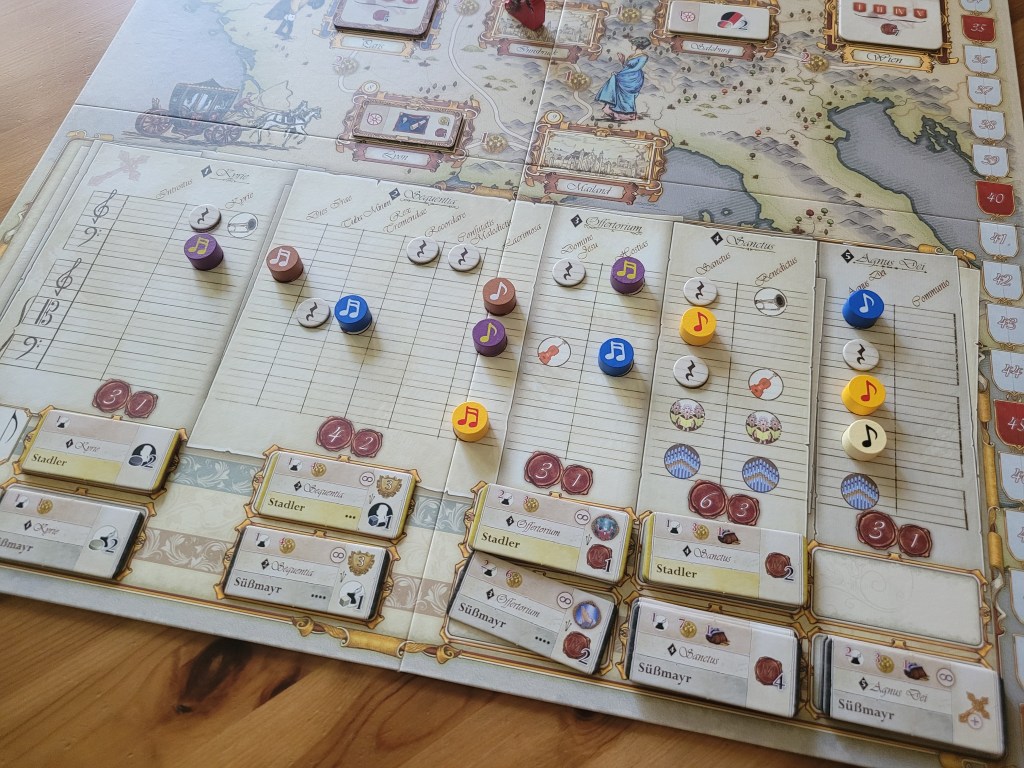
This sense of experimentation and exploration enters a shaky alliance with the idea of competition, once the game tilts towards grabbing victory. As soon as the possibility of winning becomes the group’s focal point, the game’s thematic trappings and references to real world history fall by the wayside. Ambition basically demands you adopt a stark analytical view on the game. So you end up fighting over majorities in the point scoring area, snatch valuable cards away from under another player’s nose and trigger location tiles, to make sure others don’t benefit from them. Tension grows as you hope the action you need to take is still available when it’s your turn. You enjoy a short moment of triumph when your action foils somebody else’s plan. And you delight when your victory point marker sneaks past your opponents’ at the end of the round. This competitive motif is overly familiar and it’s in these moments that Lacrimosa feels generic and almost interchangeable.
But if you find enjoyment in exploring a game in all its finer points and idiosyncracies, and you’re tired of working your way through gnarly rules sets and antediluvian card stacks, you will appreciate what Lacrimosa offers.
 Lest My Opinions Go Unheard