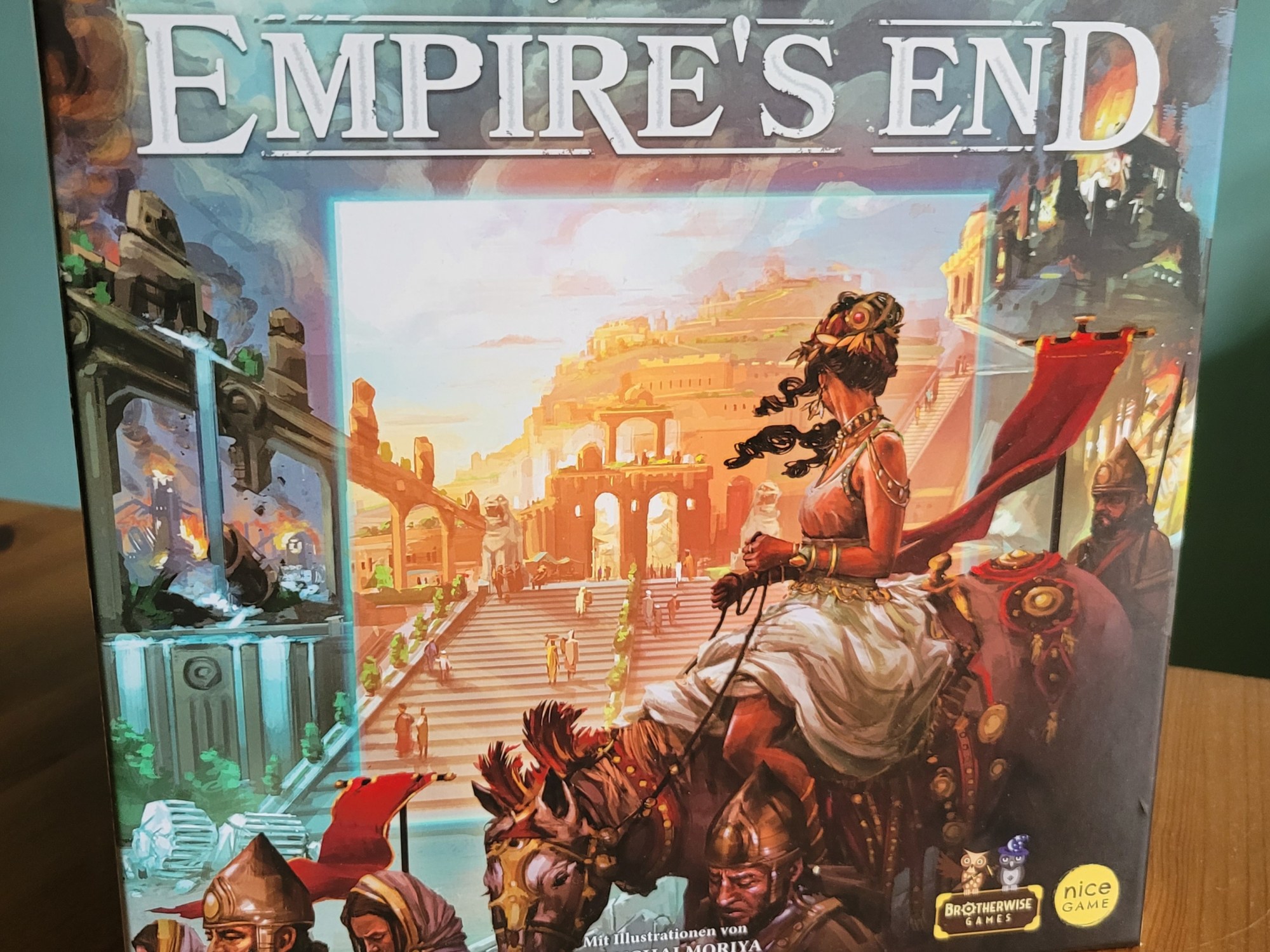
Let’s begin with a lukewarm take: board games are pop cultural products. They are generally considered a source of fun and cheery entertainment. Which is why many players doubt that games could cover other facets of our emotional spectrum. Hence the allegedly golden rule, that a game has to be fun first. But what if fun wasn’t the only thing that a game could provide? What if a game is effective because it primarily dives into negative emotions?
Thematically, Empire’s End deals with the decline of an empire. You might be tempted to say, that this is a game about loss. But in most circles saying so would you get accused of corny pathos and pretentiousness; and you would get ridiculed for it. Sure, the box and rulebook can say whatever they want, but to us at the table, all this is just some cardboard and wooden tokens. There is no history of an empire here. There is no violent past as it was made. No moments of peace and prosperity build on the backs of an exploited other. All these things are essential to the concept of empire, but within the context of the game they are neither present nor relevant.
Still, the game’s theme is aptly chosen. Instead of trying to convey the “downfall of an empire” in the most literal and prosaic way, the theme accentuates and evokes a particular tonality for our play. It frames our decisions in a specific metaphor. One that brings a certain imagery to mind and roots the game in a vague sense of melancholy. In Empire’s End we face the decline of our (victory point-)prosperity and try to handle this as well as we can. Both mechanically and emotionally.
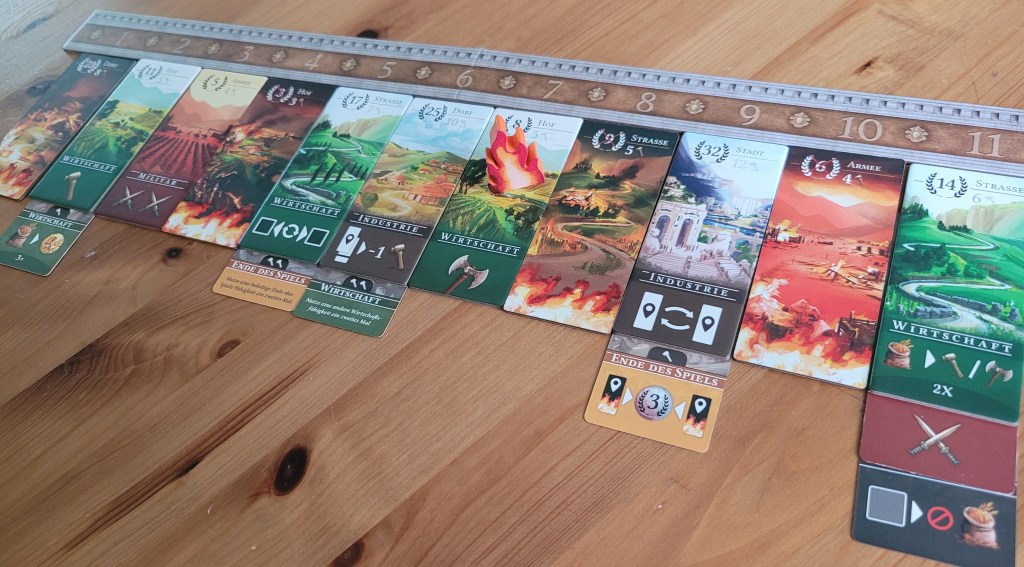
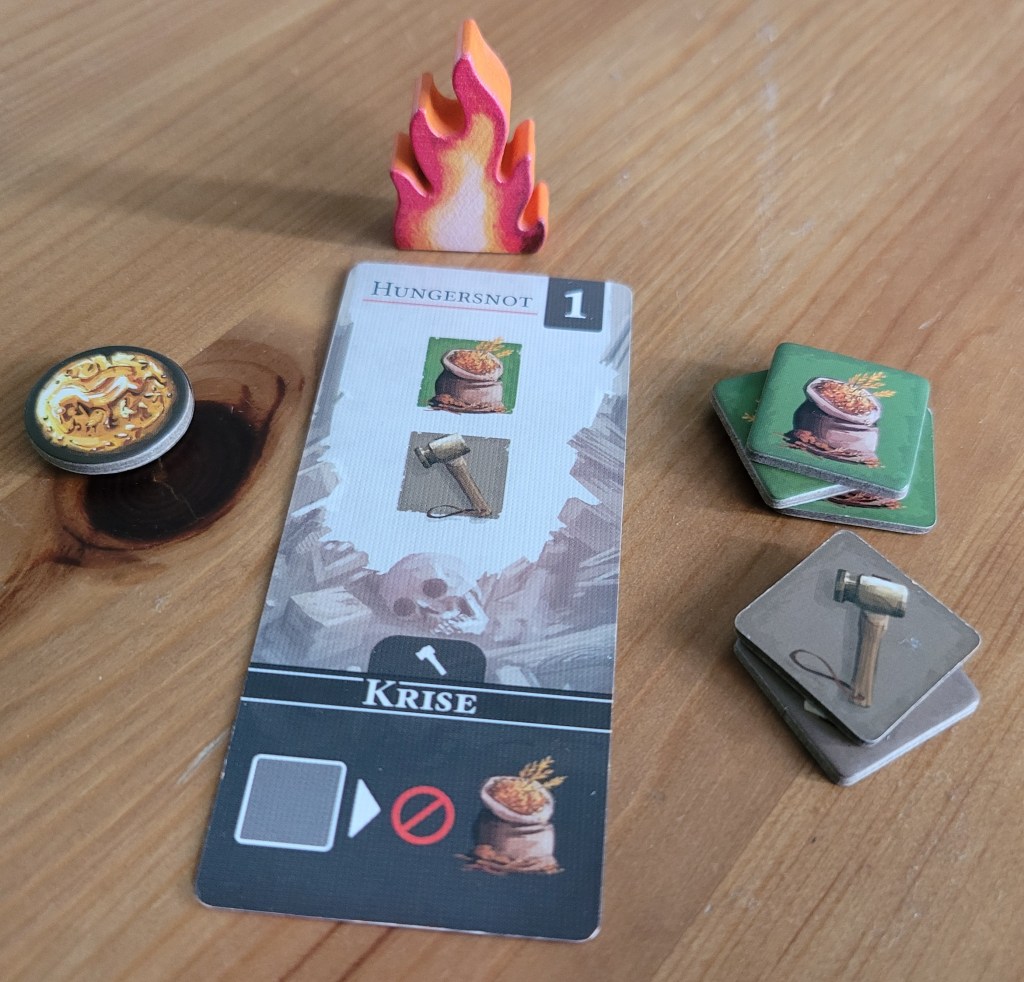
Every crisis we suffer is an ominous promise that announces our empire’s decline. But we also receive all the resources other players have spent on avoiding that very same crisis. Over time we start to consider if giving up our village is worth all the valuable means we gain, to avert a crisis at a later point. In addition, we are also given an often passive ability, we may be able to use to our advantage later. This tension in combination with the game’s theme comes together differently for each player. Some speak of the arrogance of power, when we sacrifice places in our empire, to pursue our goals. Others feel responsible for the places they allow to become uninhabitable, due to barbarians, floods or plagues. You unfortunately no longer need to be gifted with an overabundance of creativity to imagine what that might entail.
There is no denying that Empire’s End creates a strong sense of tension. In the final tally, the game still distinguishes between winners and losers. But adding up victory points feels less like a dramatic finale, but instead like a gratefully accepted end to the emotional strain we feel. It’s more of a sigh of relief than a triumphant climax.
It’s fascinating to see how differently players deal with the situation. Some are uncomfortable and feel treated unfairly (“Why me?”) and even resent players for avoiding a crisis and pushing it onto them. Some players seek a sense of spoken solidarity with others at the table, as they try to carry as much of their tableau past the finish line. Yet others switch to a radical focus on the rules alone, reserving any emotional response solely for the mathematical relationship between resources, card distribution and player decisions. We move in the familiar emotional space that reserves the emotional highs and lows for how well we’ve mastered the task we were given.
Of course, Empire’s End is hardly the first game in which you have to deal with missing out on and losing points. The psychological pattern of loss aversion is seen by some as so ubiquitous in game design, that it is assumed to be the basis of all player decisions. But a game like Empire’s End, which centers this response in its design, shows that in the vast majority of games this is merely one lever of many. It’s just one more technique for games to grab us. But by embedding it into the metaphor of an empire in decline, it creates an emotional resonance that is remarkable.
Recently, there’s been an increase in games that try to show the maturity and depth of the medium by squeezing complex historical backgrounds into the corset of a victory point race. By dressing the game up in the seriousness and importance of real history, even players who think of games only as a trivial and inconsequential activity, are challenged to evaluate it with a sense of stiff earnestness.
In Empire’s End these dry historic references and meticulously researched factuality are not present. Yet, it still gives us ample room to reflect, assuming you are the kind of player who can take the medium seriously, without being hit over the head with it. The setbacks and decline in Empire’s End are inevitable. They can be, at most, delayed. But the more crises you manage to evade, the less likely you are to have the means to avert a future crisis, that might potentially be even worse.
This is not a game, which neatly slots into many players’ expectation of the “right” decision being rewarded with positive feedback. It isn’t defined by a sense of growing progress and increasing player agency. Sure, it’s mechanically related to “No Thanks”, but it doesn’t feel like a silly take-that game. When you sit down to play it, Empire’s End is more closely related to The Grizzled and the uneasy feeling of a looming catastrophe approaching. It is this sense of setbacks and sacrifice, that makes the actual winning condition in Empire’s End feel off-kilter.
The final victory point addition does not do the emotional tension of playing the game justice. It reduces our experience to a pitiless accumulation of points. A game that taps into notions of decline and loss aversion culminates in an accounting exercise that only validates the experience of one player at the table. But what you really want is a sense of catharsis. Precisely because the effort and compromises you’ve gone through in an attempt to thwart the worst blows the game could deliver, does pull you in so deeply. It’s oddly reminiscent of the famous cut to black in the finale of “The Sopranos”, which made it so memorable and disorienting. Regardless of what playing the game felt like, and what kind of images it created in your mind, in the end it’s just about running down a victory point track.
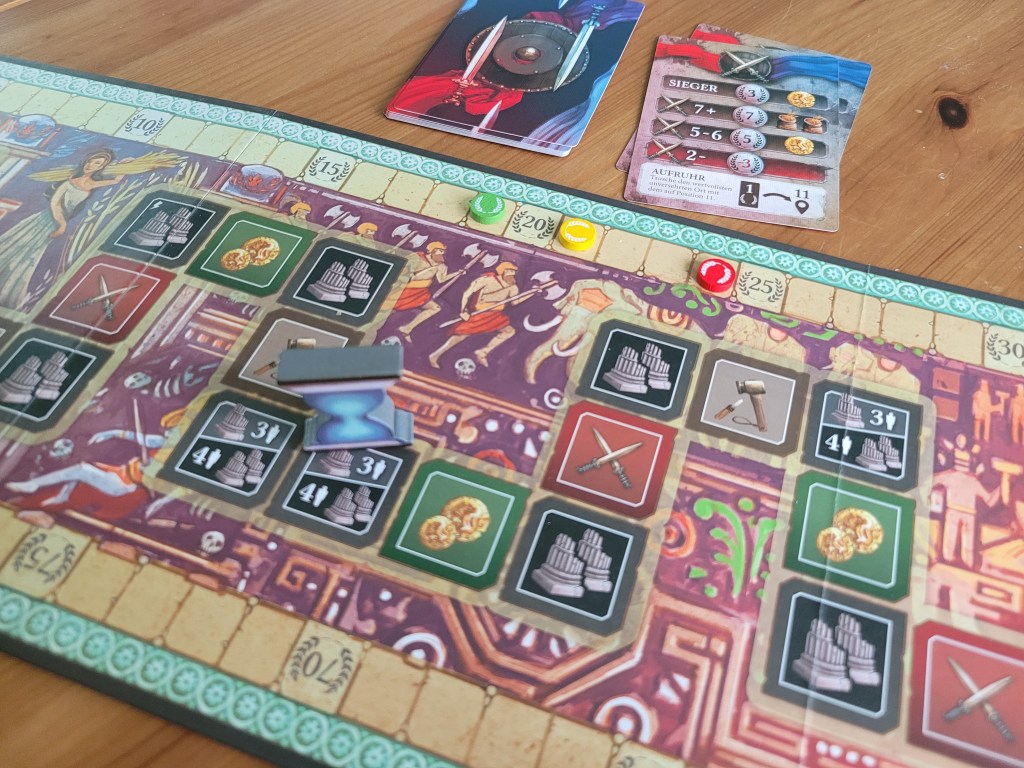
This might go some way to explain why players who have been wrapped up in the elegiac mood of the theme need some time to sort through the (not altogether positive) emotions as the game ends. How do you process and explain them? What do we get out of it? What kind of thoughts does this piece of pop culture throw back at us?
If you’re focused on the mechanical puzzle and consider a theme a pleasant facade to the underlying competition, you might appreciate the undiluted brain-teasing in Empire’s End. Decisions are rarely simple, and every crises ratchets up tension. But under this playful surface, there’s room for a far more challenging experience that provokes unusual thoughts. Empire’s End lets you think deeply about games and their meaning, precisely because it primarily confronts you with negative emotions.
 Lest My Opinions Go Unheard
2 thoughts on “Game Night Verdicts #83 – Empire’s End”