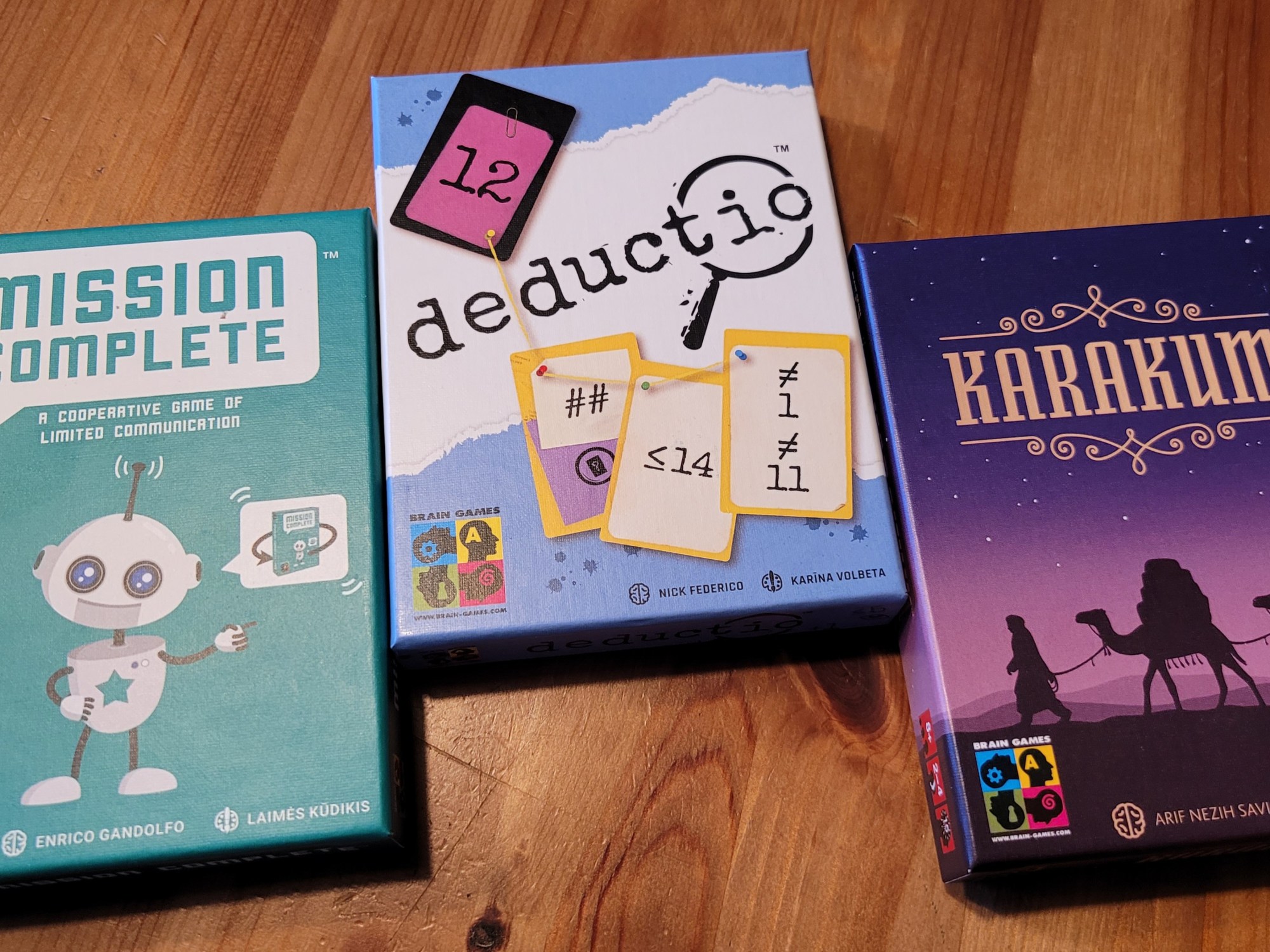
Karakum
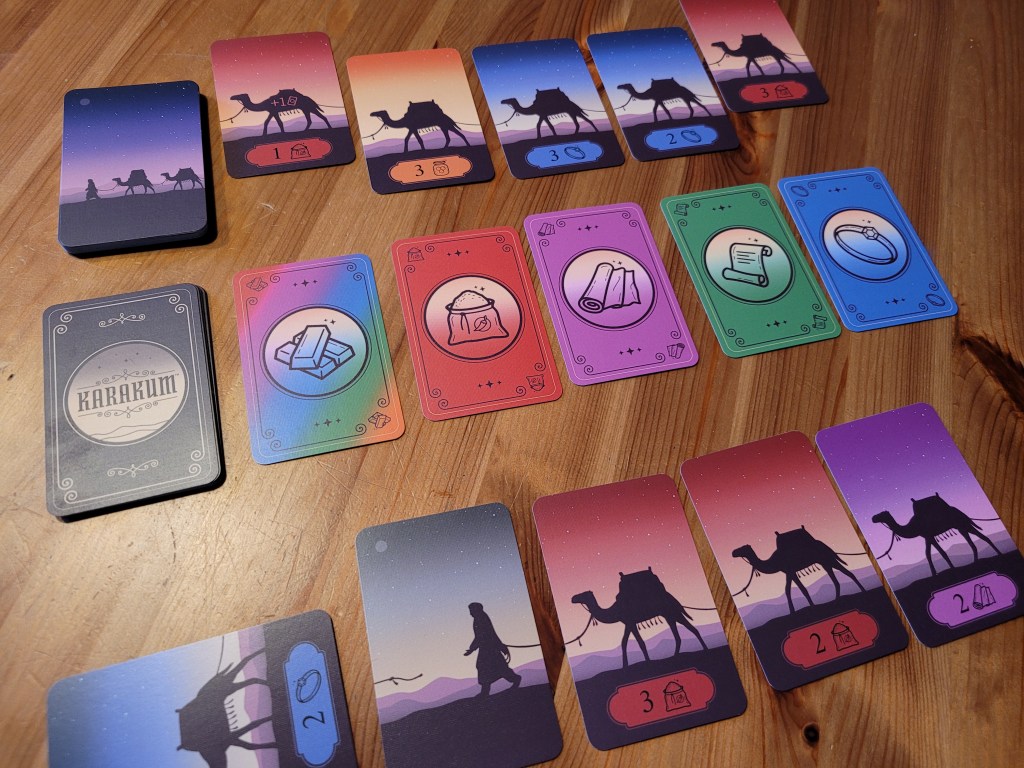
Karakum is a simple and straightforward open drafting game. Over the course of multiple rounds you draw cards (goods) into your hands, and spent them on cards (camels) from the market. The goal is to end the game with the most points. There are also two small rule details that can change costs of some cards, or affect the appeal of certain cards to players.
The game’s simplicity and clear structure is a big draw at first. Take goods into your hand, buy camels and place them in front of you. Eventually the deck of camel cards runs out, ending the game. The short playing time shouldn’t be considered backhanded compliment, though. It is instead a necessary element of the design. Because only after repeated plays and the slow emergence of a metagame, i.e. us anticipating other players’ decision-making patterns, does Karakum pick up steam and some depth.
It becomes apparent that the speed with which we empty the camel market is our most important lever to manipulate other players. Snatching up camel cards – even if we don’t profit from them directly – before another player gets to them, proves to be an important way of denying them points. To experts this is known as hate drafting.
Karakum doesn’t reinvent the wheel, or a cog, or even a toilet roll. But its mechanisms and play length is remarkably friendly to newcomers. Sometimes that’s the exact kind of game you want to have in your back pocket at the right moment.
Deductio
Deductio is a similiarly easy to explain card game, eschewing any rules gimmicks. Its brain-teasing essence is so undiluted, that veteran gamers might be tempted to claim that Deductio is more of an activity than a game. An argument, which is once again as accurate as it is insightful.
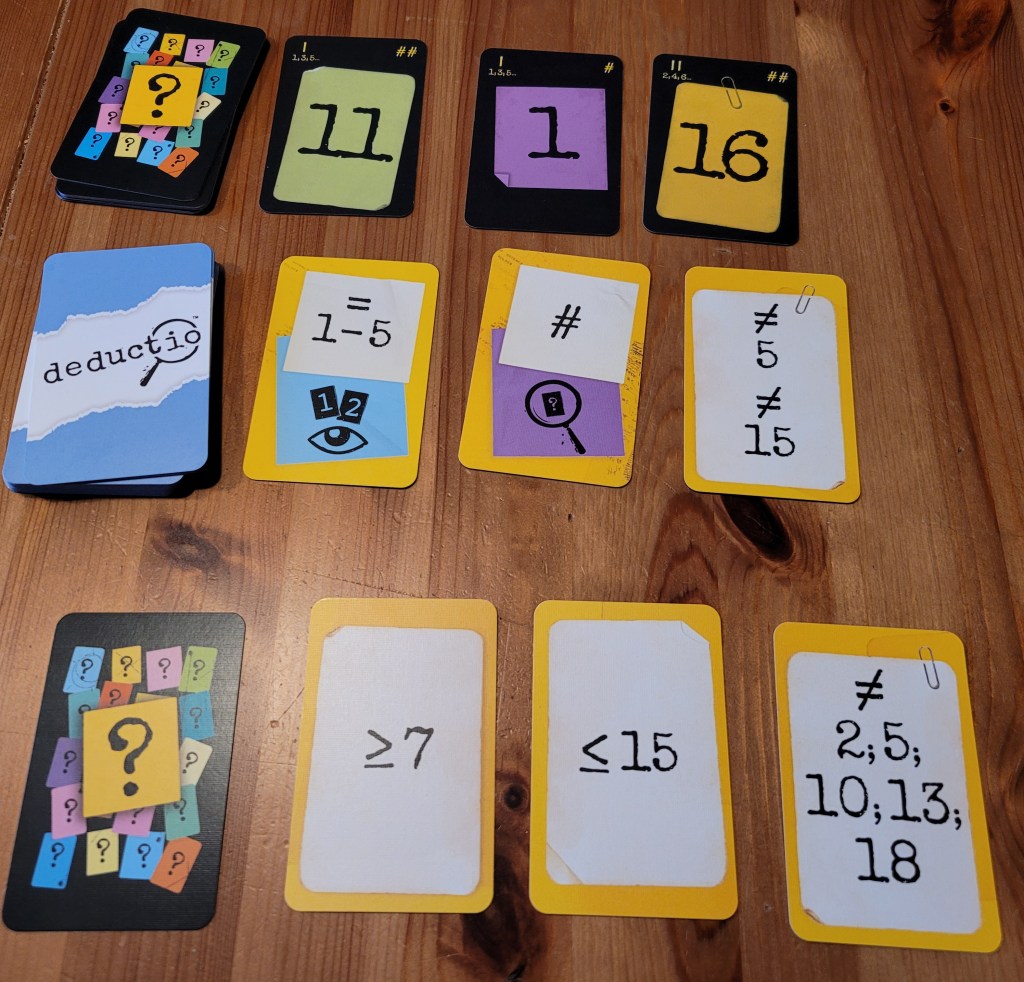
In Deductio you try to identify a specific number between 1 and 20. Instead of having to come up with some kind of obscure hint, you instead choose one from the constantly changing display. Of the three before you, you have to pick up one that applies to your secret number. Naturally, you try to give as little away to your fellow players as you possibly can. „Neither 4, nor 14“ is much more appealing than „Between 1 and 6“ might be. As the game progresses, you have to repeatedly choose new hints and continously eliminate more possibilities. A decent memory is helpful, but particularly with younger players taking notes at the table should be allowed.
Because the actual thrill of the game isn’t which card to pick, to not give anything away. It’s the decision whether to wait until you can definitely deduce somebody else’s secret number… or to risk it, and take a guess, so you can steal somebody else’s victory point.
It’s these moments of daring that turn Deductio into more than just a Sudoku with cards. Some hidden information here, or a revealing question there and suddenly your mental logic engine is running at full speed. Neither illustrations, nor rules stand in the way of some undiluted deduction fun. But that’s also why some players might turn away from Deductio.
Mission Complete
The first thing you notice about Mission Complete is its impressively difficult to understand rules leaflet. Once you’ve made it through that, you realise how difficult Mission Complete is to explain. The usual, linear explanation can’t quite handle this game. Simply walking through the game’s turn order, forces players to keep many different and similar sounding variables in mind. In fact, Mission C omplete actually needs a flow chart, that shows which objectives are relevant for players at certain points during the game.
Let’s start at the most basic: Mission Complete is a cooperative card game, in which you play a card from your hand each turn. Your choice isn’t limited in any way. But depending on which phase of the game you are currently in, you might want to achieve different goals. This in turn affects which card you want to play.
There are three phases in Mission Complete, which you keep running through until the deck of cards runs out. Which actually happens faster than you think. During the first two phases, you try to determine a task, you’re supposed to solve together and a person who is supposed to solve it. (Some tasks actually play around with the latter point, forcing players to keep more exceptions and variables in mind.)
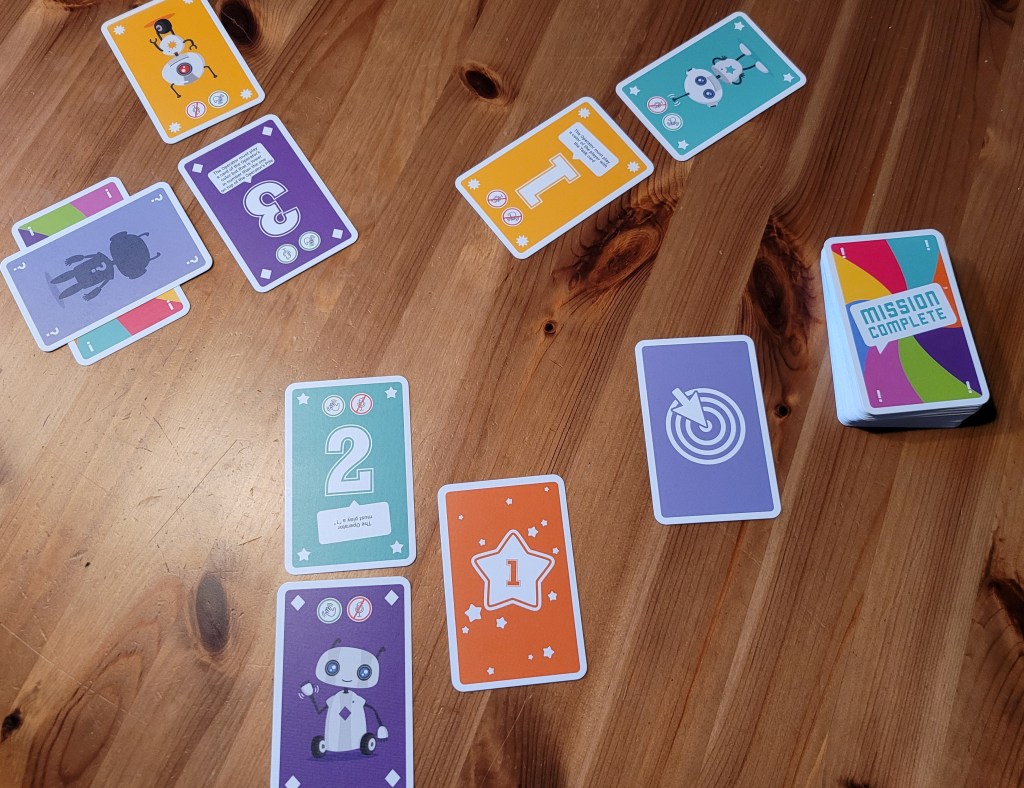
During the third phase, you try to solve the afore-mentioned tasks and this is where the typical challenge of a cooperative card game comes in: communication between players is limited.
All necessary information: tasks (as text), tasked player (as color) and communication limits (as symbols) are covered by the same deck of cards. From a production design perspective, this is impressive. But it also challenges the rules writing in a way, it can’t quite overcome.
It took several attempts in our fairly experienced gaming group, until we understood which color we were supposed to play at which point during the game. Or which bit of information on a card mattered during which phase. In a way, these difficulties of understanding things hints at the game’s core idea. Because even when you are familiar with the overall flow of the game, the actual tasks you have to solve together are often difficult to explain, if you can’t speak or use gestures.
Unfortunately, it’s these communication limits that aren’t as clearly handled as they might need to be. Not because there’s anything missing in the rules, but because going by what’s in the rules, you might end up with situations that make solving a task trivially easy. If you can speak freely, after all, you can just tell people every bit of information there is.
We were a little uncertain at first, as we worked our way through the rules. But we were downright confused, if we had accidentally broken the game at some places, had been enormously lucky in our card draws or were simply unfathomably gifted, brilliant gaming legends. (After a short internal consultation, we opted to categorically reject the last option.) The challenge of understanding the game seemed significantly harder than being reasonably successful in playing it.
Mission Complete has an air of being a diamond in the rough. There’s something special about the game, and the tasks that might play out in it. But getting to the point, where you actually grasp how to play the game, is hard. Even once you’ve made it, you’re still not entirely sure, if you’re dealing with a brilliant gem or a glass bead.
 Lest My Opinions Go Unheard