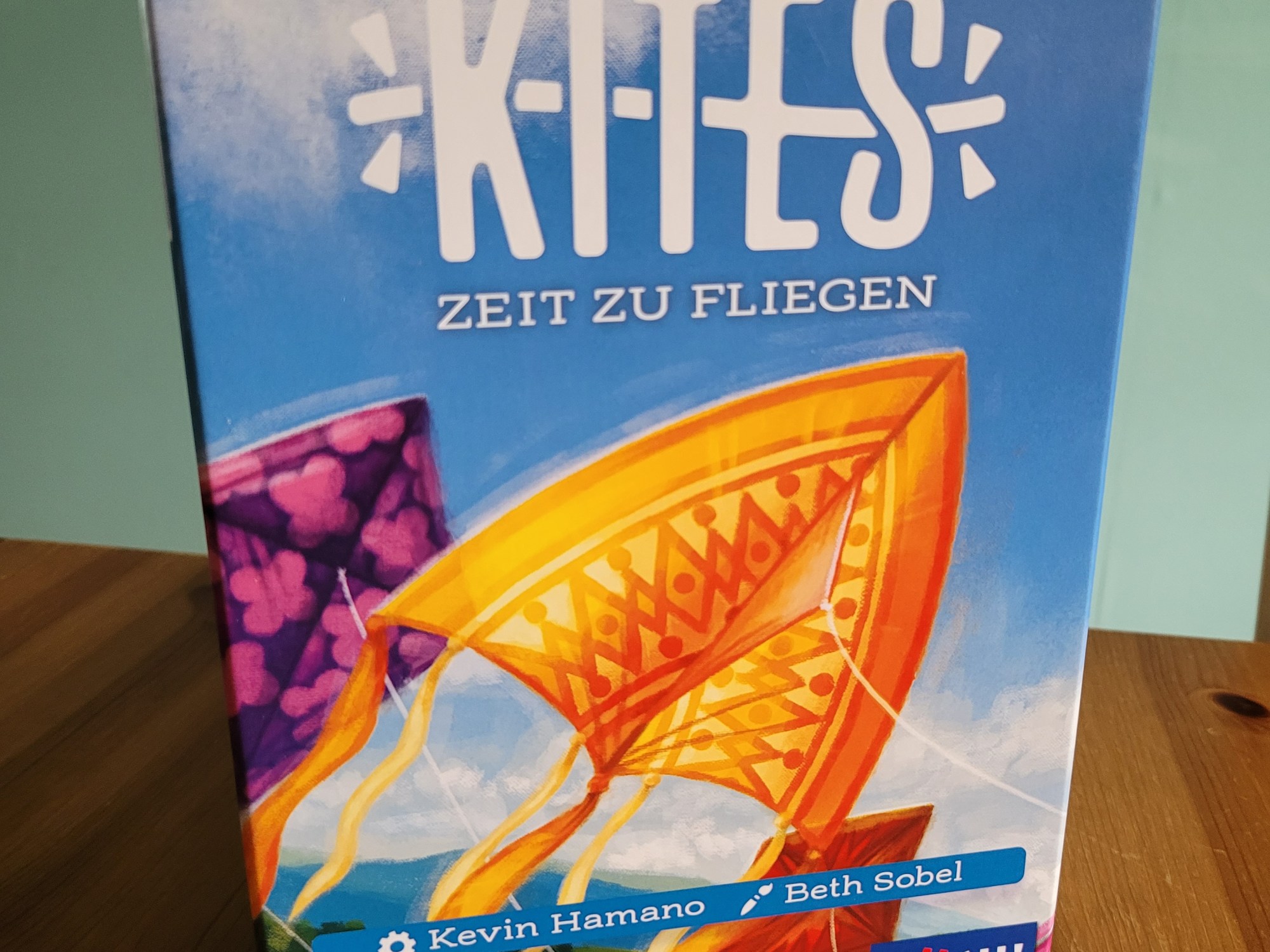
It’s received wisdom among passionate non-gamers, that „the best games are actually the simplest ones“. It’s a claim that lands somewhere between wilfully dumbing things down and an intuitive appreciation of good game design. The rules for Kites test this claim. It’s a simple real-time game, which stands out for both its colorful illustrations as well as its sand timers.
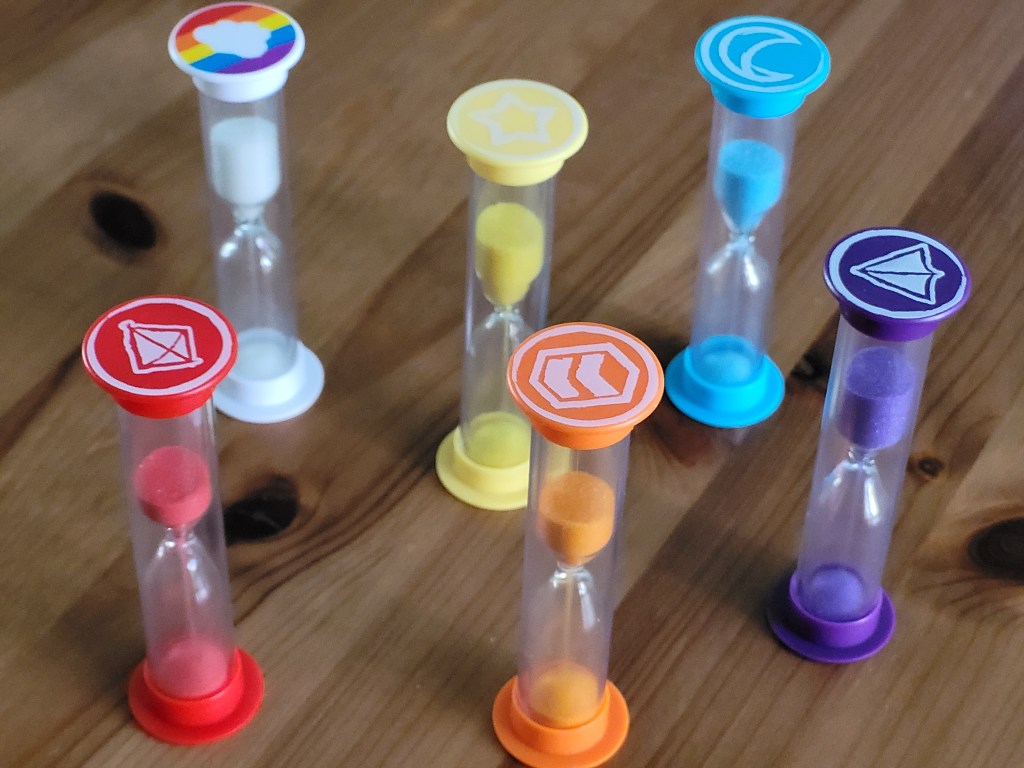
Both title and illustration hint at, well, kites. The kind which you can get into the air, provided winds are strong enough and you have room to run around in. Assuming that the weather isn’t trying to be a spoil sport. Connecting the sand timers to the time your imagined kites spent in the air comes quite naturally. You will have to flip them at the right times (and an increasing sense of panic) to make sure they never full run out. At least until you’ve played all the cards from your hand and draw deck.
You might worry, that Kites is a hectic and overall chaotic experience. But as it turns out, it’s the short moments of calm and effective communication that gives Kites its charm.
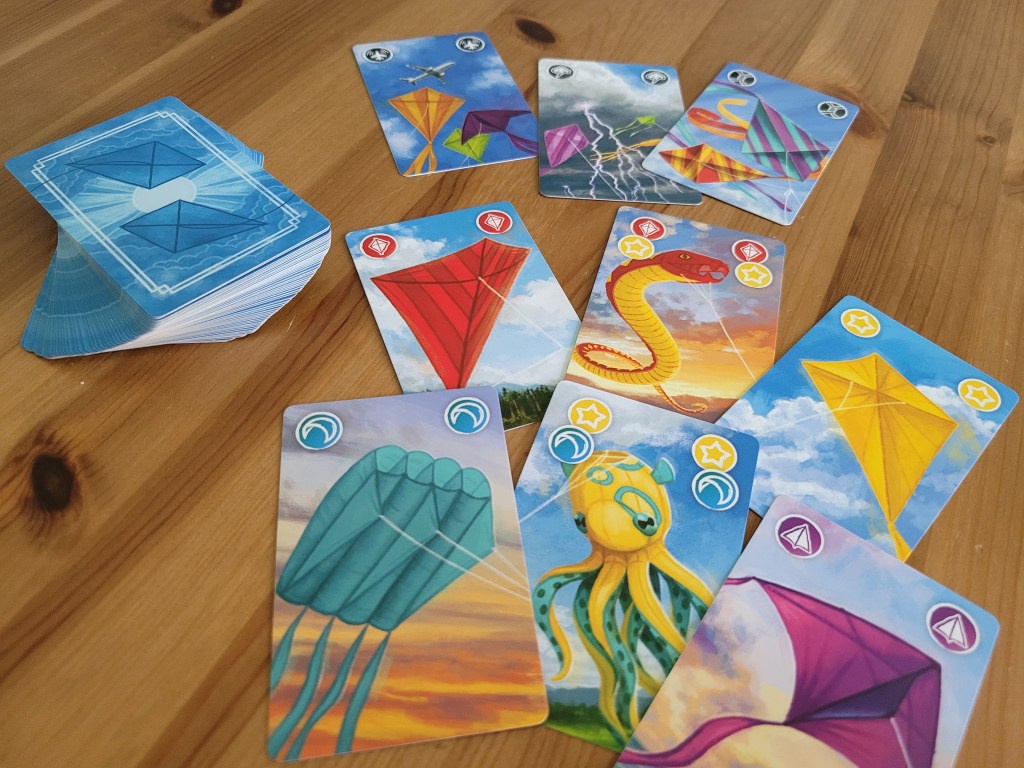
The rules to Kites are refreshingly quick to explain. The strong colours of the sand timers correlate to the strong colours of your cards. It’s almost intuitively simple to understand what happens when you play a blue card. Similarly, the consequences of playing a card with two colours is similarly easy to grasp.
There is little more in the game’s box. There are a few more additional cards, which temporarily complicate how to play cards. But if you’re one of the more experienced and long-standing members of the gaming community, the tactical and strategic depths will be apparent to you after a few plays.
Luckily, non-gamers or at least those who managed to avoid catching cynicism aren’t fixated on tactics, strategies and options, but are drawn to more basic aspects of gaming: feelings. This is what Kites manages to evoke. But unlike many other real-time and cooperative games, Kites manages to find its own niche.
It starts with the game’s core challenge. Instead of resolving the end of the game through a simple binary distinction of triumph or failure, the rules offer a short table of comparison. Like flying actual kites, this isn’t about winning so much as holding on as long as you can. It’s about staying in the flow and competently passing the figurative ball to each other. To do that, you have to keep an eye on the sand timers. Sometimes it makes sense to wait for a moment, before flipping it around. All while telling your fellow players, which colour you might be out of. This way you can try and keep another player’s turn short, to make sure that somebody else can flip the dangerously low-running sand timer around.
The resulting speed of play has a certain rhythm to it, with enough highs and lows to keep you engaged. Moments of individual stress are quickly replaced with seconds of exhaling deeply. This doesn’t just unite us emotionally, it also makes playing cards and flipping around sand timers feel like something we are doing together.
Kites’ simplicity may be a double-edged sword for some groups. It’s not the kind of game you return to, because you will continuously discover something new and different. Kites also won’t hit the table again and again, because your ambition has been provoked to finally beat the game’s challenge. Kites is a the kind of game you play to feel good, because it’s neither too difficult nor too easy. It manages to bring together different levels of experience at the table. Above all it manages to unite players around a shared experience with only a handful of rules. If this makes Kites one of the best games, is open for debate. But it is definitely one of the good ones.
 Lest My Opinions Go Unheard
One thought on “Game Night Verdicts #85 – Kites”