
This is a joke about Schrödingers famous thought experiment about a cat he didn’t like. Or maybe it isn’t.
For reasons I find somewhat confusing, I’ve gained a reputation in my social circles for not liking trick-taking games. When that isn’t actually the issue. The people I often try out trick-taking games with, are far more familiar with the genre than I am. Superficially, this leads to me never winning any of those games. At least not on purpose. But my enjoyment of these games and my opinion of them is far more strongly shaped by something else. I lack the experience to appreciate the nuances of those games. While my fellow players delight in the mental fireworks that their hand of cards cause, I tend to stare at my cards and wonder what exactly they should be telling me.
I’d go so far as to say, that his phenomenon isn’t limited to my person. It’s arguably a wide-spread experience of non-gamers when they are first confronted with the “absolute highlights” of the gaming scene. Like with pretty much all games, the biggest hurdles isn’t that the task we’re asked to do is too difficult. The biggest challenge is trying to figure out which factors actually make up the main task of the game.
Cat in the Box masterfully manages to answer both questions of “how?” and “how difficult?” separately, while combining them in an entertaining card game. As hinted above, Cat in the Box is a trick-taking game with all its common trick-taking rules. You have to follow suit. One color beats all the other colors. Higher numbers are stronger than lower numbers. You announce the number of tricks you’re going to score at the start of a round. So far, so familiar.
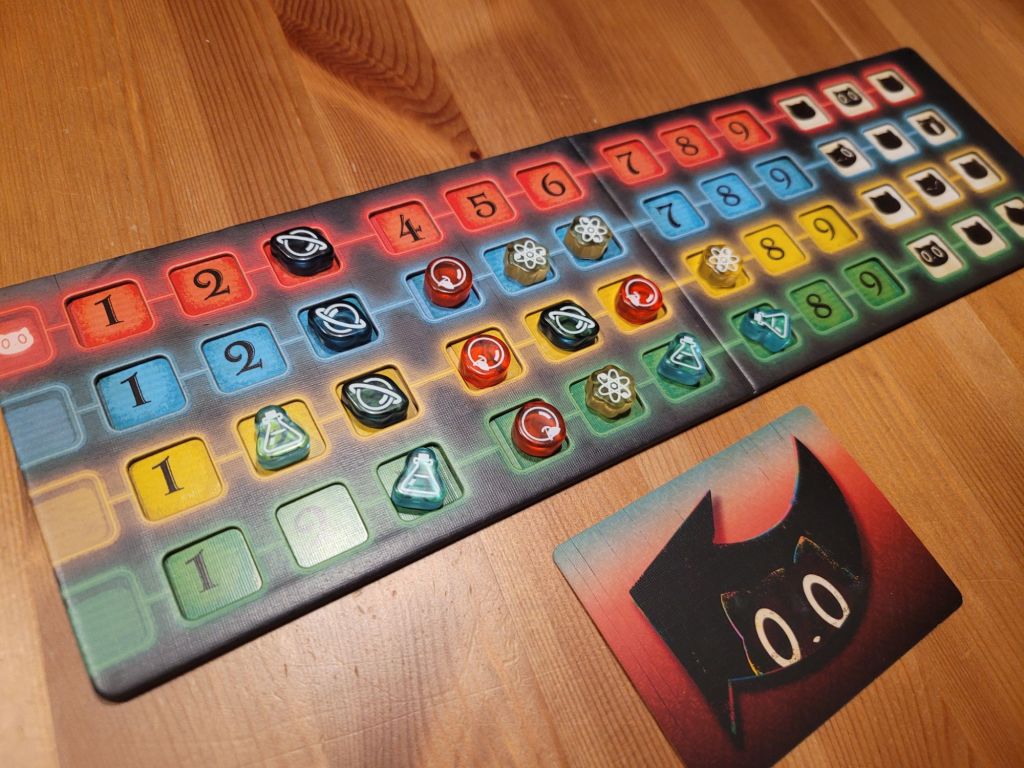
But there are two clever additions, that make Cat in the Box stand out. The one I consider more impactful, might seem trite to others. Every card played into a trick is recorded on a common board. Once you play a card, you place one of your player tokens in the appropriate intersection of color row and number column. This lets all players know, that that card is no longer in the game. In turn the logic puzzle at the heart of all trick-taking games becomes apparent to all. Which of my cards can still win a trick, and which cards are effectively useless? The game board provides a gradually filled grid, that invites you to logically deduce the strength of your card hand. These are the questions and considerations you need to identify in such a game, in order to even begin to play purposefully. More than that, it’s these mental models you need to to practice and train, in order to get better at these games.
It’s something which to my knowledge just isn’t mentioned in any rulebook of a trick-taking game. Even Cat in the Box omits such a mention. Instead you have information on a game board that draws your attention to the core of the game. It also relieves your short-term memory. Unlike in other trick-taking games, you can always tell which card can’t be played. It’s no longer necessary to memorize if your opponent still holds a certain card or not.
This alone, would mace Cat in the Box a very modern trick-taking game. One that is beginner-friendly while also sporting an interface aimed at making play more comfortable.
But Cat in the Box is also a very challenging trick-taking game. Beyond the basic skills of a trick-taking game, you train here, there are additional levels, that invite players into the depths of tactics, subterfuge and strategies. This is due to the second trick (hah!) that Cat in the Box has up its sleeve. It’s the one that is more flashy, ironically, and the reason why the game is called Cat in the Box to begin with. Because while the cards have numbers printed on them, they do not have a suit printed on them. That you get to determine, when you play the card. The resulting flexibility (or unpredictability) leaves experienced trick-taking players with a lot less certainty in planning their turns. You need to anticipate a ludicrously large number of potential plays by your opponent. It’s only after the first few tricks have been played, that things begin to take shape and you can start to evaluate which tricks you may still be able to get.
There are also bonus points you can score, if you manage a continuous area of played cards on the board. In order to claim those points, you first have to get exactly as many tricks as you announced at the start of the round. Interlocking these strategic goals has a remarkable effect. Inexperienced players feel highly motivated, if those happen to coincide. Whereas veteran trick-taking players quickly lose themselves in complex tactical considerations, that are both tense and fulfilling. They not only have to scan their hand for the amount of tricks they can win. They must also use these cards to maximize their bonus points to secure victory.
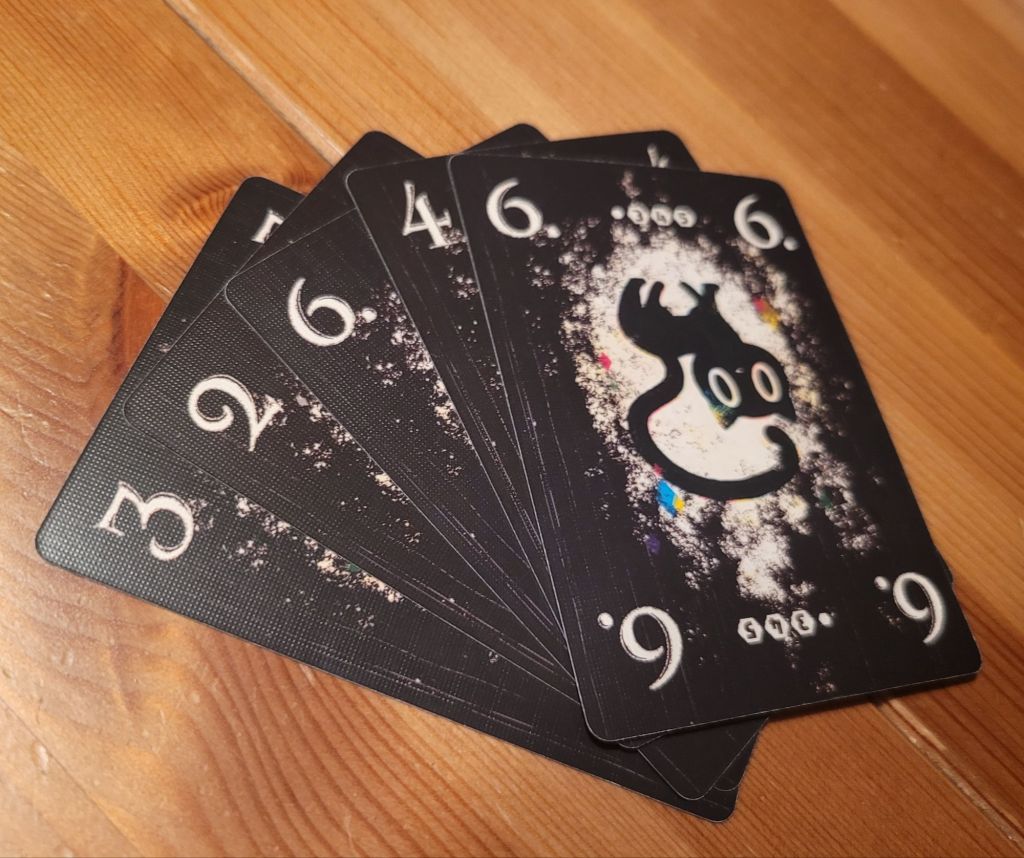
If you’re (un)lucky enough to play Cat in the Box only with experienced trick-taking players, you could find yourself in tense battles on the highest tactical and strategic level.
Nonetheless, Cat in the Box is surprisingly effective in leading groups from a beginner level up to sophisticated trick-taking play. The game’s design conveys through visual and practical means how players are supposed to think and plan ahead in the game. While the more unusual features of the game help experienced groups to have challenging and exceptional plays.
This is how Cat in the Box manages to do justice to its thematic motif or reference to a thought experiment rejecting quantum physics. It’s a game that is both extremely beginner-friendly while also offering highly challenging trick-taking experiences. Which of the two will actually take place at your gaming table, depends on who is looking at their cards. In a way, that’s also a question of quantum physics.
 Lest My Opinions Go Unheard