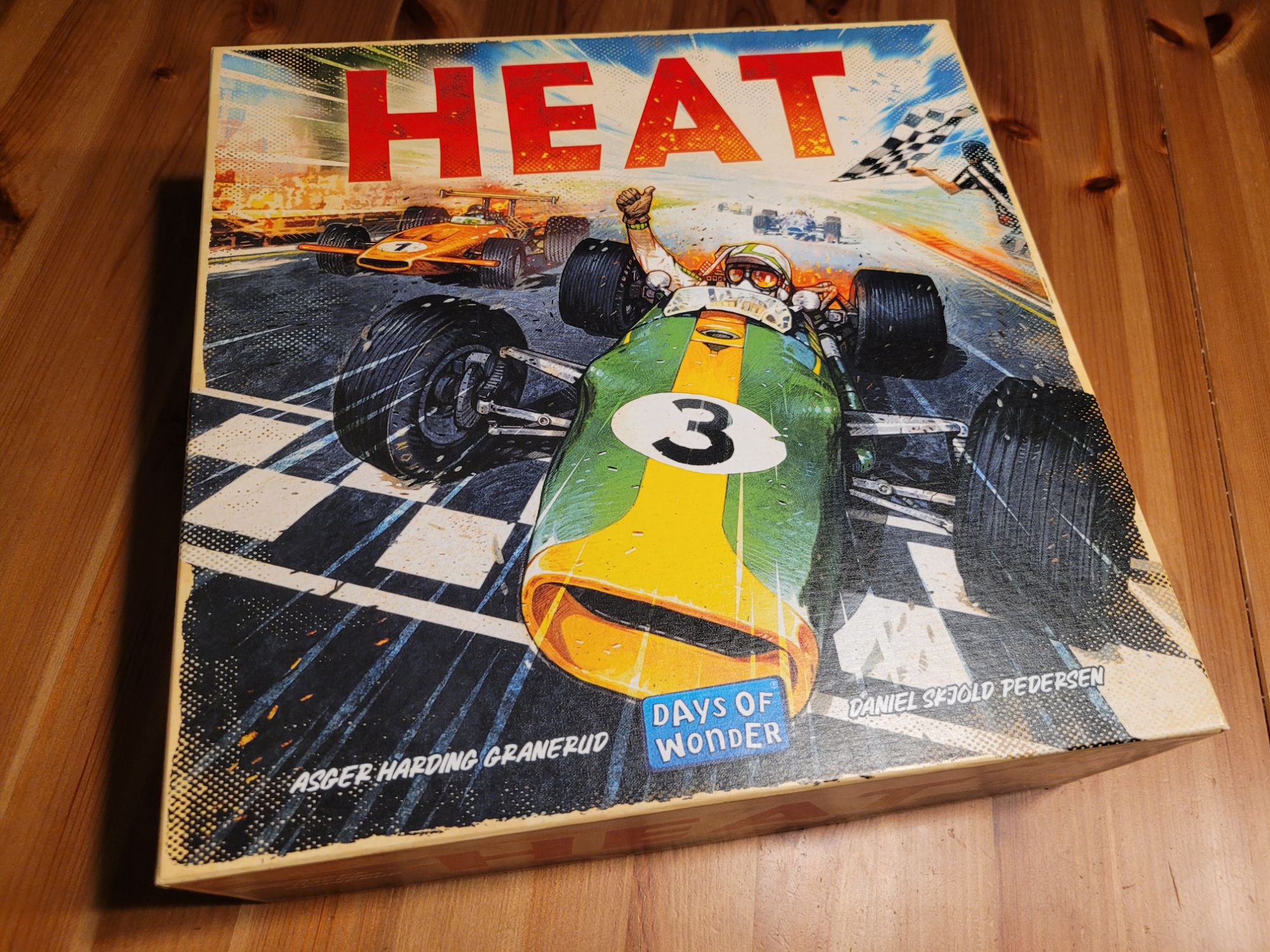
Car racing is defined by two elements: speed and tension. That is a very potent mixture, that begs to be carried over into board games. And there are board game equivalents to the afore-mentioned features: elegance and thrills. A successful car racing game stands out due to its elegant, meaning: easy to handle, gameplay and reliably occurring moments of tension. It’s no surprise that for years now Formula D has become the reference point for this thematic genre. Throwing dice and moving your player token isn’t just an easy-to-grasp game mechanism. Each dice roll offers a short moment of thrilling tension that we’d imagine an actual car race to have.
At first glance, Heat appears to challenge this fixture on the gaming firmament, but that isn’t really true. While it is also a car racing board game, it has a different emphasis and – more importantly – is designed with a different kind of engagement in mind.
The overall structure of the game is appropriately elegant. We move our car tokens along the track by playing cards from our hand. Depending on the “gear” we’re in, we commit ourselves to play one or more cards. It all depends on whether we want to move particularly far ahead or need to reduce our movement due to the restrictions on the track. This underlying concept is effectively as easy to grasp as the dice rolls are in Formula D.
But even in the supposedly simple basic version of Heat, we run into some finer points we need to consider. There are specific cards (“stress”) that require us to draw a random card from the top of our deck and add it to our “speed” (distance travelled). This ties the thrill of a die roll to player decisions. There are also other cards (“heat”), that do little else but clog up our card hand. We can only remove them by slowing down or movement (i.e. switch to a lower gear). The same cards also end up in our discard pile, as a kind of penalty for rushing through a corner too quickly. Which in a racing game like Heat is likely to happen quite often. Because as the patron saint of car racing Ricky Bobby has already noted: “If you’re not first, you’re last.”
Additionally, you can benefit from fixed movement spurts (“slipstream”), if you manage to end your turn next to or right behind another car. And it’s usually when resolving a player’s turn, that the first questions come up. Do you discard heat cards, before earning them as penalty? Does slipstreaming add to your movement value? When do I have to decide, if I want to use a stress effect to draw a card and add it to my movement?

A lot of relevant information to these and similar questions has been written down on your personal player board and thematically dressed up as your car’s dashboard. But in practice this spread of icons is often first intimidating and then confusing. You soon get the impression that Heat is only elegant and simple, when you don’t pay too close attention. As soon as you sit down and play, a lot of tricky details appear, that require careful attention and experience, to create a smooth playing experience.
This oddly turns Heat into the boardgame equivalent of the vintage racing cars you see on the box cover. Their sleek presentation is appealing at first, but once you look under the hood, you notice all the rattling, creaking and whistling noises. Yet as soon as you’ve learned how to deal with those, the whole thing has its own arresting charm. With a little practice, you’ve learned how to discard heat cards at the right moment to zoom past your opponents, who are hitting the brakes in a corner. Leaving everyone else in the dust like that is a very satisfying feeling when you play Heat. Instead of relying on the roll of the die, Heat grants you more control over how the race will play out. Over time, individual tactical decisions are submerged within strategic considerations that look at the course as a whole, and not just the speed limit of the next corner. These are the moments when Heat is most reminiscent of its spiritual predecessor Flamme Rouge. Which also had the benefit of having a far more approachable set of rules.
But the rules of Heat aren’t the game’s actual hurdle, even if they turn out to be a little more cumbersome than expected. Nor is it the somewhat peculiar rulebook that likes to first use new terminology, and explain its meaning some time later. Heat’s biggest hurdle is the assumption of how often the game will actually get to the table. The chimera of “high replayability” has pushed the design into a direction that requires, and supposedly wants to invoke, repeated plays of Heat.
Because Heat only reveals its strengths and character, when you’re familiar with the track and have acquired the strategic understanding when to switch gears. Discarding heat cards to use them later on in order to ignore a speed limit is essential to playing well. It’s a core dynamic of the game, that is both clever and appealing. Getting your heat cards into the right flow between your hand, your player board (“in the engine”) and your discard pile is the key player skill you have to learn and hone. It will take most groups a few games, before they’ve reached a sufficiently high strategic level to make the game open up to them. But it would appear that Heat’s creators didn’t consider this reason enough to play Heat repeatedly. So the game includes some rules variants, you can add.

By using the “Legends” variant you can stock up the number of competing cars to six by using a inelegantly explained, but easily executed card mechanism. Instead of a simple car racing duel between players, every game of Heat gains the feel of a big race tournament. The “road conditions” rules add some variation to sections of the track which give familiar tracks some new facets to consider, depending on the “weather”. Then there’s the option of playing with the “garage” rules. Here you get to add special cards to your individual deck. This way you get to customize your deck of cards, and in a thematic sense tune your car. By cleverly using those cards at the right time, you can secure a hair’s breadth of an advantage to come in first place. Even the differences in ranking can be made to be mechanically relevant by using the “championship” rules. Here you get to play through multiple tracks – usually not in one evening – to claim championship victory in final scoring. A championship in Heat is – if not a full-day commitment – at least something that will take up several game nights. The printed ranking on the boards suggests that these rules aren’t intended to be entirely optional. There’s a podium printed on each boars to place cars that have made it past the finish line, right next to the number of points that they gain for their final score.
If you were to roughly estimate the number of plays it would take to familiarize yourself with all those variants at a reasonable pace (hah!) as part of your regular gaming schedule, Heat quickly appears to be a very time-consuming game. This is not a strength.

The issue isn’t that you get “too much game for your money”, but that playing Heat could actually be a hobby of its own. There’s the unspoken assumption that once you buy Heat, you won’t be playing anything else for a while. This doesn’t make Heat a bad game. In fact, it says nothing about whether the game is good or bad. But at least as a product, it moves it into a slightly different category. Because I am a little dissatisfied that Heat demands so much time and so many game nights to really get the most out of it. I don’t know if I have the stamina or the players to get Heat to the table again and again.
You could, of course, always content yourself with playing the basic variant and only include the variants when the opportunity arises. But that’s a little like buying a state-of-the-art electric car, and only use it once a week to drive 800m to the post office. Heat isn’t a time sink as such, but it seems to me that it was made with the assumption of being turned into one. But when you don’t have the opportunities or the incentive to dedicate a lot of time to playing Heat, it just remains a slightly clunky and a tiny bit too complicated car racing game.
Heat is an entertaining and well-functioning game, that rewards skilfully implemented strategies over small moments of chance. The tracks have nuances waiting to be discovered. Its card play asks to be learned and mastered, and including the various rules modules opens up interesting new facets to the game. But you first need the practice and skill set to enjoy it fully. Heat has a lot of exciting moments, but you need to put in the time before you get to put the “pedal to the metal”. Until then, you might find yourself overtaken by a bunch of cyclists on your left.
 Lest My Opinions Go Unheard