
The impressive thing about small, well-made games is always that their rules often seem so simple, and almost trivial. You find yourself wondering why nobody else came up with this idea before. Maybe with Trio (originally called “Nana”) this is less about a stroke of genius, but simply the cleverly packaged publication of a locally familiar variant of Memory. Regardless of what Trio’s origins are, once you sit down to play it, its elegance speaks for itself.
At first, Trio really does just seem like knock-off version of Memory, in which you collect three cards of a kind, as opposed to a matching pair. If you want to be particularly reductive, you could describe Trio this way. Picking from the face-down display, our own hand of cards as well as those of our opponents, we’re trying to find three cards of the same number. What makes Trio special isn’t the fact, that much like playing Go Fish, you can ask other players for a card. The small detail that elevates Trio above many other simple card games, is small and innocuous. From your own hand and those of other players, you may play or request only the highest or the lowest card.
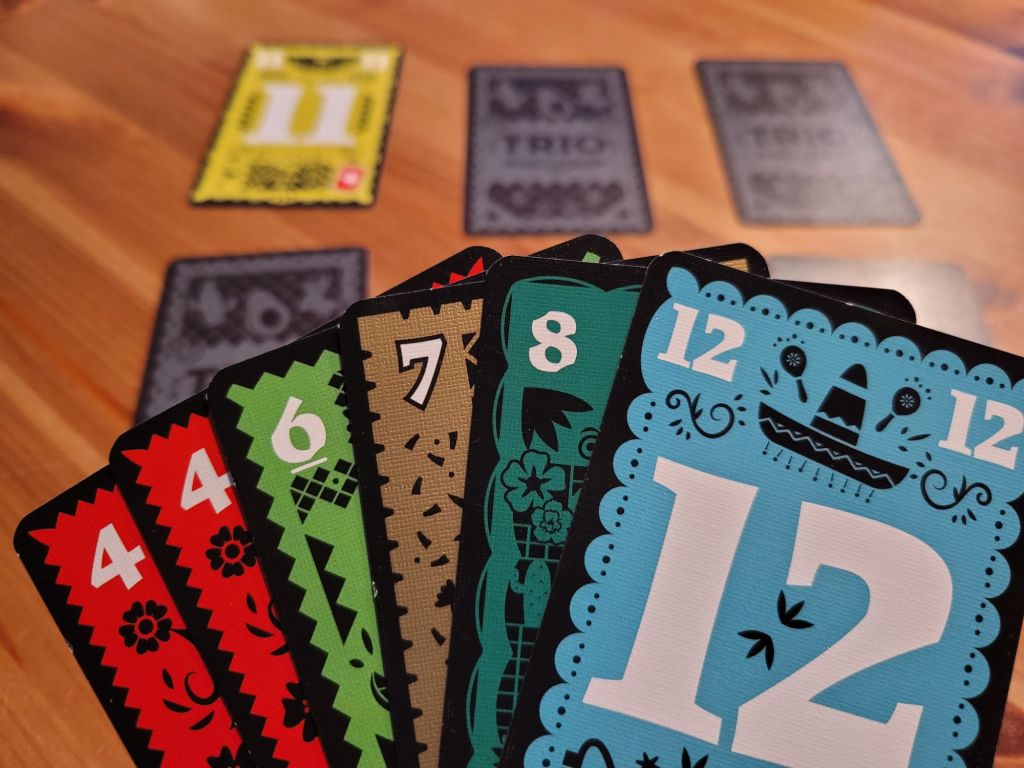
This small restriction allows us to draw logical conclusions every time a player asks for the highest or lowest card to be played, or when they reveal one themselves. Asking another player can reveal insightful data about the card distribution among players, particularly when coupled with what we know about our own hand. But everyone at the table is aware of that, and soon enough you start paying attention who you ask to reveal a card and who you don’t.
This makes Trio a refreshing and unusual mix of deduction and memory game, with a pinch of bluffing. Most of all this leads to a recurring back and forth between moments of hilarity and tension. It’s regular bursts of excitement, when you’ve identified a pair of cards and know that the third one is the lowest in your own hand, all while hoping that that nobody else will call on you to reveal a card. Or it’s the small moments when you have to consider, if you want to turn over a face down card instead of asking somebody, in hopes of finding that missing third.
As far as the rules design goes, Trio is guaranteed to entertain, regardless of what’s pictured on the cards. To that end, Cocktail Games’s decision to swap the original illustrations of family-friendly drawings of animals with loud contrasting colors and patterns and icons that are reminiscent of the Dia de los Muertos, doesn’t negatively affect how much fun Trio is to play.
Like many other card games, Trio can be described as essentially abstract. And it’s commonly believed that theme is irrelevant with these types of games. But details matter a lot in games. From the texture of the cards, the tone of the rules writing or even the art direction of the game: everything affects the experiences in a subtle, but noticeable way.
The aesthetic direction of Trio is energetic. It is dominated by strong colors and stark contrasts. It feels fitting to play Trio in a similarly extroverted and competitive manner. The disarming charm of the original “Nana” is absent. Yet the vocal excitement, when a gut decisions turns out to be right and completes a set of three identical cards, remains. Whether “Nana” would have been similarly embraced by the local gaming scene, is impossible to tell. Trio’s visual volume and intensity at least does get people’s attention. Maybe that’s exactly what’s needed to show, that even simplistic seeming changes of a familiar design concept can lead to an entertaining new card game. Maybe theme isn’t quite as irrelevant with a seemingly abstract game as some want to believe.
 Lest My Opinions Go Unheard