For the longest time, games for two players were shoehorned into being duels. Equipped with mutually exclusive goals, whoever would prove to have the smarter head on their shoulders would be declared the winner. It was the perfect pastime for couples whose relationship lacked a pinch of antagonism. It was only in the last few years, that the two-player game matured somewhat and made cautious steps towards cooperation. While there’ve long been cooperative games that could be played with only two players, only a small handful were explicitly designed and sold as two-player games.
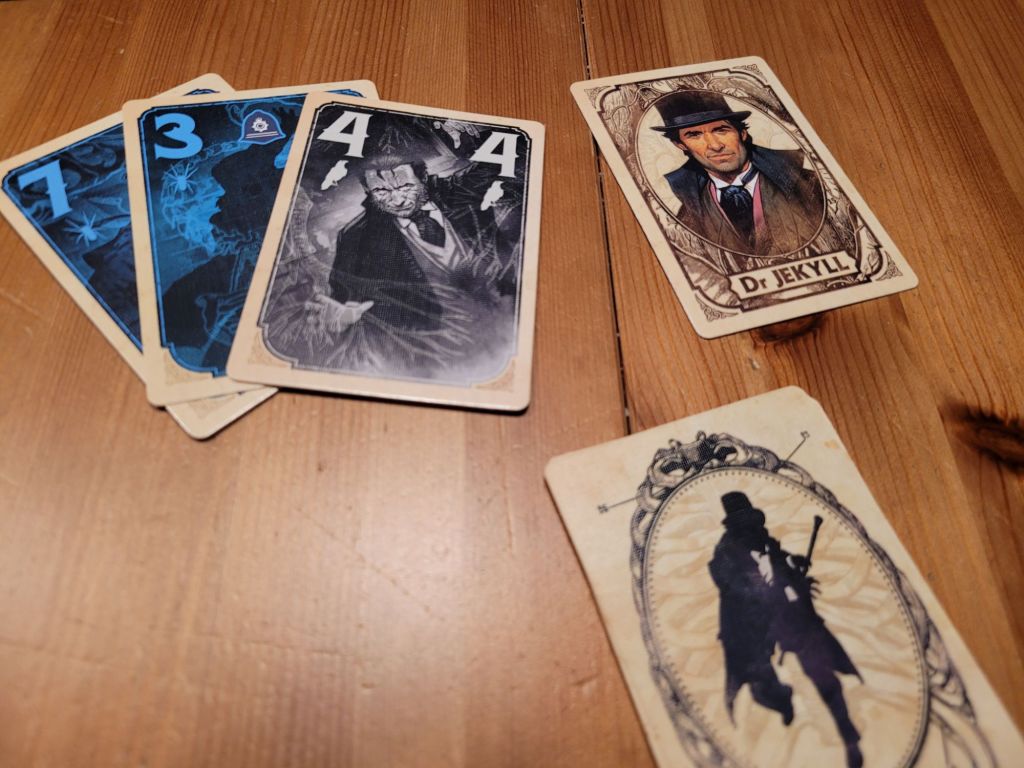
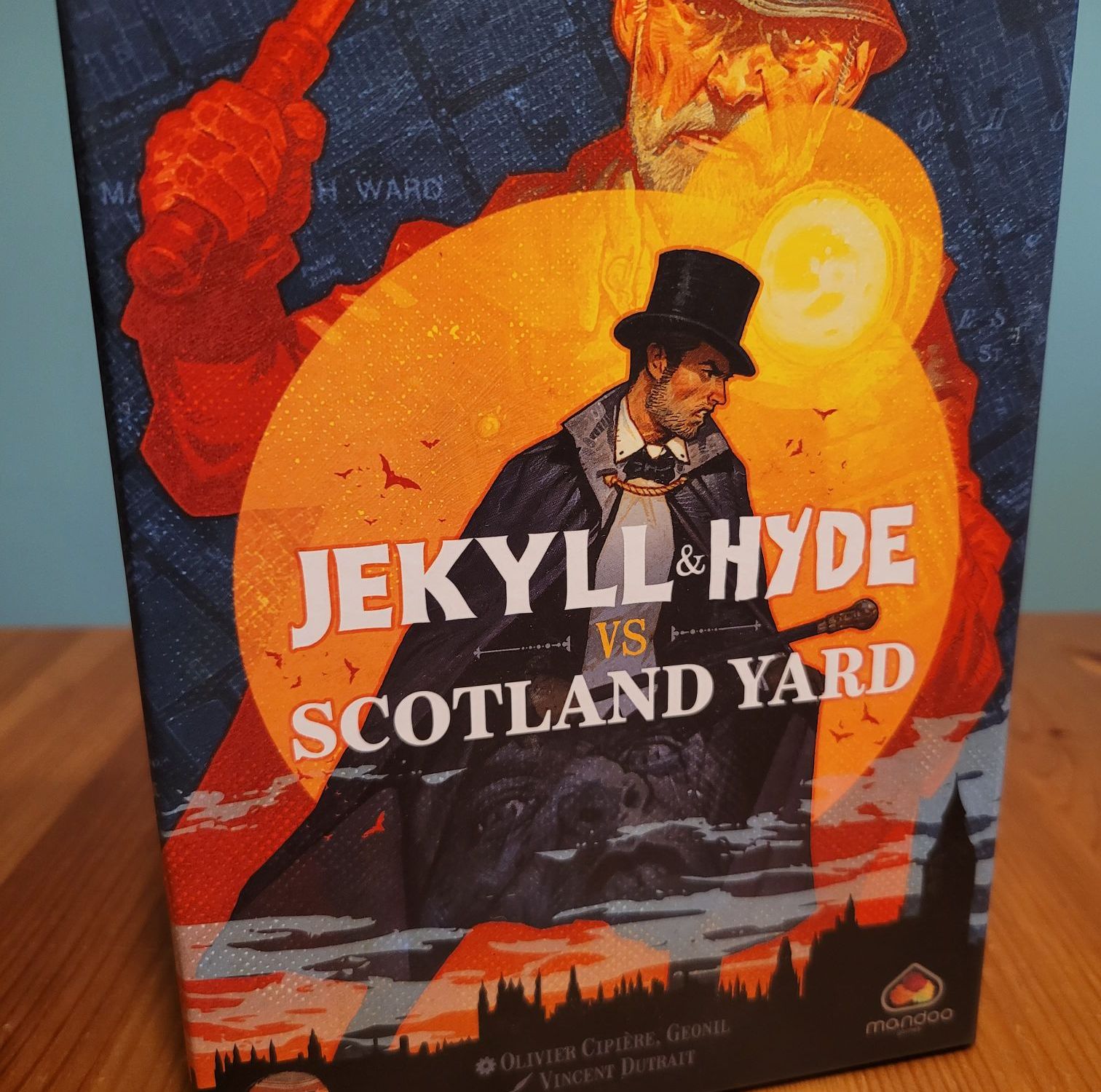
Jekyll & Hyde vs Scotland Yard doesn’t push the envelope too much, by “merely” being a cooperative variant of the already well-received Jekyll vs Hyde. They are both trick-taking games, in which we score by cleverly playing the cards in our hand and triggering specific card effects at the right time. Much like in its predecessor, we compare the tricks we’ve won each. But the shared player token on the board doesn’t move based on the difference between the two numbers, but instead based on the smaller one. This means we want to split the tricks evenly between us. Which is easier said than done, because there is a third, virtual player at the table with us. Scotland Yard – as referenced in the title – is trying to win tricks themselves, while chasing after our Jekyll & Hyde player token. In order to win, we need to get to the end of the board after two rounds, while also evading the authorities. The fact that this pushes Jekyll & Hyde vs Scotland Yard closer to its literary inspiration is probably only of interest to English majors.
What’s far more interesting, is that the resolution of tricks scores is close to being the most complicated rules of the game. Like with many modern trick-taking games, we are introduced to variations of the core trick-taking elements (follow suit, higher value wins the trick, there is a trump suit) step by step. This leads to a very beginner-friendly way of introducing the nuances of trick-taking games.
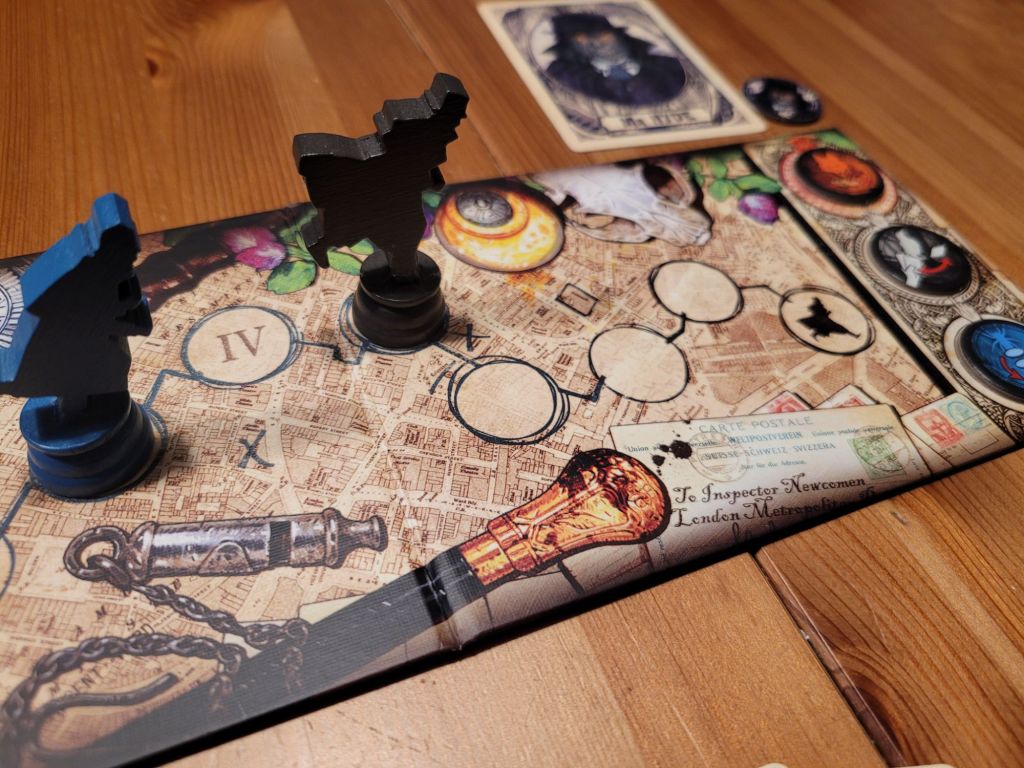
Switching to cooperative play greatly changes the experience. Instead of anticipating our opponent’s decision and trying to steer it towards our own benefit, Jekyll & Hyde vs Scotland Yard requires us to share what we know and learn. Playing cooperatively perfectly maps the exploration of the tactical and strategic depths of the game. You want to share every insight after the game. Every clever move you stumbled upon will be discussed right away. Because only a well-working team will manage to make it through all 12 variations of Jekyll & Hyde vs Scotland Yard. The game’s difficulty ramps up alongside a story roughly sketched out in a few paragraphs with each new wrinkle added to the game. Soon you find yourself wanting to push through and evade the law.
More than winning a round, you’re motivated by the way you get an increasingly stronger grasp not just of the game itself, but the outlines of the trick-taking genre as a whole. There’s probably no other trick-taking game that so elegantly and unobtrusively teaches basic trick-taking expertise to its players. Its presentation, illustrated by Vincent Dutrait, is reliably expressive and pleasant. Even if its gloomy style fits the theme, you’ll occasionally wish for a more light-hearted illustration to lift you out of a particularly intense phase of plotting and planning. But these nitpicks are barely worth mentioning.
Jekyll & Hyde vs Scotland Yard makes trick-taking games feel modern and fresh to a new audience. The Crew’s presentation promised to be a fresh air for the genre, but ultimately relied on familiar trick-taking tropes. By comparison, Jekyll & Hyde vs Scotland Yard is brimming with new takes, which are, admittedly, carbon copies of its predecessor. These very same ideas are polished and perfected here, leading to an easy-to-learn and approachable card game. The intriguing plotting and planning unlock a genre, which has seen new and unusual ideas implemented in the last few years. Thanks to Jekyll & Hyde vs Scotland Yard, even inexperienced players will be ready to dive right in.
 Lest My Opinions Go Unheard