
It’s not secret that a game is made up of disparate elements that have to carefully arranged to allow for a pleasant experience. A critique should in theory keep all those elements in mind to evaluate the game. Some (like the presentation) are easier to pick up on than others (like the rulebook). But next to the legibility of the game board, the rulebook is often a sign of good design craft. In the past, publisher MEBO’s rulebooks weren’t their strongest suit. Which makes it even more impressive how much of an improvement the rulebook for Lisbon Tram 28 is.
This may read like a back-handed compliment, but it is anything but. A good rulebook is a rarity in board games. Far too often, publishers focus on all-encompassing, air tight wordings of the rules, making legibility a secondary concern. Not to mention a rulebook’s primary goal: to communicate complex systems in an easily digestible manner.

Lisbon’s tram network is
littered with stops
Most rulebooks are meticulously phrased, but only a handful is structured in such a way to be easy to read and to make play more accessible. Good designs stand out, because they present their made-up connections of rules and abstractions in such a way, that they are almost intuitively grasped. At the end of the day, the high art of game design is about making the complicated seem simple.
That is why Lisbon Tram 28 reads like a simple game. With one glance at page 2, turn order is explained. Another glance at page 3 lays out the game’s setup. What follows are cleanly laid out examples of every single action you can take in the game. A game that thematically references the tram network of Lisbon, is accordingly a game, in which we pick up passengers from one stop and deliver them to another. Each time when we bring the right passengers to a tram stop, we score points. Occasionally, we can use a bell to push away trams blocking our path. This lends a sense of playfulness to an otherwise dry, card-driven route plotting game. Lisbon Tram 28 never feels like a particularly complex game, which is in part due to the well-made rulebook. Because the turn structure isn’t trivial, but thanks to the rules explanation in concert with the theme, seems so self-evident, you barely notice how many single steps make up your turn.

A bell, a tram
and stops reached
The same holds for the game’s presentation. Its clear visuals remain pleasant and helpful at all times. Family games in particular rely heavily on their visuals. Here they suggest a calm atmosphere, that never threatens to overwhelm less experienced players.
While probably not intended as such, Lisbon Tram 28 is a fantastic souvenir to bring home from your vacation in Lisbon. If you know the city and get to revisit the famous sights at your gaming table, memories are bound to resurface. A game that fills a similar niche – Zoom in Barcelona – shares many of its attributes. If you know the city, play will feel far more thematic. As opposed to a player who knows Lisbon only by way of Google Maps.
Outside of that target group, Lisbon Tram 28 can quickly run its course. The turns feel too similar from round to round. Surprises and tense moments happen too rarely. Lisbon Tram 28 is a very tempered experience. One, in which you generally don’t feel the need to hurry. The options to expand your individual actions are well integrated into the design. But their effect on gameplay is fairly small. You move a little faster or pick up a few more passengers. That’s useful. It makes you more flexible. But it doesn’t make the competition with other players more heated. Nor does it make moving passengers across the board more interesting. You get to do a little more. But nothing particularly note-worthy.
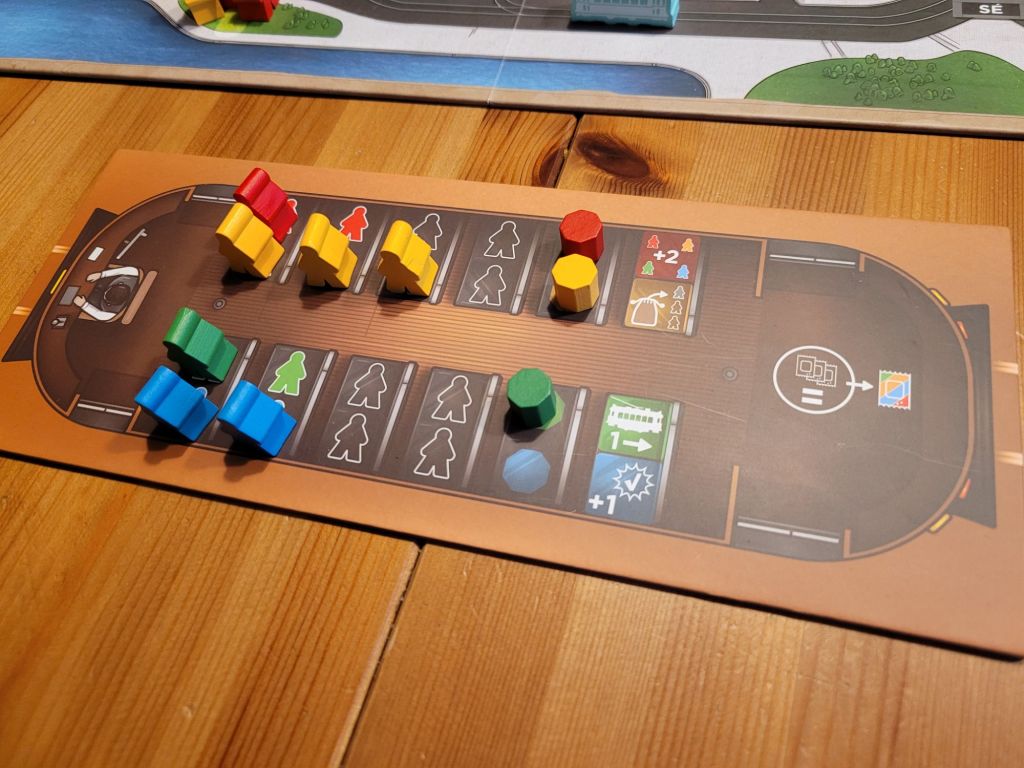
A busy tram heads
to the next stop
Lisbon Tram 28 has a very good rulebook, coupled with a rock solid design and a somewhat unremarkable theme. It lacks the kind of hooks and sharp edges to excite gamers without a connection to Lisbon. But if you do love Lisbon, or are just starting to love board games, this is a decent game that doesn’t make any major missteps.
 Lest My Opinions Go Unheard