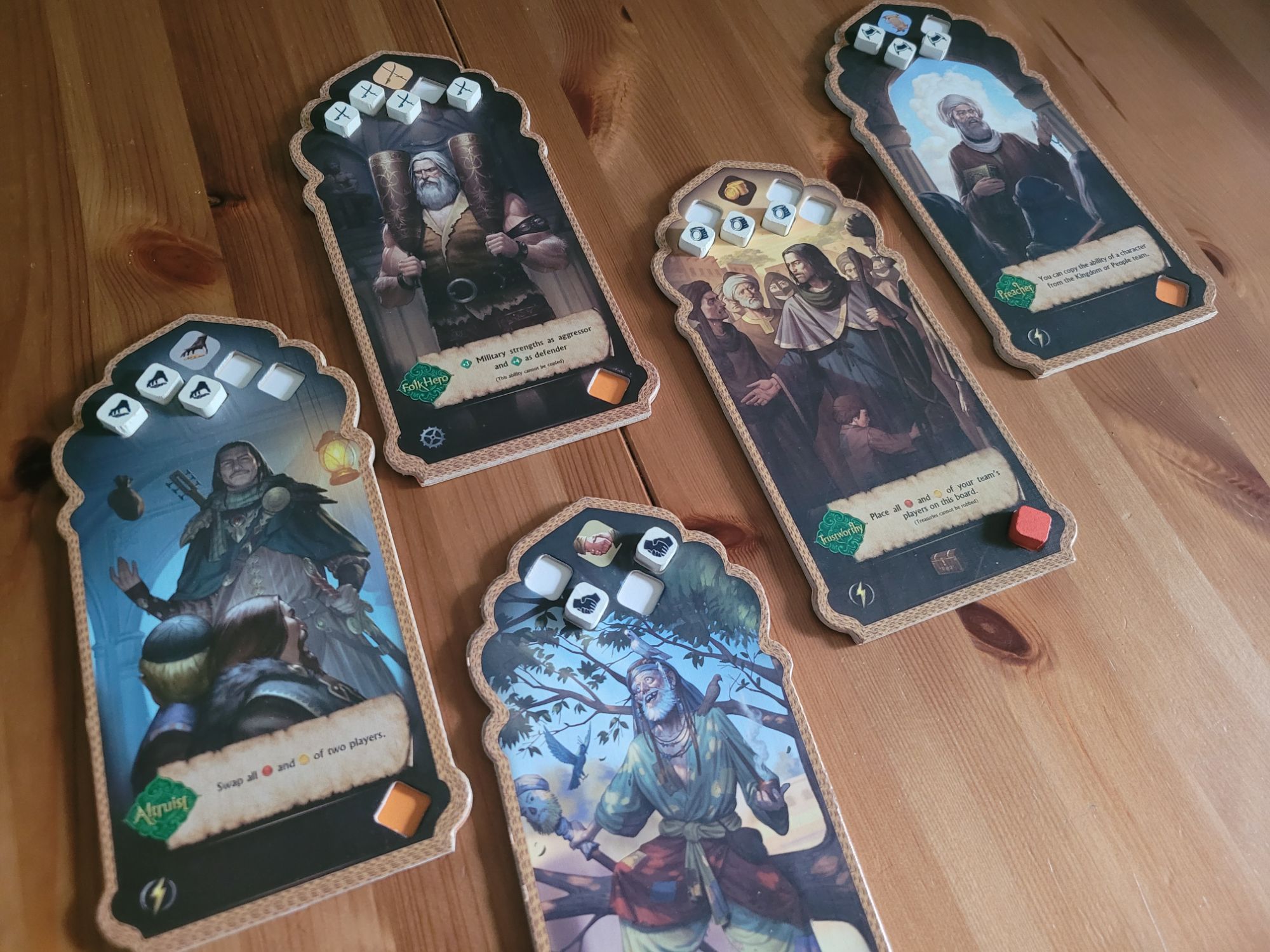
For the longest time gamers would explain taking board games seriously by referring to how they are an opportunity to learn things. I was quite happy when this knee-jerk justification began to fade. Now it seems to have made a comeback. But this time it isn’t the games themselves, but their themes that are used to argue in favor of a serious approach to board games. They are deemed valuable because playing them promotes their themes. Meaning that games are actually a means to an end. They are the conveyor belt that carries us towards knowledge and understanding. This strikes me as a very pat way to apply didactics to games. By merely being exposed to the theme, we’re assumed to understand and learn about it as we play.
I think this approach doesn’t go far enough. There may be anecdotal evidence to back it up, but it assumes that playing is learning by osmosis. At best it’s learning through immersion. We subconsciously pick up individual facts, but without a sense of direction, support or context.
For this approach to work, we should prepare the theme before the game and follow up on it after the game. We need to contextualize whatever we’ve picked up during the game. We then need to unpack the experience of playing the game, to grasp what we’ve learned so we remember it. Play itself is then primarily a way to motivate people to learn. But play isn’t the thing we learn from.
But the reason why games are getting so much attention when it comes to what we can learn with them, isn’t that, I think. It’s actually how games can unlock our ability to absorb and retain new information incredibly quickly and efficiently. It’s an observation that Jane McGonigal picks up on in “Reality is Broken”.
Games are an impressive way to get people to grasp complex contexts quickly. People are casually trained to analyze a situation following specific criteria, identify goals and look for an approach to reach those goals. Additionally they invite them to practice soft skills (at least evaluating and anticipating other people’s behaviour). All this often leads players to memorize specialized knowledge in a short amount of time.
It’s the last point in particular, that makes people take notice. Games might be a potent method to teach specialized knowledge more effectively. I believe doing so hinges on one important detail, that shouldn’t be overlooked. Because exposing players to thematic content isn’t enough for them to learn about it. Reading a historical fact on a card isn’t enough to quickly memorize it. It’s not enough to repeatedly visit a coastal city in a game, to understand its historical importance for international trade. The name might become familiar, but whether its relevance is understood, is highly questionable.
We soak up complex contexts and specialized knowledge in a game, when it is actually relevant to playing it. If the thematic context is necessary to create a positive experience, it becomes valuable to us and we have a vested interest in understanding it. That’s why presenting themes and betting on players learning about it by osmosis, isn’t games’ biggest strength. After all, we want to have a good time playing a game. We will invest some effort to enjoy ourselves. If that means we need to learn things and gain certain skills, we will try to do that.

Naturally, the effort expected of us and the enjoyment promised need to strike the right balance for us to actually try it. A quiz only drives us to learn, if we get some sense of enjoyment from knowing more than others. Once that fades, the effort of memorizing facts is no longer worth it. In the same vein, competitive forms of play only aid us in understanding thematic contexts, if we find joy in being better than other players. Once we’re no longer invested in that feeling, we must switch to a different form of play to make learning easier for us.
But the principle to using games as a learning tool remains the same, in my opinion. We will be driven to absorb knowledge and gain skills, if they are a necessary precondition to meaningfully participate in the game. For the simple reason that games are fun, and we’re willing to overcome certain hurdles to fully enjoy them.
A game’s theme can teach us things effectively, if those things are closely tied to the act of play itself. A historical fact on a card is valuable and worth remembering, if it helps me to play the game better, i.e. enjoy it more thoroughly. If it is only a nice flourish to some abstract rule, we only register it as a trivial detail. Something to pay fleeting attention when passing the time.
Within the framework of a game, certain skills and special knowledge are highly valued. Because they offer an immediate benefit to players, they matter within the context of the game. Of course we’re going to do our best to know those things as quickly as we can.
 Lest My Opinions Go Unheard