
Conventional gaming criticism says, that decisions lie at the heart of a good game. The more decisions a game offers, the more of a game it is. Some critics distinguish between meaningful decisions (which are good), and minor decisions (which are busywork). Effectively decisions with a strong impact on the game state, and those with little impact.
If you fully subscribe to the majority opinion, you’re unlikely to embrace Captain Flip. We make few decisions here. In fact, it’s just two per turn. The first has to do with whether we flip over the tile we just drew from the bag. Each side of the tile features a member of a pirate crew. Each such member scores points in some way. Some do so right away. Others only if certain conditions are met. Yet others only score points at the end of the game. The decision is further complicated, since we only know one side of the tile. Only by turning it over do we discover the alternative crew member, but also commit ourselves to keep them on board.
The second decision, we get to make, is comparatively simpler. Our personal player board shows five columns. Our tile has to be placed in one of them. As we complete a column starting from the bottom, we unlock some kind of bonus. We have to consider which column will score the most points for our tile, or if we want to work towards unlocking the bonus.
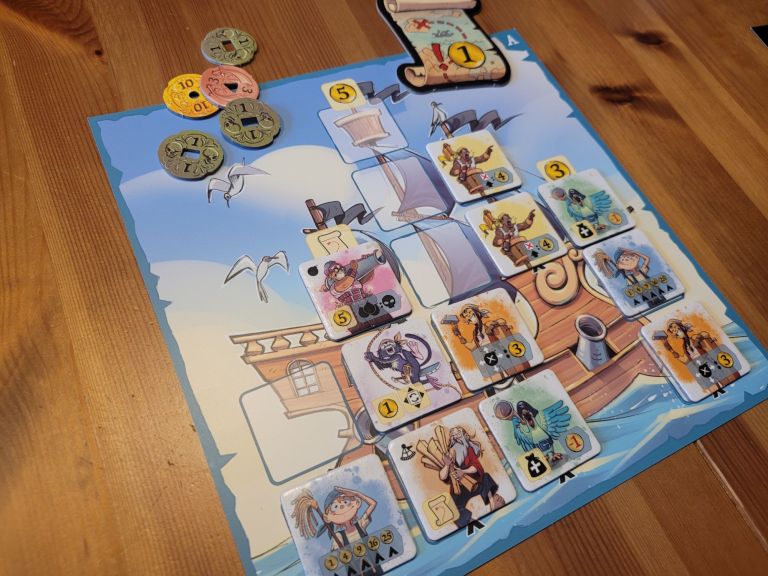
If we’re lucky enough to draw the tile, we want, the number of decisions on our turn goes down to one. If we follow a set strategy in how to place our tiles, our turn almost plays itself. Getting what you want, nullifies the gameplay of Captain Flip.
But as is the case with many other designs, Captain Flip starts to be fun, when our hopes are dashed and our plans go awry. It’s a game that only gets going, when you don’t get what you want. Just as you jealously peek at other players’ tableaus or everything hinges on drawing just the right tile out of the bag, is when Captain Flip delivers humor, tension and fun. You’re constantly tempted to make gut decisions instead of rational ones. Maybe now you’ll finally draw the cook, you’ve been working towards? It’s the visible frustration, complaining and despairing that earns you sympathetic laughter at the table.
So it’s no surprise, that experienced gamers in particularly have a hard time warming up to the game. After all, countless games have shown, that keeping a cool head and careful analysis of the game state is the best approach to winning. 9 times out of 10, the “smart” and “safe” choice is the best path to victory. Rarely does random chance pick the winner. (And when it does do so in more than 1 out of 10 times, that game is clearly “far too random and luck-based”.)

The truth is that Captain Flip is a luck-driven game. One which can often be quite entertaining. It thrives on the thrill of drawing the right tile (like in Bingo) and wondering if you should flip it over instead for a better option (like the Monty Hall problem). Especially when played with a more extroverted group, each play can be quite an event. Every tile drawn will elicit a comment from somebody at the table. It’s these moments when Captain Flip feels special and memorable. But there are also games, when careful analysis and strategizing kills the game’s momentum. Not making a quick decision is a sure-fire way to take the wind out of this game’s sails.
This might sound as if Captain Flip is only fun, when played as a mindlessly stupid activity. But that does the game a disservice. There is room for smart decisions and bold strategies. But at its core is the tension between your gut and your head. Because that too can lie at the heart of a good game.
 Lest My Opinions Go Unheard