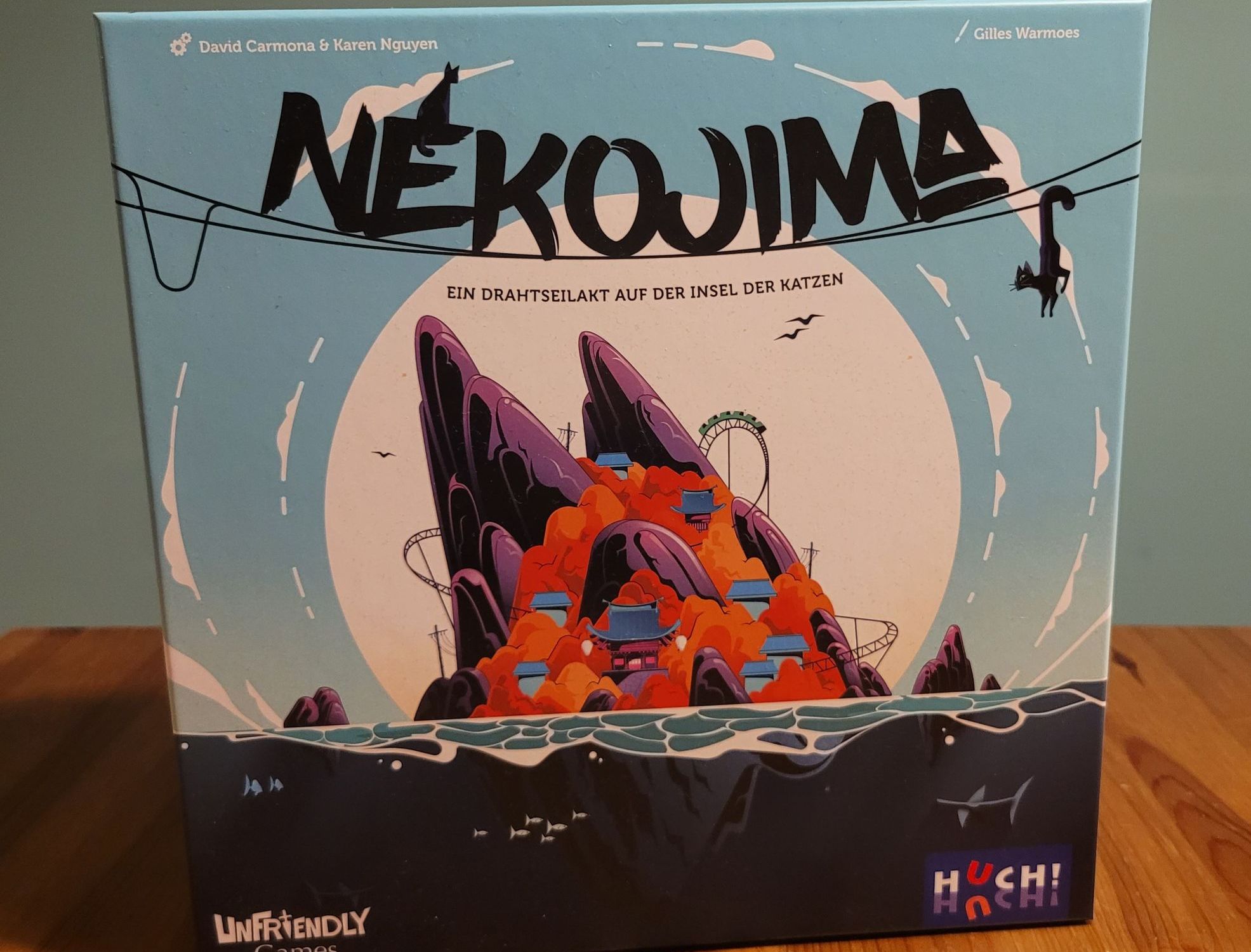
Games deal in emotions. Naturally, the various genres are aimed at providing certain emotional experiences. Strategy games offer challenges, which when tackled by making the right decisions, lead to a great sense of satisfaction. Deduction games appeal because they let us feel smart for taking a mysterious puzzle and disenchanting it through stringent logical thought. Dexterity games offer something else. In the case of Nekojima, that’s tension and thrills.
In Nekojima we have to arrange the game’s components (21 “power poles” made of two broad wooden sticks, connected by a short, colorful rope) on the game board in such a way that no object touches another. To that end, we may also pile them on top of one another to avoid contacts. A comparison to Jenga is almost inevitable. But whereas Jenga implies a vague hint of tactics and strategy due to its clear geometric forms, Nekojima leans into playfulness. Two dice determine where to place the wooden poles. Another randomized element picks the group of wooden poles we have to choose from.
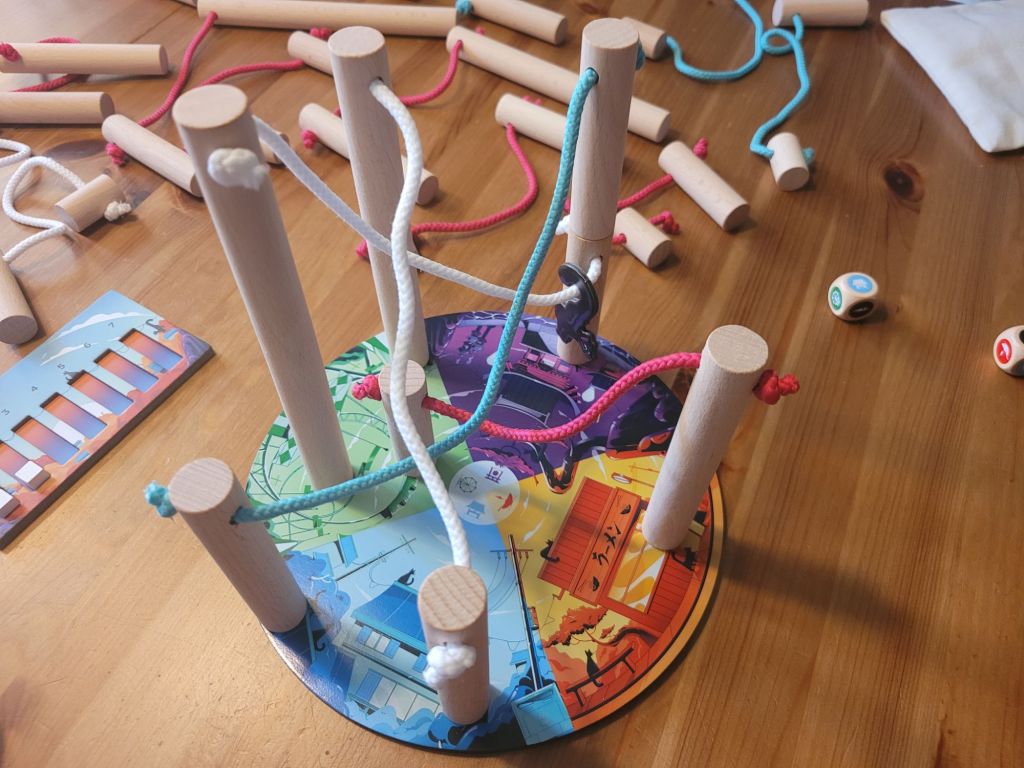
This distinction is made by way of the strong colors of the short ropes between the sticks. These expressive splashes of colour don’t just underline that Nekojima is, above all, a game. They also contribute to making the construction that emerges on the board as we play have a character of its own. It’s a temporarily constructed monument of the thrills and tension we’ve been through. Whereas most strategy games allow us to wax philosophically about tactical options and strategic depth, this topic feels misplaced and misguided with dexterity games. Here the visual and tactile experience is what we focus on.
In the age of taking phone pics while you play, it is almost impossible to capture a running game of Nekojima without showing a construction that seems ludicrously unstable. But this phenomenon isn’t reserved for social media users and their filters. Even when looking at Nekojima on the table, you tend to get a little nervous. It often seems as if even the slightest whiff could bring the whole thing tumbling down and end the game.
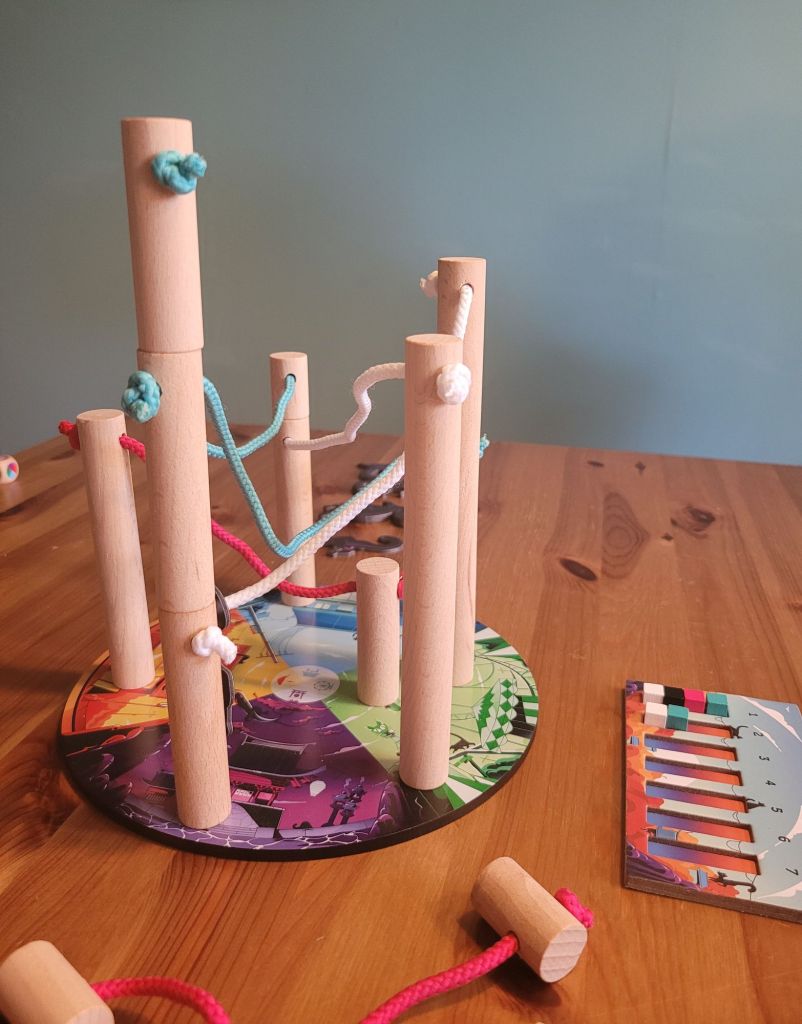
It’s this nervousness and tension, that makes Nekojima fun. The components are not a means to an end. In a dexterity game everything hinges on the quality of those components. It’s not about whether the material used is particularly upscale or looks costly. What matters is that the characteristics of the components are in line with the design’s goals. This is where the publisher and/or authors apparently struck gold. The low weight of the wooden poles makes it difficult to tell, if stacking them on top of each other will succeed; whether the poles’ center of mass might have been a fraction of a millimetre to the left. How much of an impact weight has on how the game plays, becomes apparent when you compare the wooden poles to the black cardboard cats, which you have to hang onto the ropes during the game. The unexpected weight of those punch-out tokens makes it even more difficult to gauge, if the stacked wooden poles will stay upright or not.
The right placement and orientation of Nekojima’s objects is of course important and has to be carefully weighed (hah!). But at its core, Nekojima is a tactile experience. It’s about the growing tension, when the highly unstable construction on the game board seems to be repeatedly threatening us with collapse. Also, you can play the game competitively or cooperatively. A decision which mostly hinges on whether you want the game to be shaped by schadenfreude or solidarity. Either way, Nekojima is anything but dull.
 Lest My Opinions Go Unheard