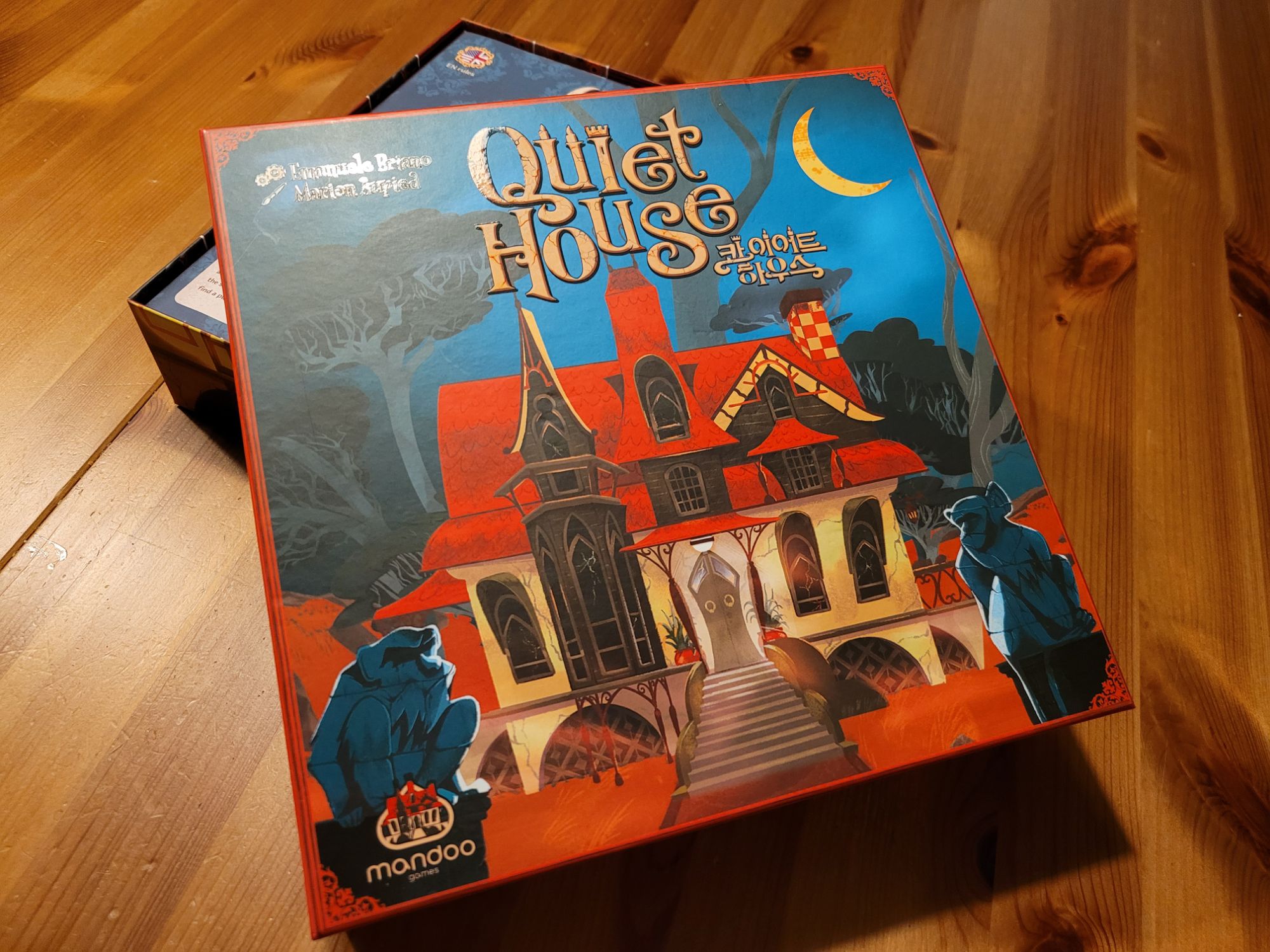
Based on his experiences in a haunted IKEA store near Uppsala [citation needed] designer Emanuele Briano has captured the plight of being 2-4 incorporeal entities redecorating in the most passive-aggressive way imaginable: without talking to each other. In Quiet House we move furniture (wooden playing pieces) around our shared home (the game board). We do so following strict, mystical laws (movement rules) and attempt to arrange them in a way we don’t fully understand ourselves.
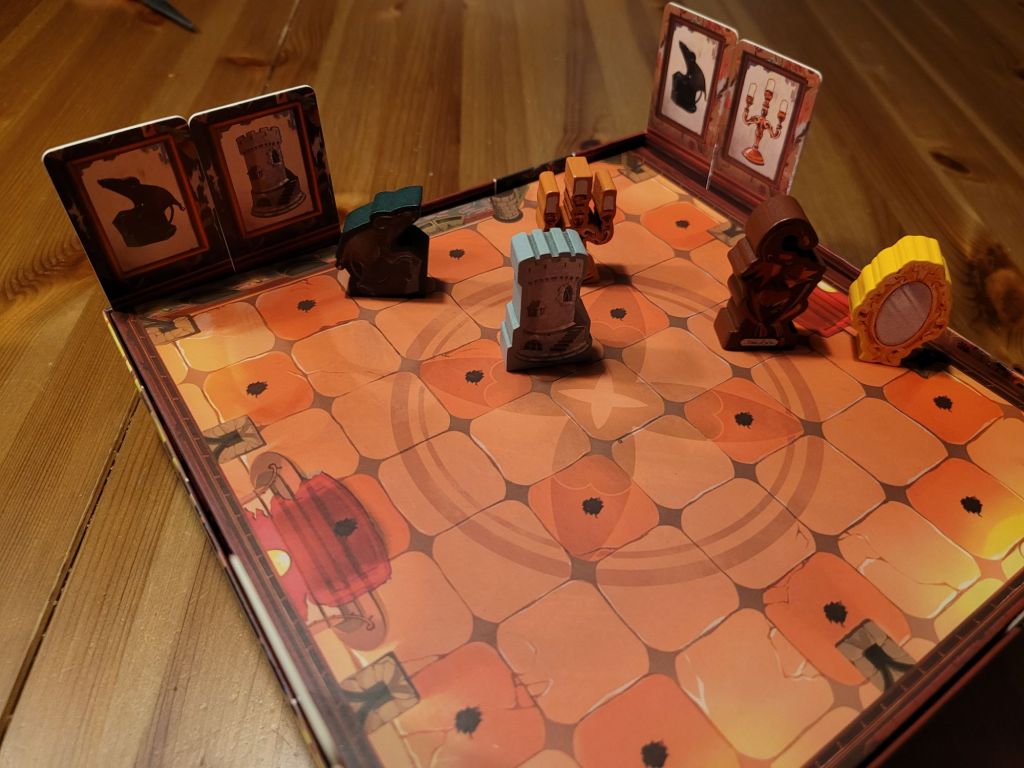
The last part should be taken literally. As the randomly drawn cards during set-up determine how we need to arrange the wooden pieces to win the game. But everyone of us only knows a fraction of those goals. My knowledge of them half overlaps with that of my two neighbours. Whereas I know nothing about the goals the person across from me can see and vice versa. It’s these gaps of information that Quiet House turns into its main source of challenge and tension.
The difficulty in Quiet House is based on the movement limitations we have to consider, forcing us to smartly plan ahead. Each row and column on the board may only hold a single wooden piece. In addition to that, each wooden piece follows its own specific movement rules. Before long our plans become fairly sophisticated. The candlestick has to move left first, before the mirror can move forward, so that the rook can move into the empty row. Everyone around the table pursues a comparable, but not identical plan. Which usually means you get into each other’s way and often unintentionally mess up your fellow players’ plans.
Depending on your personality type this is ether highly entertaining or deeply frustrating. But before long a second level of Quiet House opens up – the attic, if you will. Because with a little bit of deductive skill and careful observation, you can figure out the kind of goals the other players at the table are after. This is when the fully cooperative character of Quiet House reveals itself. As soon as you understand your ghostly companions, you can more or less pass the ball (or pieces of furniture) to each other. Our silent means of communication – we’re only allowed to hold up signs that express our approval or disapproval with another player’s turn – soon finds its own rhythm. On particularly high level plays, you even consider the card deck, that determines which playing piece can’t be moved on your turn. Every playing piece is blocked from moving once during each of the five night phases. This too can help you come up with a more efficient plan or even shed light on somebody else’s move.

This shouldn’t lead you to conclude that Quiet House is a highly complex deduction game, that you should only tackle if you’re the chair of your local Mensa branch. In particular during the early rules levels – the movement rules can be changed in a number of ways from simple to challenging – the game has a family style quality to it. In fact, the game’s attractice and family-friendly presentation is home to what can be a tricky, abstract puzzle game. You need both logical deduction as well as strategic foresight. Your ability to inhabit another player’s perspective is a far more reliable means to win the game than hoping that your plans won’t be thwarted because somebody moved that damn mirror in the wrong direction.
The highlight and Achilles’ heel of Quiet House is that its presentation suggests an approachable family game. Something that the slim rules set delivers. But the lightness and alleged randomness is only a taste of the game’s depths. Later difficulty settings will keep even skilled deduction veterans on their toes. Even if they might have preferred a creepier and darker presentation.
Quiet House is more challenging than a first glance would suggest. Tight logical deduction is merged with cooperative play. This mixture isn’t particularly novel, but it’s delivered in a tempered package.
Unforunately, it is this temperance that keeps the game from soaring. You’re waiting for something to push the puzzle and deduction past the tight corset of the game board. A twist or idea that would blow up the game’s steady rhythm. Quiet House stays true to its name. In a well-functioning team the game soon follows a predictable arc. It feels petty to criticize a game for it. But it’s also not something worth praising.
 Lest My Opinions Go Unheard