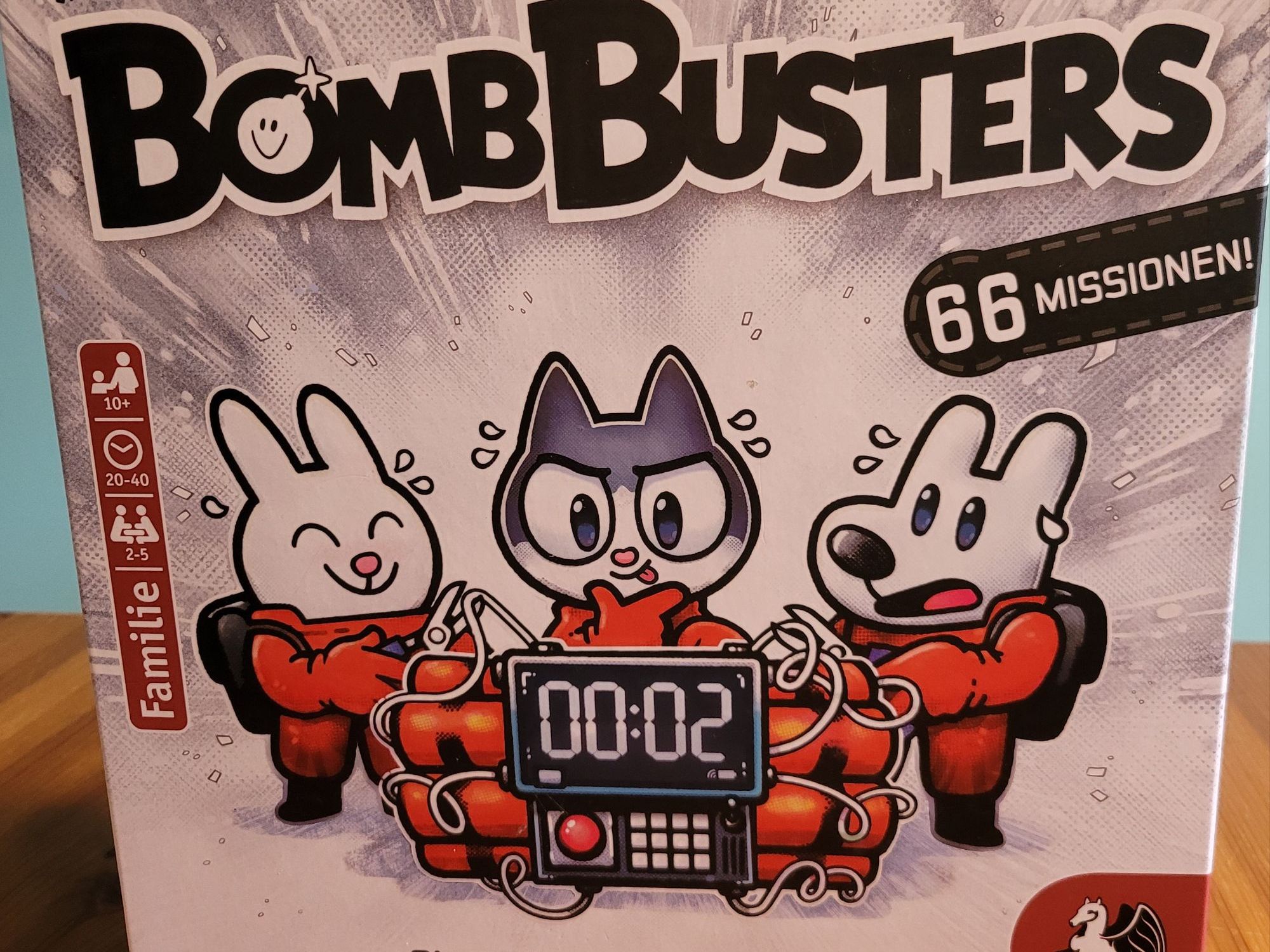
Bomb Busters is a cooperative deduction game. As an introduction to a review this is functional, if somewhat lacking in fancy prose and flourishes. Bomb Busters follows the model of cooperative games, in which communication between players is limited. All players share a task. Everyone has some information about that task, but – at least at the start of the game – nobody has the complete picture. Through our actions we try to relay what we know and try to dissuade others from making a mistake.
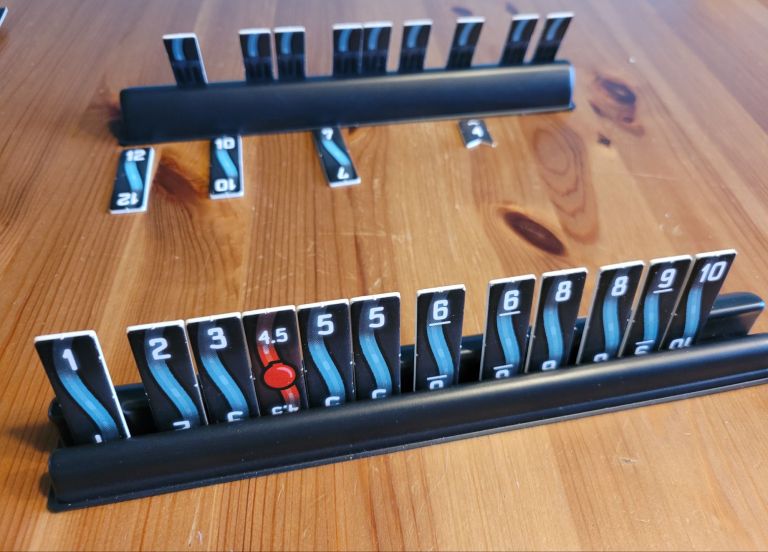
It’s the kind of interaction that is reminiscent of Hanabi (Spiel des Jahres winner 2013). When it’s your turn, you have to choose an action and must rely on what others have already communicated through their actions in previous turns. While Hanabi let you choose between playing a card and naming a card, Bomb Busters allows for only a single action: choosing tiles. More accurately: choosing two identical tiles. One of which you know (as you can see it in your tile holder) and one that you suspect on somebody else’s tile holder (based on clues given earlier). Once you’ve revealed all tiles, you’ve won together. Make too many mistakes, or pick the “red” tile by accident and the game ends in a loss.
At the start of a round picking the right tile or deducing it is a little risky. But with each newly identified tile, it becomes obvious which tiles are likely placed before and after it. Even when you misidentify a tile, a hint marker reveals its actual number. Whether you’ve deduced things correctly or not, all players know more as a result. This elegant design choice makes Bomb Busters smoother and faster to play. A wrong choice reveals the identity of the wrongly named tile, a right choice gets you a step closer to winning the game. The arc in Bomb Busters (unlike in history) bends towards progress.
This neat, almost imperceptible design choice gives players the needed feedback to feel able to tackle the current and later missions. On its box Bomb Busters proclaims its 66 missions contained within. This brings up memories of “The Crew” which had turned house rules into “missions” and printed them into a small booklet that shipped with the game. The missions in Bomb Busters feel – once you’ve made it out of the tutorial – much less like house rules, and more like distinct variants of the game. But this is a two-edged sword.
Even if the high number of missions is a delight for our inner penny-pincher, as you get “so much game for you money”; the longs list of missions eventually starts to feel like a burden. This may be, because the missions in the game are simply given numbers 1-66. Not unlike some of the longer running animes. This decision is both unimaginative and somewhat confusing.
Because this seems to run counter to the short, often humorous narrative texts, that name an antagonist in each box which players are going up against: the dastardly villain laying confusingly wired bombs all over the place. In other words: every box with missions could have easily been presented as a complete miniseries or story. This would split the 66 missions into easily grasped chunks, and add something like a manageable time table to the game. You could easily go on a break, once you’ve concluded a box. Instead you find yourself putting the game back in the shelf, feeling like you’re “not quite done” yet.
Bomb Busters feels entertaining and plays swiftly. But when you hold the packed up game in your hand, it doesn’t feel like you’ve accomplished much. Only that there is still so much left to do. Which seems wholly unnecessary, because the game already has everything it needs to feel like a collection of miniseries. The short vignettes in missions and antagonists on boxes are already there. “The Hunt for Doc Nitro” offers far more thematic cohesion and a thematic hook than “Mission 12-24”. It feels like the publisher made it all the way up to the finish line with developing the game, and then called it quits before taking that last step. This decision isn’t so much a big deal, as it is simply confounding.
Yet this unexpected decision has ripple effects that are felt over time. Instead of a light-hearted puzzle, when pulling the game from the shelf, you’re left feeling like there is a lack of a resolution, that Bomb Busters is a game of the perpetual cliffhanger. What was supposed to create joyful anticipation eventually transforms into fatigue.
The other, obvious features of Bomb Busters is far less subtle. The components feel cost-effictient as opposed to luxurious. A point that was brought up a while ago with e-Mission (the German edition of Daybreak, which as produced locally to be in line with the game’s theme of environmental awareness). In that case the game’s topic was enough to quell some critics’ desire to voice their sense of entitlement, for fear of how that might make them look. Consequently it was only brought up quietly and as an aside. With Bomb Busters no such sense of decorum is necessary: a modern game ought to have material of a certain quality!
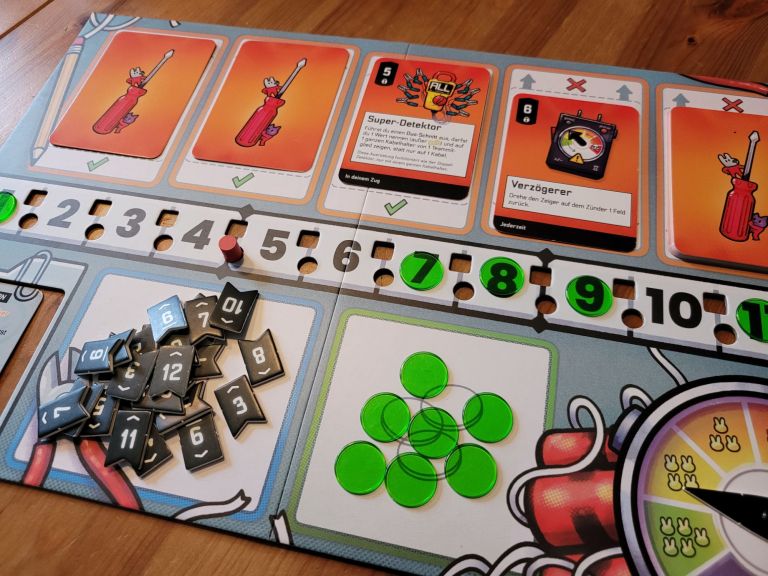
The functionality of the actual components is very rarely questioned. It’s the fact that the tactile experience of playing Bomb Busters is not as pleasant as it could be. The game’s components merely do their job. There are no tile holders made of hard plastic resin or thick player tiles to dazzle players with. As patently adequate the components are, they have no bearing on the quality of the experience. Having to pick out and place the tiles a little more carefully or not, offers little change to how the game actually feels to play. Even the plastic, see-through tokens used as a memory aid during the game, need no further embellishment to do what they’re supposed to do.
There is not question that components can improve the experience of playing a game. The best example of this is without a doubt Splendor (but I’d also add Azul and Akropolis). But whether a game trades in some of its quality by not including components of high enough quality, seems a little far-fetched. At best, you could argue that it was a missed opportunity during production. But it’s hardly even a blemish on the game. Bomb Busters’ design and forms of interaction are simply too robust and approachable to need high quality components to highlight the experience.
The only point in which Bomb Busters uses its components to improve the experience are the aesthetic flourishes players get to unlock over time. The small boxes, which already introduced changes and surprises in Dorfromantik, offer new missions but also stickers for the game’s box. They can be used to mark certain achievements by players. With each newly applied sticker, Bomb Busters’ box documents our experience of playing this game together. It is a small, undoubtedly low-cost component that leaves a much bigger impact on players than thicker tile holders ever would.
This approach kind of sums up Bomb Busters as a whole. It’s a small, charming game, which was expanded by the publisher just enough to not be brushed off as an inconsequential card game. It’s the opposite of overproduced, but still manages to create a fully-rounded sense of play. Bomb Busters is a shared experience, in which logical thinking and deduction are the means with which we create moments of suspense, thrills and success (sometimes in our second or third attempt) for everyone at the table. Maybe that’s what I should’ve written in the introduction.
 Lest My Opinions Go Unheard