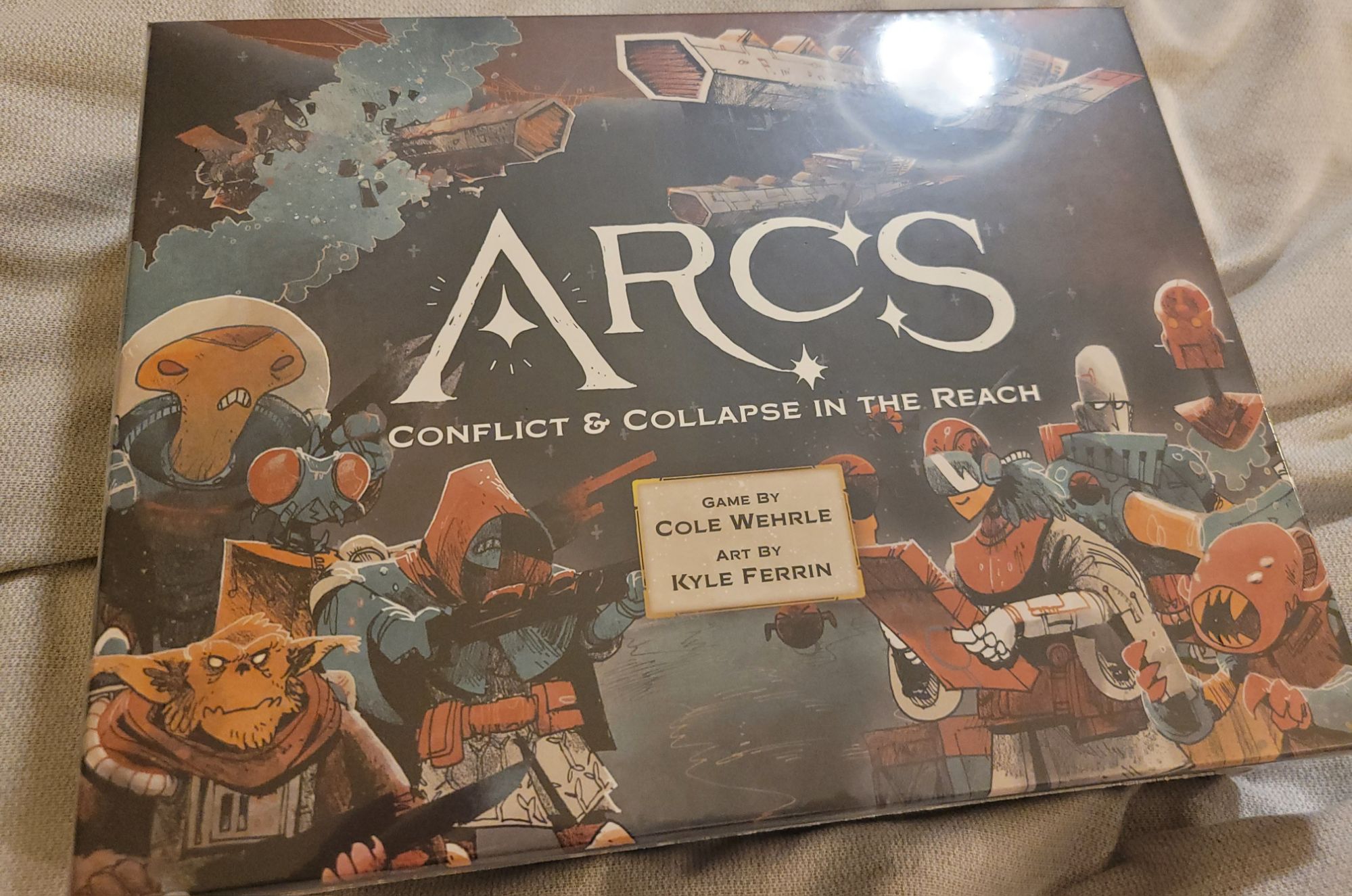
It’s not a hard and fast rule, but I’ve come to believe that any long-form piece should start with a flash-forward. So here goes: Arcs is a decent game buried underneath a bad one. There’s a non-zero chance that this will have already incensed or annoyed you enough to read the rest of this in a very snooty, dismissive tone. Such is the fate of any written online text. Tone is set with the first statement the reader either agrees or disagrees with. But let’s see if the rest of this slightly longer than usual text, can neutralize whatever first impression this paragraph has saddled you with.
Arcs is a pretty confrontational game that draws on a wide range of design influences to create a game that is ultimately stingy with giving players agency. Arcs’ rules are technical and specific, adding edge cases and unique exceptions in spaces players might not expect them. It has a somewhat deconstructed feel, because the trick-taking elements of the game don’t exactly work like trick-taking games do. The area control parts of the game don’t easily match the rhythms and strategies of other area control games. Even the way scoring points is handled fuses player incentives with game state manipulation. Simply put, Arcs can be a lot.
Because of this consequences to actions feel intimidating. A wrong move or forgotten rule can quickly soft-lock you out of competition. While being eliminated from a game is bad, feeling like you’re just a bystander while others are deeply involved in playing Arcs is invariably worse. So it’s only reasonable that you pivot to a risk-averse style of play: only plan with certainties, avoid doing anything that draws a target on your back, only move out of a safe space when it’s absolutely necessary.
High risk play is exciting.
Unfortunately, Arcs is not designed for low-risk play. Everything about the game is poised to have players get up in each other’s faces. Stealing each other’s resources, removing each other’s tokens from the board or the card display, fighting over initiative, etc. In theory this should lead to an enticing sense of tension as you’re pulled in two different directions with every decision you make. Do I play it safe and hope for a better chance at scoring points later, or do I take a swing at things right now, with the possibility of scuttling my chances at getting back on my feet for the rest of the game? High risk play is exciting. When it’s tied to meaningful consequence (like seriously damaging your position on the board) it’s thrilling. But in order for it to feel fulfilling and not simply stressful, you need players to buy into it. You need players who are willing to take those bets.
One of the key decisions in Poker is choosing how much money you want to risk, after seeing your cards. This is in part based on the strength of your hand, in part it is based on how well you’re able to read other players, but… almost imperceptibly… it is also based on how much you’re ready to lose. An important part of player agency in Poker is buried in this decision: you are supposed to bet only as much as you’re willing to lose. Push it too far, and you have a strong chance of regretting it, getting angry at the other players, at the game or even random chance. Because when things don’t play out as you had anticipated or hoped, you get frustrated.
Is this setback going to be minor or major?
Early games of Arcs don’t offer the luxury of you understanding the stakes of your decisions. Without a number of games under your belt, it is practically impossible to gauge what you’re actually risking when you decide to make a run at scoring points. Is this setback going to be minor or major? Will you bounce back the next turn, or will you have to come up with elaborate schemes to try and get back into the running for first place.
All this results in the impression that many players have in their first few games, that whether you win or lose all comes down to the strength of the cards you’re dealt at the start of each round. There are layers of tactical decision-making, board positioning and majority-jockeying in the game, but they are obscured by how the game presents itself. It’s only after multiple plays of Arcs, that these layers reveal themselves to players.
In order for play to be engaging, players need a sense of agency. They need to feel they are in control. Not necessarily of the outcome of their actions, but of the decisions they’ve made. In particular, they need to feel as if they’re making sufficiently informed decisions. If you have no idea what kind of hands are possible in a game of Texas Hold’em betting money based solely on the two cards you have in your hand, isn’t an engaging, informed decision that qualifies as agency in the game. It’s throwing money on the table and hoping you will somehow win. Imagine having to learn the strength of individual hands in poker by playing game after game, and getting introduced to flushes, straights, pairs, full houses and so on piecemeal like that. You’re not discovering layers of strategy and depth, you’re learning the full breadth of the game in the longest, most expensive way possible. You keep throwing money into the pot until you eventually feel like you’ve gotten your bearings. But you always have this gnawing suspicion in the back of your head, that there is still a hand of cards that might beat your straight flush. But you will never know until it actually happens.
Arcs feels a lot like that in your first few games. It might even feel that way when you’re eight games in or even twelve games in. It all comes down to how things play out in your gaming group. From a design perspective I find this puzzling, as it only serves to obscure the rest of the game. But it would be needlessly reductive to talk about Arcs solely as a mechanical design. It is only one facet of the game.
The other major facet of Arcs is its narrative potential.
The stories we get to experience when we play are thorny, but dramatic. They’re filled with sudden reversals and crushed hopes. There can be moments of capricious defeats, as well as games that play out with a grim inevitability. Where other designs are curated to produce a specific arc of play, to let a specific kind of tension emerge between players, to reward them for the time they’ve instead into playing it, Arcs could not care less about ensuring players have a good time.
To some this is refreshing, exciting and even a bold new direction to take board games in. Away from the status quo of staid, even-keeled or even “fair” experiences, in which everyone at the table is treated as an equal. Games in which making the right, rational choices elevates one player above the others, thus granting them the title of “winner”. Arcs is a game that does away with these antiquated notions.
To others, though, Arcs taps into every bad experience they’ve ever had playing board games. It brings back childhood memories of arguing over rules, of being blind-sided by a particularly conniving use of a rule or simply getting agitated over the events of a game and being denied a satisfying resolution. It evokes all the bad experiences that the advent of “German games” and later “eurogames” sought to minimize.
The game’s divisiveness then is not proof of Arcs’ radical difference and courageously avant-garde nature (as its proponents seem to believe), nor is it proof of Arcs’ regressive design philosophy and unpolished designcraft (as its detractors want to argue). It is proof only of the game’s opacity. Not merely in its rules, which are finicky and – by all accounts only become more so with the expansion. But in how opaque the identity of Arcs is until you’ve played it multiple times. Actually, it might not even be possible to do so with certainty, after playing Arcs multiple times.
But even this distinction reads like a mark of quality to some, and a sign of failure to others. To understand why that is, we need to dive even deeper into the schism of what games are and what they are not.
One perspective that has gained some traction in the last years has been to look at board games as narrative media. A term that used to apply to literature, film, animation, theatre and so on was now the angle with which to approach board games.
I see the appeal of applying our knowledge of classical narrative media to board games. But treating them as media that tells us stories, doesn’t quite get to the heart of what games are and what they do, in my opinion. It’s a way to approximate the thing we’re dealing with. It’s an attempt to use methods and approaches that have proved useful elsewhere, and hopefully glean some insight from games this way.
There are upsides to thinking of them as narrative media (or something close to it). We can look at a game and attempt to identify its “text”, its story, the way it tells it and how it affects the audience. We can scan the game for dominant metaphors, for layers of subtext and how one game is always a commentary on itself, its genre, its medium or even society in general. We can argue that games can have messages. This approach lets us look at how games make a statement, pose a question or even serve as an expression of cultural identity.
We would have a much harder time critiquing a toaster this way
It has become an approach that has grown to be self-validating. Since we can approach games this way, and it does unearth some insight that we might otherwise not have had, treating games as narrative media must not only be valid, it must also proves that games are, in fact, narrative media. We would have a much harder time critiquing a toaster this way, for example. If reading games as narrative media creates a tangible result, we must conclude that games are a narrative medium. If we can use it as a book, it must be a book.
For the longest time I found this reasoning persuasive. It seemed sound, not least of all because it meant I could apply my literary analysis skills and knowledge of literature and film to this utterly arresting “hobby” I had found myself in. Not only did my previous knowledge enhance my experience of playing a game, it also enriched the conversations I could have about it. It tickled the part of my brain drawn to novelty and discovery. Looking at games this way made them more valuable and meaningful to me.
I think it is no coincidence that the most well-regarded game critics today all have a background in literary analysis or writing. Talking about games as if they were narrative media, talking about all the things this medium “tells us” creates interesting, engaging and entertaining texts. I am not going to call them content, as that would diminish the effort, care and skill that went into them. But I will stop short of calling them critical analysis. To be clear, it’s not the first part I have doubts about, it’s the second. I am not convinced that what this school of criticism creates is based on analysis. It is in my opinion based on personal expression, and a genuine enthusiasm for a game’s narrative potential. Which is something that every single gamer can relate to. We are all genuinely enthusiastic about what games can mean to us, the kind of emotions they can evoke in us and the wide range of ideas we can connect to them.
This is intensely personal, not necessarily in the sense of being an intimate experience, but one that is entirely tied to who we are. Our biography, our education, our identity, our personality. Everything. To that extent games are like Rorschach tests. We see a somewhat convoluted mess of objects, language and visual references before us and try to make sense of it as we play. And we use the things we know, we’ve learned and we can imagine to make it coherent. To make the otherwise trivial exercise of competing against each other over victory points or victory conditions or whatever into something more valuable to ourselves.
Do not mistake this as me saying that games are meaningless, and talking seriously about them is an exercise in self-importance and vanity. Far from it. Treating play as substantial, as meaningful and valuable lies at the core of why it is so fascinating to us all. It’s the reason why games are not, and never were, child’s play. It is this action that pushes playing games from a way to pass the time to a cultural, if not cultured, activity. In fact, this is part of playing a game in the sense that it is a way to engage the game. It is no different from the vivid post-cinema discussions you might have after watching a particularly gripping film. It is no different from talking about a book’s dominant metaphors, layers of subtext and how it comments on itself, its genre, its medium or even society in general. But there is one pivotal, fundamental and undeniable difference between a book and a game.
As readers, film-watchers or even theatre-goers we do not have agency. We are passive recipients of the author’s intended narrative, which we may or may not fully understand. Based in equal parts on our media literacy and the author’s storytelling craft. We can interpret it, we can apply our understanding of the author’s biography to the text or we can seek out how to contextualize the events of the narrative within the time it was made. We do not need agency for any of this. We have no say in the narrative itself. The outcome of a book never changes. The film you’re watching will always end the same way. Except for Clue, which is fittingly based on a board game.
But games give us agency.
They hand us the reins and tell us “this is yours now, make of it what you will”. This is what games are for, what they are poised to do. It is the reason why we choose to play games in the first place. Because playing games is the antidote to passive consumption. They are not just a way for us to throw some dice and move some chits. They are, if we’re willing to use them like that, a way for us to share and reflect on our ideas and our views of a game’s theme, of the way we interact with each other at the table or away from it. Games let us draw on all the cultural knowledge we have and use it to enrich the time we get to spend together.
That’s what makes games not like books or films. They are not a medium for narrative, but one for agency. We get to bring the sum of what we know and who we are to the table and turn the nice tokens, the pretty pictures and funny words into a temporarily shared fantasy. Some times it can feel like a magic trick.
Whether it’s our individual experience of imagining ourselves handling the military levers of controlling spaces on the board or the political vagueries of our opponent’s decision-making. Our creative and emotional investment into the game means it becomes more than the sum of its parts.
Thinking of this as immersion does us all a disservice, as it re-frames our active participation in enriching the game into something we experience passively. The same is true for the game’s narrative. If we conceptualize games as narrative media, we relegate ourselves to the role of a rapt audience of the game. We deny the agency we have over what a game means to us, and instead label everything we’ve made out of the game an inherent (and sometimes even intended) consequence of its design.
This is why I find myself stepping away from understanding games as narrative media. It has served its purpose to draw attention to the fact that games are more than just formalized interactions between competitors. But it’s starting to feel constrictive in any critical appraisal of games and play.
Instead, I would adopt the C. Thi Nguyen’s argument that games are a medium for agency. They are a means for us to do things, we otherwise couldn’t. Games are, in a very “touching the monolith”-kind of way, tools. Their makers intent is important only in so far that all tools serve a purpose. Designcraft is not just about honing the tool for its purpose, but also making its purpose legible to the people who will use it.
Maybe Arcs is “not for you”
So what does it mean when a tool’s purpose is opaque? It means you have to keep trying things out, until the game begins to come together. It means you have to rely on how others relate their experiences with Arcs, so you can make sense of this box on your gaming table. Or you give up in frustration. Maybe Arcs is “not for you”, whatever that means. Or maybe you just don’t have the kind of group to continually try things out with, until you finally manage to make Arcs work. It is this murkiness of purpose, this fuzziness of application that envelops Arcs like shrinkwrap. This is the bad part of the game. Not the thorniness of competition, or the peculiarity of its rules. It’s a design that plays hard-to-get in the mistaken assumption that this somehow makes it more valuable.
When it all it does is make the genuine enthusiasm people have for this game come across like hype and zealotry. A game’s strength should not be difficult to articulate. It shouldn’t be an uphill battle to make a case for why something has value. Leaving you with hard to answer questions is something that makes a book or a film great, but not a game.
There’s a decent game in Arcs. One that is lean and highly player-driven. It’s a game that has enough emotional range to appeal to a wide group of people. But it won’t, because of all the hurdles they first have to get over.
 Lest My Opinions Go Unheard