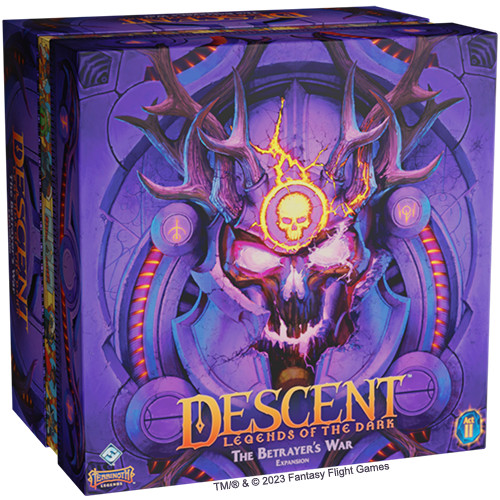
Expansions generally arrive in one of two forms: either as a sequel or as a re-interpretation. Descent – The Betrayer’s War proudly opts for the former. This is, in part, due to the game’s narrative constraints. Descent – Legends of the Dark had announced itself with a very confident Act I on its box, making it the opening of a multi-part narrative. Naturally, this meant that The Betrayer’s War had to feature Act II on its box as well.
Since a sequel is, by definition, an expression of continuity, everything builds on what has come before in Act I. There are many miniatures, many weapons, many skill cards, many more terrain elements and a great number of narrative sequences. The emphasis here lies on the word “many”. Since the presentation of Act I was carried by maximalist ideals, so does Act II have to follow suit. This turns out to be a double-edged sword.
The dialogue sequences between main and supporting characters end up making the same mistakes as in its predecessor. They are not written for the game, i.e. filled with game-relevant information, but have quasi-literary aspirations, i.e. they are focused on world-building. Readers of fantasy fiction are all too familiar with this. As world-building has its own appeal and fascination. It is a beloved facet of that medium, adding to the joy of reading such a story. It makes it easier to immerse ourselves in that world, as we learn more about it while we read. Much, if not all, of what we read feeds into a better understanding of the story we’re being told.
If games told stories, these long dialogue sequences would without a doubt be the highlight of the game. They are written with an eye towards revealing character. They are not just interchangeable phrases. You can in fact identify characters by the way they express themselves in dialogue. This is well-crafted and worthy of praise. Even character development – outside of the mechanical increase in available actions – takes place within the story. While some player characters from Act I play a slightly less significant role in Act II, Brynn, Galaden, Vaerix, Kehli, Chance and Syrus do undergo some form of change. That, too, makes a good story. On top of that, cut scenes work with foreshadowing and recurring motifs, that any English major could have a lot of fun working out.
But Terrinoth does not solely consist of our six main characters. There are least as many supporting characters that show up in the sequences between each adventure. They, too, are given their own recognizable characterisation. And they, too, will undergo some form of change as Act II progresses. Some more pronounced than others. Storytelling and world-building are two goals that are very purposefully and ambitiously pursued in Descent – The Betrayer’s War. The world is supposed to feel alive. As the players go on their adventures, Terrinoth should noticeably change.
If boardgames worked like point-and-click adventures from the early 90s, Descent Act II would have been a definite AAA title. But they don’t. They don’t tell stories, but put players centre stage, so they can make stories happen.
In my critique of Descent – Legends of the Dark, I compared the game to Hero Quest. A game that was originally designed to get board gamers excited about the much more liberating world of role-playing, Players were supposed to be given more agency and influence over the events of the game. They were supposed to be the focus of the action, as opposed to the world they inhabited. The game’s world was dynamic, sure, but the game would be driven by the decisions players made.
This intoxicating feeling of being the protagonist is also what makes board games stand out. Their framework might be less flexible than a role-playing game, but the essence of play lies in our identity as people, who push the game’s plot forward. This role is far more essential to making a game feel alive, than a well-developed, multifaceted and dynamically acting game world. And it’s this exact point, that occasionally seems to have been forgotten with Descent Act II. The shift from filling out the game world to putting the players into the driver’s seat often feels imprecise and unmotivated. It’s often a sudden shift in perspective from acting player to attending observer.
Just as in Act I, each character gets to make a number of decisions throughout the campaign. Decisions, which change the two internal character traits or convictions. This felt important and relevant in Act I, because these decisions were tied to story beats, that seemed impactful. There seemed to be something at stake. Comparable moments in Act II tend to come across like a holdover from its predecessor, a design obligation that couldn’t be ignored. But it doesn’t feel like the driving force behind the campaign. They tend to appear in situations, which you don’t really attribute a lot of significance to. This is regrettable, since this further pushes characters and game world apart. This is why Descent – The Betrayer’s War feels less like Hero Quest, and more like Pandemic Legacy Season 2. Gameplay-wise it is noticeably more ambitious than its exemplary (but far from flawless) predecessor. The core elements of the game are more refined and more demanding than before.
The story, as told through dialogues and cut-scenes, is also far more pointed. Many ideas, which the more conservative part among players tends to look at with suspicion and refusal, are centered with a charming shamelessness and confidence. Yes, this story is about refugees and the moral necessity to help them. Yes, this story is about romantic relationships that do not fit into heteronormative patterns. Yes, profiting off of other people’s fundamental needs is the deplorable, yet legal, behaviour of monopolists in Terrinoth. Descent – The Betrayer’s War does not hide behind some sense of political neutrality or uses its fantasy setting to work through fantastical problems.
The story in Descent Act II is narratively stronger and more expansive. But it no longer feels like the story of our characters. The narrative develops around us, but not out of our actions. When the sum of our previous decisions end up impacting our situations in the game’s final mission, it feels less like the end of our characters’ journeys. Instead it feels like calling in favours, that the supporting cast in Terrinoth owes us. It is as if they are finally paying off a debt they’ve accrued with us, because we helped them out once. And now that the campaign is coming to a close, it is time to pay up.
This is one of the reasons why the emotional arc of the campaign feels somewhat frayed. It is no longer driven be the inner change our heroes have gone through, but by outside circumstance. In addition to the surviving characters from Act I, new characters have been introduced into the action. They too need to be given a clear identity through dialogue. Which the designers succeed in more often than not. That too deserves praise. But at most, they add something to individual adventures. Their relevance to the character development of our heroes is nominally at best. This is in stark contrast to, for example, the ranger in Act I, which gave us more insight into Galaden’s tragic backstory. Not least of all because their interaction showed us which inner conflict Galaden was dealing with in Act I.
In Descent – The Betrayer’s War this supporting cast opens up the game’s setting, that is to say Terrinoth itself, but it loses sight of its main characters: our heroes. This is good for world-building, but less so for our experience of playing the game.
Descent – The Betrayer’s War is narratively a direct continuation of the themes and motifs of Act I. Simply delivered with an even stronger sense of conviction. If you play campaign games for their story, this might seem like an unreservedly good thing. But Descent – Legends of the Dark wasn’t praised and celebrated for its story. It was the fact that this campaign felt like “our” story. It was “our” decisions that shaped the fate of the land. It was “our” decisions that led to the end of a campaign that brought together both themes and character development. This didn’t just feel great, it was something unique.
By comparison Act II feels unfocused. It puts too much emphasis on world-building, which makes it feel overstuffed – particularly during its long dialogue sequences. There’s simply too much that has been build around Descent’s core. Too many places, too many supporting characters, too many story lines and too many references to background details that only true Terrinoth-connoisseurs will know what to do with. Hardly anyone will know what the name “Timmoran” refers to.
But despite all these minor disappointments the game’s foundation remains robust and stable. Every adventure included in the game has its own identity, its own clever spin and at least one entertaining idea to become memorable. This alone makes Descent – The Betrayer’s War a worthwhile continuation of Act I.
It would have been even better, had it also been an evolution.
 Lest My Opinions Go Unheard