
Film studies is where board gaming has borrowed the term immersion from. It describes being so engrossed by a work of fiction, it fully captures our attention. For this to even be possibly, audiences need to be able to suspend their disbelief. They have to be able to overlook the fact that what they’re watching is just acting and visual tricks. This is most apparent in science fiction movies. The look of aliens, travelling to distant planets or even the possibility of travelling through time, has to be accepted as valid and legitimate by the audience. Otherwise the story doesn’t work. You don’t need to believe those things are real, but you have to be willing to accept them as part of the narrative.
(As an aside: the same is obviously also true for so-called realistic dramas. In which audiences are asked to treat certain behaviour as plausible and coherent. Such as criminal’s unrestrained willingness to commit violence against people, or the inherent competence and decency of police officers.)
We can only have immersion in a film, if our suspension of disbelief is upheld. But I don’t want to write about immersion today. What’s more interesting – and the topic of this article – is the board game equivalent of suspension of disbelief. Because in a board game this isn’t aimed at creating a more authentic and believable presentation of the setting. It’s also not about suppressing any doubts about how that setting is presented in the game. Thorough and careful research into the setting’s background generally doesn’t lead to a deeper and more involved experience playing the game. Even the inclusion of representative voices and member of the relevant culture do not necessarily create a better, more rounded and more intense experience. (A more diverse, equitable and inclusive approach to game development needs no justification. But even if it did, it wouldn’t be found here.)
In order for a game to properly unfold and draw our full attention, it doesn’t need our suspension of disbelief (with regards to the game’s setting), but our assumption of agency.
By this I mean the trust in our ability to actively participate in the game. It’s the conviction that we can have agency in the game, or at least are able to learn the game over time and acquire it this way. This may sound trivial to some, but it’s still a foundational element to creating play in the first place. When players can not hold this assumption, because the rules are particularly dense, other players seem to play on an entirely different level to them or because the course of play seems too prohibitive and punishing, the game effectively doesn’t work. Instead of playing the game, they are merely experimenting with it and triggering rules effects.
This is the threshold players need to pass with each new introduction to a game. They need to feel that they can actively effect a change in the course of the game. For example by setting goals they can pursue. Or by trusting themselves to be able to respond to every situation they may encounter during the game. It’s only when players trust themselves to have agency within the game, that we can talk about actually playing it. Experienced gamers will know this trajectory all too well. Almost every game begins with a sense of inability to play and – ideally – grows into the belief to have grasped the game. At some point thing simply *click* and they understand what they’re supposed to do. They have passed the εὕρηκα threshold, they have assumed their agency and that is when play begins.
Making it past this threshold and assuming agency is something that players must do. It can’t be prescribed through rules, or guaranteed through any single design decision. But there are details in games that can make it harder for new players to claim agency for themselves.
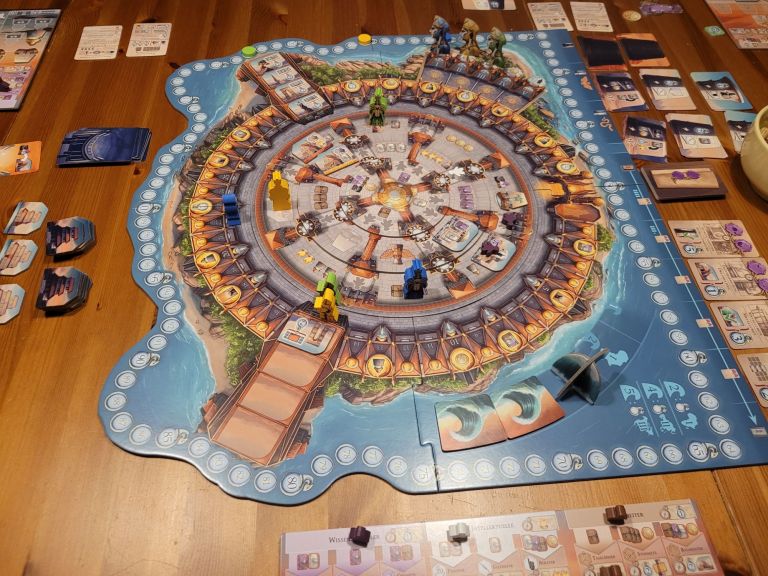
It starts with something like the volume and granularity of a game’s rules. The more pronounced those are, the harder it is to believe that you are able to actively and purposefully make use of them. An example of this might be Civolution. Its proudly worn label of being an expert game will already deter a number of players. But even self-identifying expert gamers will accept a number of “practice games”, before they consider themselves skilled enough to fully immerse themselves into the experience. That is why the rulebook’s layout and design has been highlighted in a great number of reviews. Because here the publisher has intentionally worked towards getting the εὕρηκα threshold closer to new players.
Similar observations can be made about game components. As impressive as hundreds of minis, cards and tokens may seem, they’re just as likely to discourage player’s faith in every getting a handle on such a game. A great example for this is probably Twilight Imperium. A game which can even intimidate veteran expert games, because in addition the wealth of components it also features a game length that’s practically shrouded in myth and legend.
Rulebooks and game introductions work best, when they don’t primarily focus on what players aren’t allowed to do, but instead offer a wide range of possibility to be active. When their focus lies on enabling players to play the game, as opposed to lecturing them about all the ways they can’t or aren’t permitted to do things. Doing so makes it easier to get past the threshold towards your personal eureka moment.
This shows, to me, that this assumption of agency much like suspension of disbelief is a psychologically-driven pattern of behaviour, which can be learned and adjusted. At its core, it’s trusting that you have the ability and skill, this game requires in order to be played.
The way people handle dice rolls in board games illustrates this quite well. There are players, who see the inclusion of dice in a board game as a way to take away agency from them. It’s only when a game offers them ways to mitigate the results in some way, that they consider themselves active participants in the game, as opposed to passive attendees. But if you were to swap these dice with a deck of unique cards that can be memorized (e.g. by using various zoo animals), their perspective shifts. Now agency seems not only possible, but something that be acquired through repeated play.
In order for a film to feel immersive, the audience has to suspend their disbelief and accept what they see as truthful and valid. A similar dynamic happens in board games. For a magic circle to exist, players need to believe in their own agency. They need to make decisions with the understanding that this will effect change in the course of play. They must make it past the εὕρηκα threshold, from “I don’t know what I’m doing” to “By George, I’ve got it”. It’s only then that a game moves from being a learning task, to simply being played as a game.
 Lest My Opinions Go Unheard