Next to historical farming and international trade routes, trains and their railway networks are some of the most common thematic framing for board games. Whether this is due to an ingrained interest in history and its infrastructure, or because these themes can easily be projected onto game mechanisms, is probably a matter of your personal gaming philosophy.
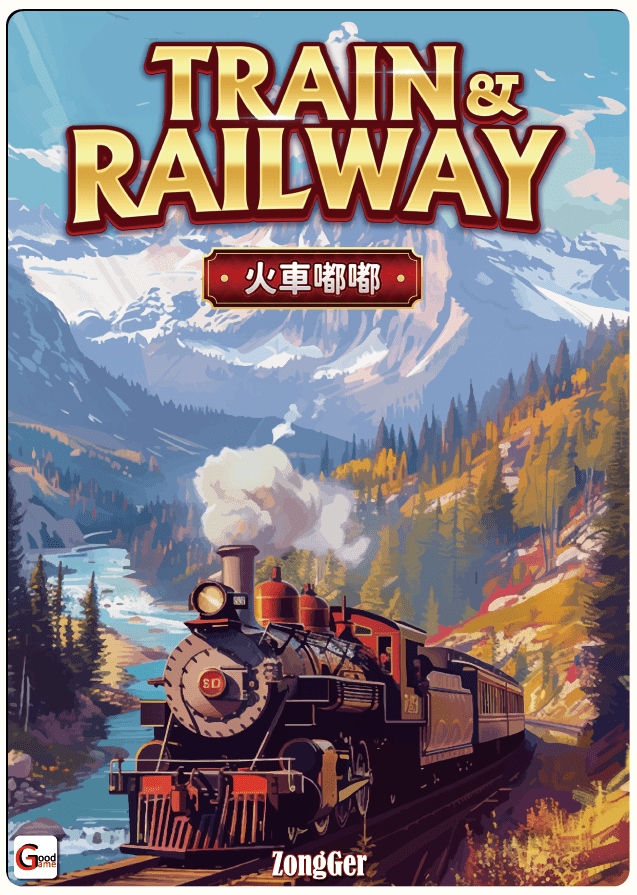
As the name suggests, Train & Railway has chosen trains and railways as its major thematic focus. But it does so while avoiding any explicit or easily identifiable references to history. While a steam locomotive features prominently on the cover, with a mountain range in the background, illustrations are generally kept somewhat generic. Whether we’re playing in North America or somewhere in Europe does not seem to play much of a role. This isn’t a game about thematic details, but about the broad strokes of its central challenge. We lay down tracks on the board, move our trains along them, collect goods and deliver them somewhere else. By doing so we earn victory points as well as ability upgrades as the game progresses. We can use those to tackle the afore-mentioned challenge in a more efficient and more profitable way. Much of this can easily be gleamed from the game’s components, if you’re an experienced gamer who has an eye for such things.

This trained eye will also soon notice that the tracks aren’t laid out, but instead drawn. This somewhat forgotten feature of train games has been re-used here, for both production and game design reasons. Because the maps used in the game aren’t re-usable, but simply paper. This brings to mind the wave of roll-and-write games of a few years ago. But where these consumable components saddled the genre with an inherent sense of triviality, their effect in Train & Railway is different.
Drawing tracks with one of the game’s markers makes these decisions feel binding, as every player now gets to use these tracks. Since there are only 20 maps in the box, and no map is identical, each play of Train & Railway gets immortalised on the map you’ve used. This makes every game feel unique in a similar way to ripping your very first card in Pandemic Legacy. Every map documents that moment in time, when you sat together to play this game.
In many Legacy games this uniqueness became the centre piece of the entire experience. The rest of the rules existed mainly to allow for an unobstructed play each time. Which is why the gradual rise in complexity over multiple sessions has always been one of the genre’s imperfections. Games began as easily accessible and pleasant experiences, and eventually evolved into complex and often drawn-out sessions filled with rules uncertainties and a lack of player focus.
But at most Train & Railway carries echoes of this toying with permanence like in a Legacy game. The used-up maps do not feel interchangeable, like in a typical roll-and-write game or its wipeable cousins. But the game is also not driven by the desire to find out what will change next.
But still the subtle undercurrent of permanence makes itself felt during play. You want to carefully consider your decisions, because it is so difficult to undo it later. The decision feels like it has weight. Even though there is not much of a mechanical difference to putting down a tile in Carcassonne, drawing a new track on the map feels like a palpable and lasting change to how the game will play out. In other words, every action in Train & Railway feels like an act of self-efficacy and influence, in short it feels like agency. Putting the felt pen on the map and drawing three continuous lines is simply using the components as prescribed, but these components give our decision weight and meaning.

Designer Zong-Ger takes these decisions, that feel impactful, and weaves them into a pick-up-and-deliver game. You pick up goods with your train, and deliver them somewhere else. To do so, you need to create connections between these disparate places. Objective cards further elevate some spots on the map over others. At least, temporarily. In the eyes of the players, the flat paper map gains a sense of topology. Important spots need to be connected swiftly, while also making use of other players’ railways. Because the web of railway connections isn’t owned by a single player, but available to all trains. That competition and individual hunt for profit results in something that benefits the community is one of the convenient fairy tales we just have to accept in this game.
Still its design draws our attention towards something else in the game. The available objectives not only serve as a source of victory points, but as a way to expand our abilities. Assuming, we only fulfill half of it. Doing so removes it from the display and usually lets us pick up an upgrade from our personal player board. Yet if you complete an objective fully, you get to keep that card for potential bonus victory points at the end of the game. It’s a familiar idea: if somebody is pushing towards one objective, you might want to consider stealing it from them at the last minute. A game that can otherwise seem somewhat solitary, bares its fangs here. Play becomes a little more tense, our focus likewise grows in intensity. Both success and failure gets accompanied by a noticeable surge in emotion.
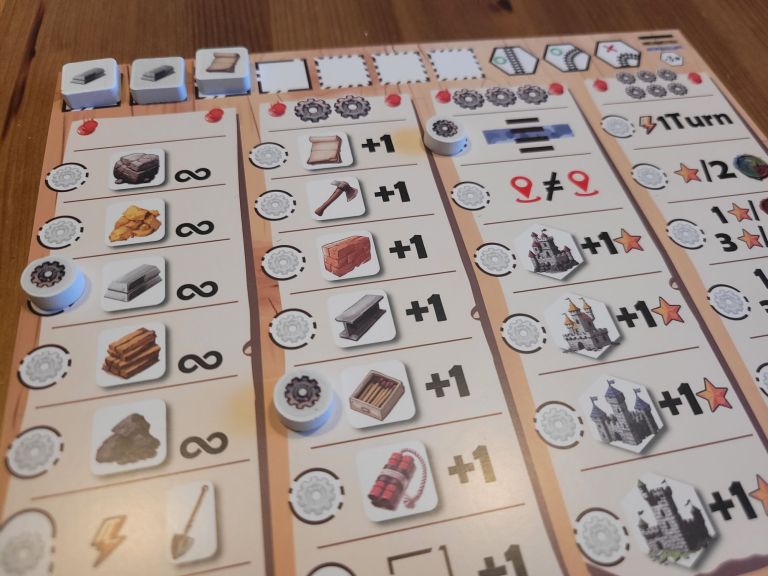
There are familiar and reliable rules mechanisms at work here. They allow for a quick and easy entry into the game. Train & Railway is all about quickly turning the people at the table from “learners” into “players”. Because you only get to the meaty and exciting decisions in a game, once everyone can hold their own. The number of individual improvements is intuitively tied to the game’s core actions. This means you soon learn to spot the opportunities and possibilities on the map, the supply and demand of the current game state. This makes play feel thrilling, because not only do you get to feel like you have agency, you get to put it to use as well.
Train & Railway does not re-invent the train game. It follows in the footsteps of its genre too closely to do that. But its clear structures make it imminently approachable. It’s easy to get this game to the table again and again, even after a longer hiatus. Once you’ve made it through the game’s 20 paper maps, there are just as many PDFs waiting for you from the publisher.
There is something inherently playful about the presentation of Good Game Studio’s games, which is arguably one of its most overlooked assets. These games telegraph their own playfulness and charm, without overselling either. The illustrations fall just short of whimsy, but are also brightly coloured enough to hit the right note of spending a pleasant Sunday afternoon around the table, having a good time with friends. Train & Railway is not a treatise on the economic structures and pressures of the age of the railway. It’s simply a good time, and that too is something to get excited about.
 Lest My Opinions Go Unheard