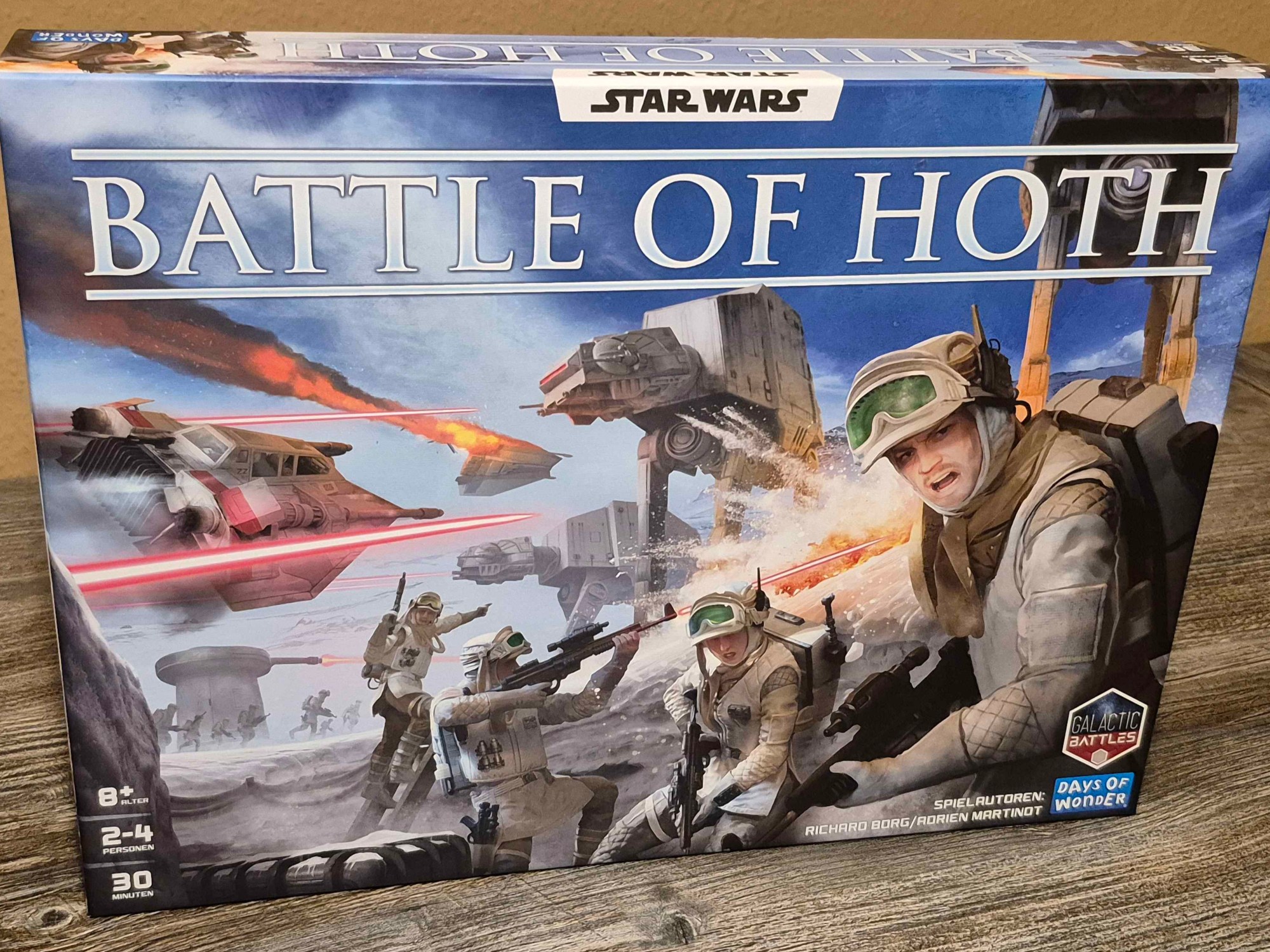
John Williams’ theme to Star Wars is not only epic and quite catchy. It also is a major reason why the original movie series hits a certain tone. Despite its martial sounding name, you’re told to expect adventure, excitement and heroism. As dark and dramatic some plot points may be, they all exist in service to the sense of adventure the films evoke.
Battle of Hoth is – much like in Star Wars movies themselves – a clash of two distinct vibes. On the one side there is tension, fun and strategic decision-making. On the other side, you have groups of soldiers gunning each other down in pursuit of medals and victory. There is a sense of adventure along the lines of John Williams’ score, but there is also indiscriminate killing in the name of military dominance.
This stark contrast isn’t accidental. Battle of Hoth is based on 20 year old release Memoir 44. An entry-level war game with basically identical rules, in which you command soldiers in World War II. The allies stand on one side of the board, the German Wehrmacht on the other. Memoir 44 didn’t get a release in Germany until this year. A decision which the recent press copy for the German has proven prudent.
Regardless of how you feel about playing the German Wehrmacht, as the game progresses you find yourself romanticizing individual soldiers’ fate in battle. Single characters are lionized into heroes, as they take down multiple enemy units. In fact, by explicitly referencing real military confrontations in history, it’s suggested that these soldiers were in fact more than simply cannon fodder. That they were actually fateful individuals who’ve shaped history, if not outright written it themselves.
In the context of German history this is particularly problematic. That is why relocating the experience into a less risky theme is not only a plausible but fruitful decision. By setting the game into the fantastical narratives of the Star Wars movies, the fictional quality of the narrative we play is emphasised. You are unlikely to look at Battle of Hoth as making a statement on history, or even attribute an immersive perspective into the past to the game.
When you’re playing Battle of Hoth, you understand that your playing the game simply creates a narrative, which itself is based on a narrative. Namely, the first act of the “The Empire Strikes Back”. That is why you’re unlikely to find the arbitrary elimination of human beings or industrial level mass murder in the game’s subtext. Instead these are stories of heroic, adventurous John-Campbell-inspired myths. The very same myths that helped Star Wars become the entertainment behemoth it is today. Because subtext in board games is context-sensitive.
Within this narrative and emotional framework we play out skirmishes between the Rebel Alliance (think Vietnamese freedom fighters) and the Empire (imagine theocratic US fascists, if you can). To do this, Battle of Hoth relies on the well-iterated Memoir ‘44 system which has already proven itself in games like Battle Cry, Command & Colors and even Battlelore.
It’s worth mentioning that Memoir ‘44 is still in print 20 years after release, having only just received another, purely cosmetic reprint. This longevity can be traced back to one very simple fact: it’s a massive amount of fun.
At the start of your turn, you’re boxed in by the cards in your hand. At the end of your turn you tap into the thrill of a decisive dice roll. The cards give you limited options to turn the game state in your favour. While the dice unite both attacking and defending player into a short moment of thrilling anticipation, as they look at who will last in this war of attrition.
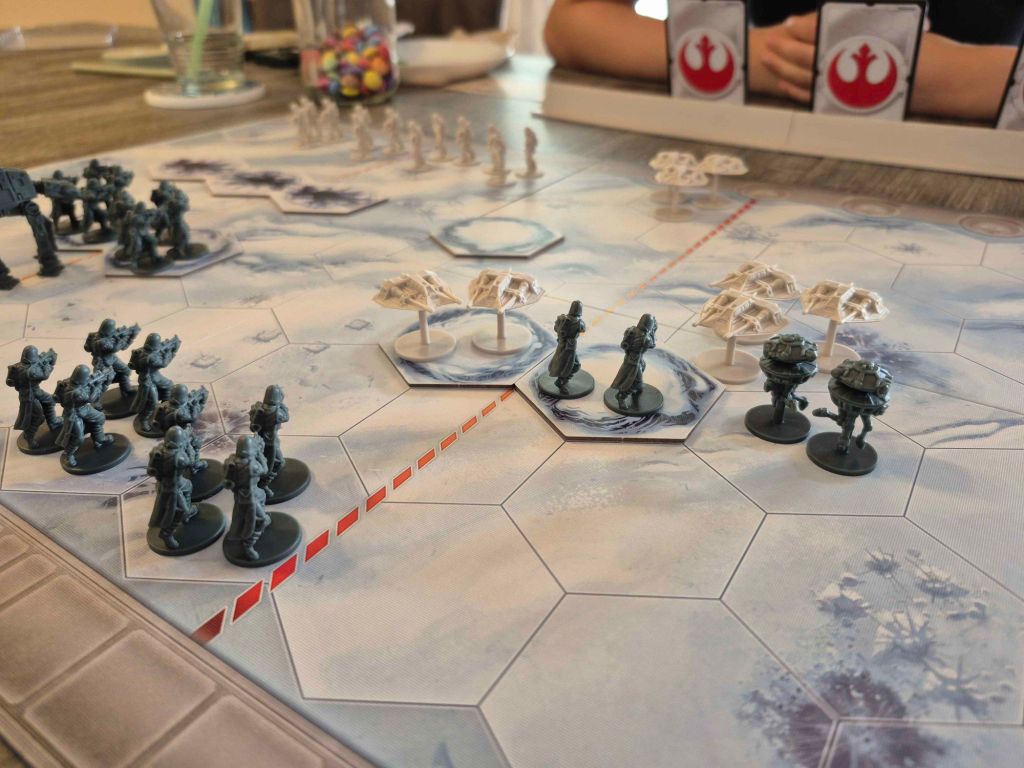
This core loop is the engine that drives a dynamic game of tactical positioning. You often move more than one single unit on your turn. After the dice resolve a firefight, the defending unit is often forced to retreat. Battle of Hoth rarely feels static, without fully slipping into random chance. So it’s no surprise that before long you start looking at the board differently.
You scan the snowy landscape for spots where your units will not be too exposed, while also trying to get close enough to enemy units to – should the opportunity present itself – deliver a decisive hit.
After a few playthroughs, you naturally assume the perspective of a military general, giving your troops precise orders to occupy strategically important spots on the board. Before long, your battles will end with a prolonged “expert” discussion between players about which tactically sound actions led to somebody’s victory. Or which unlucky dice roll denied you that one advantage that would have won you the game.
It only takes a few games for both players to feel part of a tightly-wound community that talks about tactical finesse and strategic plays on what feels like a highly advanced level. The very approachable challenge of the game manages to reach beyond the confines of the gaming table in these moments. And by doing so it manages to captivate its players.
But if you are familiar with the game’s design roots, it will be difficult to ignore the looming shadow hanging over this game: that you are in fact playing a trivialisation of war. It begs the question if this high level of enjoyment and excitement doesn’t also normalise this idea of talking about military conflicts as if their consequences were similarly easy to manage as they are in a game.
But then again, this makes Star Wars – Battle of Hoth hardly any different from the vast Disney buffet of entertainment content. This is primarily entertainment in the form of a board game, and as such it will rarely provoke much reflection in its players.
Still politically ambitious storytelling didn’t really land in Star Wars until Andor. (If you’re in doubt, remember your reaction when I compared the Rebels and the Empire to the Vietcong and the US, respectively.) Maybe we simply need to wait a few years, until there is a game that deals with the political motifs the setting is build on.
Until then we have a highly entertaining pastime with Star Wars – Battle of Hoth. Where we can push around small plastic soldiers, make laser weapon sound and occasionally hum John Williams’ epic title theme. There are surely worse things to spend your time with.
 Lest My Opinions Go Unheard