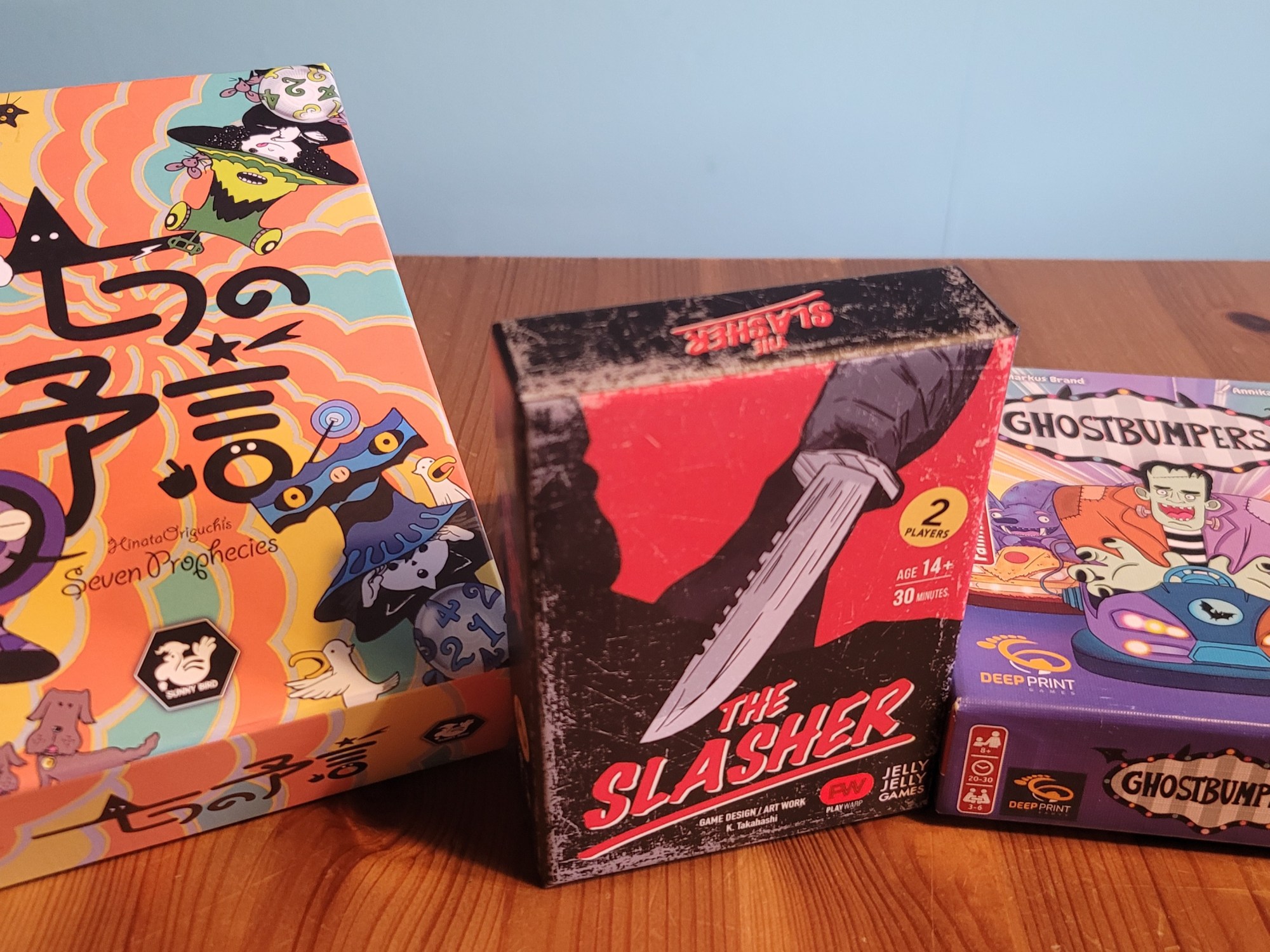
Ghostbumpers
Ghostbumpers is a simple trick-taking game. It is particularly simple, as it does away with suits giving the trick to whomever plays the highest card. That is why 9 times out of 10 Ghostbumpers is played as a trick-avoidance game. For each trick you score, you have to discard the top card of your point cards stack. The height of which, i.e. the number of tricks you believe to be yours, you can secretly set at the beginning of a round. A very weak hand might mean scoring a lot of points. A very strong hand may only score you few points. Because you will place a sudden death card in your point cards stack. If you happen to reveal it, when scoring your trick, the current round ends immediately and nets you 0 points. So you have to evaluate your hand, and place your sudden death card as high as possible and as low as necessary.
This is the core of the game. It is only interrupted by a nil-round (i.e. you empty your entire points card stack for 10 points) and a multiple discard action, which changes the value of the card you’ve played. The latter makes card counting or even interpreting other player’s choices something of a guessing game.
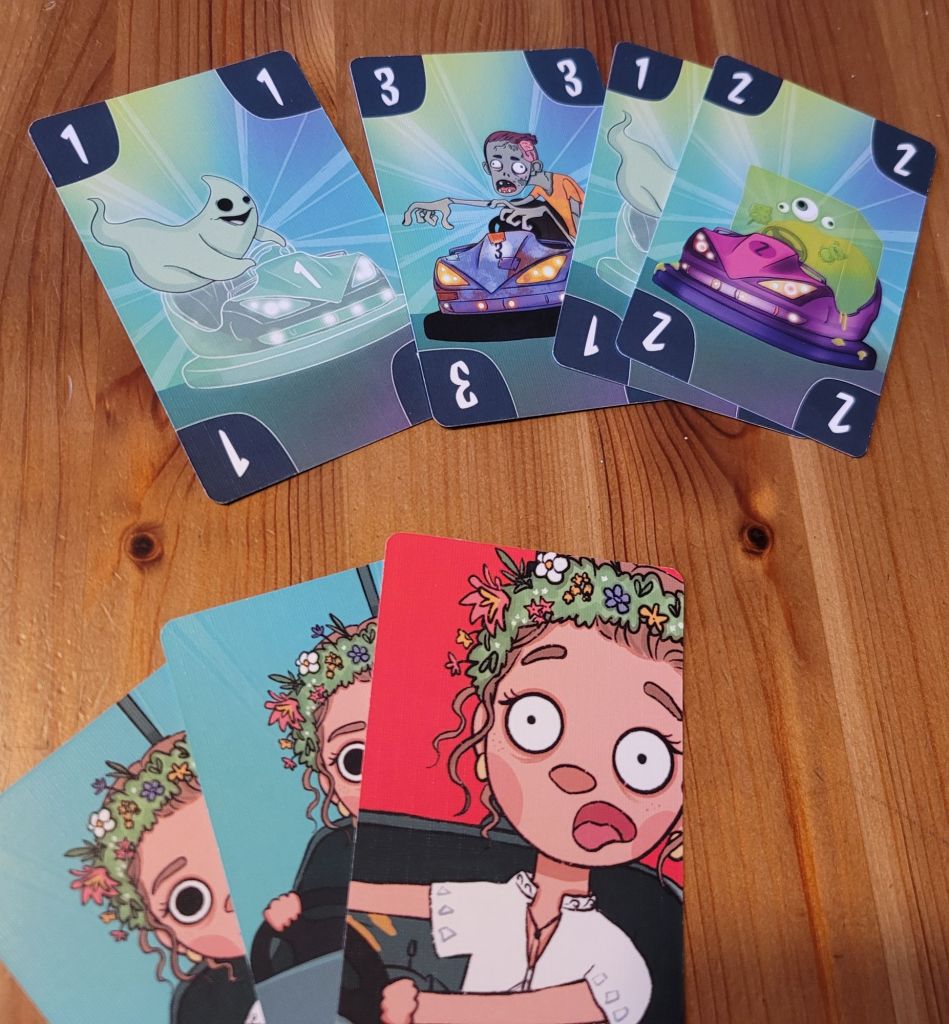
Despite its relation to classic trick-taking games with their somewhat strict set of rules, Ghostbumpers is a pretty wild ride. One that is primarily shaped by disruptive plays and unexpected swings. To that end, the game’s defining feature isn’t necessarily its set of rules (which are robust, but not particularly unexpected). It’s also not necessarily its illustrations, which consist of references to well-known and slightly less well-known characters of horror films and/or novels. Both are above average, but don’t come across as particularly exceptional. Ghostbumpers’ unexpected highlight is the thematic metaphor this card game is wrapped in. It’s about driving bumper cars.
It’s about the loud, often intrusive ramming and bumping into each other, while seated in dinky, electrical wagon while noisy pop songs of yesteryear blare from tinny loudspeakers all while slightly drunk teens are laughing over who rammed whom. In other words, it is silly and chaotic. It follows some basic rules and is over so quickly, you might as well have another go. It doesn’t hurt, and even if it does, this only lasts until you’ve managed to throw somebody else off, and the schadenfreude threatens to overcome the entire table. It is rare that the a trick-taking game’s theme is so neatly expresses what playing it feels like. Ghostbumpers is impressively close to being Bumper Cars – The Trick-Taking Game.
Seven Prophecies
Whereas Ghostbumpers is very transparent about its chaos and unpredictability, Seven Prophecies suggests a little more control and influence. After all, each round begins by determining the suits the next 10 tricks will have to follow. Here, the traditional categories of suits and value of 1-10 is alive and well. What’s less traditional, is that instead of announcing how many tricks you will win; you will have to announce how well you will score in each trick. Which is to say, will you play the strongest, second-strongest, third-strongest or weakest card into the trick? As clairvoyant witches this should be a walk in the park. Surprises aren’t rarer in this game, but the often carry through to later tricks as well.
The self-chosen prophecy quickly reveals itself to be an easily-understood, but not necessarily trivial puzzle you have to solve. Despite the certainty of knowing what suits to follow later, an unexpected card play of another play can quickly upset your best-laid plans. Seven Prophecies’ memorable moments emerge from a comedy of failures, which is particularly entertaining when you can sympathise, but also when you inadvertently caused it.
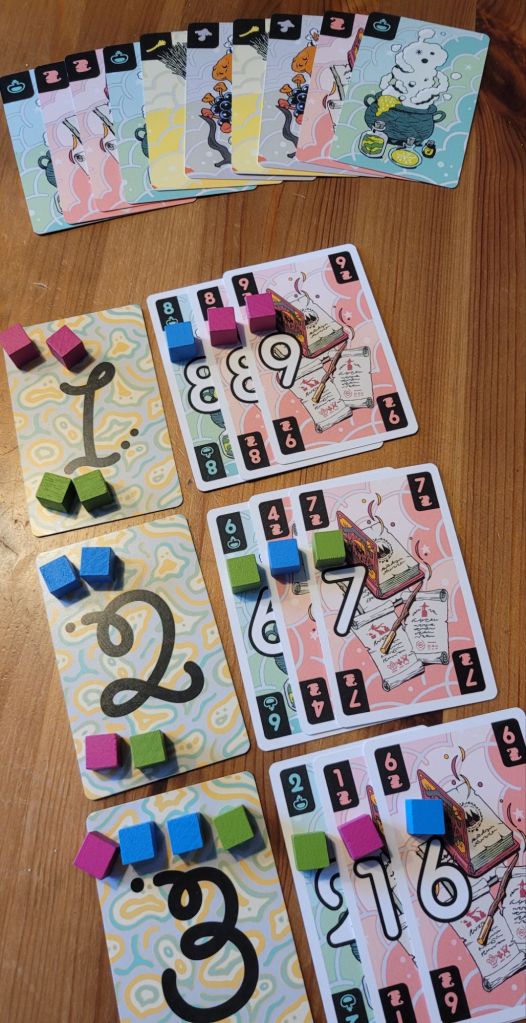
This is how Seven Prophecies gets at the heart of a good trick-taking game. The heady planning and deduction is infused with a little hubris, which when it suddenly collapses, you can’t help but laugh about. A perfectly prophetised game may be theoretically possible, but in practice your planned “weakest card” in trick 3 suddenly turns out to only be the second-weakest card. You’re meticulously planned plays from your hand suddenly doesn’t match your predictions from the beginning of the round.
You immediately have to start improvising to get to your goals somehow, in the hopes of finishing the round with the blatantly obvious fib of “Everything has happened as I have foretold.” Since your objective is now more expansive than a simple “Win/avoid tricks” Seven Prophecies feels quite flexible, despite its strict rules. The result is an entertaining game which invites you to laugh at yourself.
The Slasher
It’s no secret that emotions are central to play. It’s even less of a secret, that games only offer a somewhat narrow range of emotional experiences. There’s joy (in our own fortune or other’s misfortune). There’s playful silliness or dramatically enacted outrage, when you’ve been unscrupulously outplayed. Less entertaining emotions such as fear, are generally considered out of reach for games. Doubly so, when they are strongly abstract like a trick-taking game.
I wouldn’t go so far as to say that The Slasher is a game which manages to evoke fear in its players. But its biggest trick (HAH!) is a clever mix of thematic references and easy-to-grasp game mechanisms. This all culminates in an experience that is unexpectedly easy to immerse yourself in. And by doing so you find yourself hardly less tense than watching a horror movie on VHS. Think of Halloween, Friday the 13th or even Sleepaway Camp.
The Slasher is, as you’ve undoubtedly guessed, a trick-taking games. This time it’s a cooperative one, which already changes how players relate to each other. Instead of trying to get the most out of your hand of cards, you need to keep an eye on the tricks scored by all players involved. In order for this to not overwhelm you, the number of players is two. You play as a couple and try to get the right distribution of cards. Whether you can inch yourself closer to victory often depends on the number and suit of tricks won.
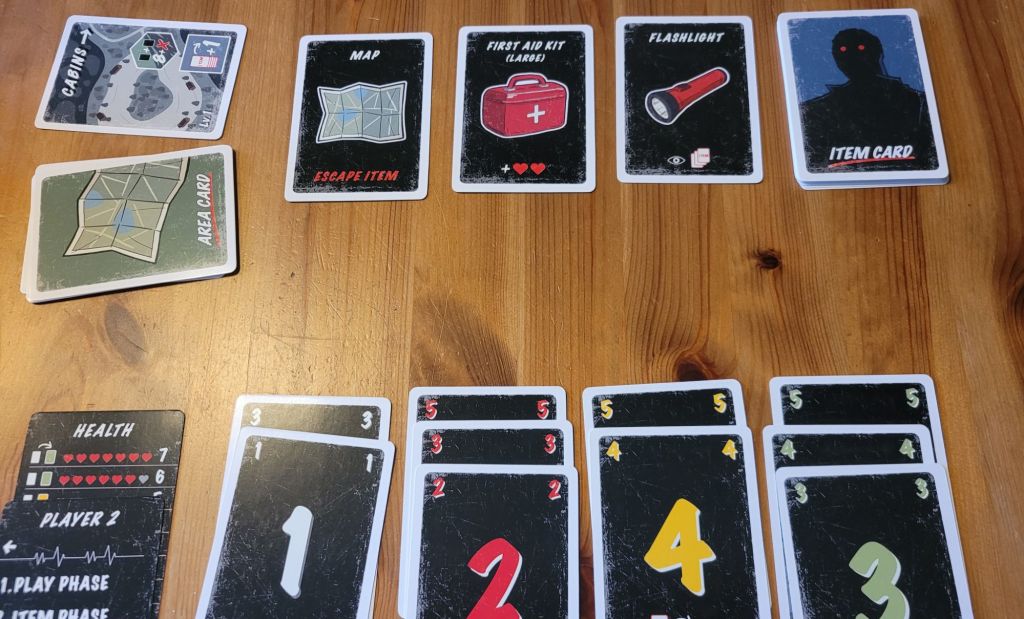
So far, so mechanical. But its inclusion of thematic references and the carefully curated visual style of the game manages to kick off players’ imagination. Designer and artist K. Takahashi eschews extensive details or long-winded narration to create The Slasher’s atmosphere. The places we flee to from round to round to avoid the killer are established in simple top view and given generic names: Fire Pit, Woodlands, Lodge, etc. That’s all it takes. If you’re passingly familiar with the slasher genre, you immediately recognize its archetypical elements and can vividly imagine them as you play. After each round we go through the deck of item cards, looking for objects that will help us survive or for items we need to escape the killer and win the game.
Here, too, the visuals are reduced to their most expressive essentials, which jump-starts our imagination instead of leaving it hanging. This is most apparent, when it is time to resolve the tricks we’ve won. The tactical give and take of tricks leads to the game’s intermittent highlights. The number of won, yellow cards tells us how many item cards to draw. But within that deck hides “The Killer”. A card that shows a blood-smeared hunting knife, held by a black-gloved fist ready brutally strike again. When that card is revealed, you can practically imagine the terrified shriek, the sudden blast of music and the dramatic close-up of the killer’s hand.
Each newly drawn card challenges fate to reveal the faceless, anonymous killer next. Snooty veteran gamers may take this opportunity to push up their glasses and mention something about “push-your-luck” mechanisms, but they are the kind of people who usually find a surprising, but no less excruciating end in these types of movies.
The Slasher is a game that can be tense and evoke a sense of fearful trepidation in players. This doesn’t happen despite, but because of its minimalist approach. The constraints placed on players mesh neatly with the visual style’s ambience. There aren’t many illustrations, but where they exist, they have a strong narrative impact. Our imagination is propelled forwards leading us to suspect the killer under each unrevealed card. A good game often resembles a good horror film: it’s the things we can’t quite see, that we find most compelling. The Slasher does just that.
 Lest My Opinions Go Unheard