
While AI Space Puzzle sounds both generic as well as desperately modern, it’s the name of an abstract cooperative deduction game. With rules that are commendably clear and simple. This allows the conclusions we draw during the game to not rely on nitpicking rules ambiguities. Instead we have to interpret a message consisting solely of tiles and symbols. This message is given to us by another player at the table taking the role of the titular AI. Whereas the rest of the players (the “astronauts”) are tasked with interpreting this message. We practice exegesis. A message laid out within specific constraints is interpreted and then translated into actions.
Said message consists of tiles with symbols. These symbols are the vocabulary the AI gets to use to communicate with the astronauts. The goal is to explain which character carrying which object should be placed on which part of the game board, in order to win the game (or one of its 45 missions).

As we play a dialogue emerges between AI (speaking in uncommented symbols) and the rest of the players, whose conversations and decisions show what – if anything – they have understood of the message. This is where the single rules ambiguity emerges, which may also have been intentional. Even though the group is not allowed to directly talk to the AI (to explain, for examples, which pieces of information should be included in the next message), you can’t prevent the AI player to listen in on the group’s deliberations. This in turn affects their decision-making.
By placing this small lever into the hands of the gaming group AI Space Puzzle becomes both a fragile but very interesting game. Because the game’s challenges collapses, when the group talks and interprets messages in such a way as to become clear requests made to the AI. In other words, if we ask the all-knowing entity what we should do next. But then you also talk and act differently, if you know that this all-knowing entity is paying close attention.
Playing AI Space Puzzle remotely might arguable the platonic ideal here. Sending phone pics while playing in different homes. This does away with the AI player’s need to don an inscrutable poker face. It also avoids the pitfall of players giving the AI player unintentional hints. This is undoubtedly the highest difficulty to play AI Space Puzzle on. But I’m not sure, it would make for a better game.
Because the most appealing thing about AI Space Puzzle is emergent player dynamics at the table. When bits and pieces of information get through, which isn’t inherent to the played tiles themselves. It’s the moments when AI Player and astronauts try to use the limited means of communication to understand each other. When you have to find a shared language in a few turns, while still following the rules of the game and mission.
It’s during these moments that AI Space Puzzle becomes something special. Even though its rules concepts and ideas are familiar, they come together to form a game with its own character. You could try to draw parallels to Codenames. But Codenames often relies on leaps of logic that needs players to know each other well. You could also look to Hanabi for comparison. In both games rules and components strictly limit what kind of words and ideas you’re allowed to communicate with.
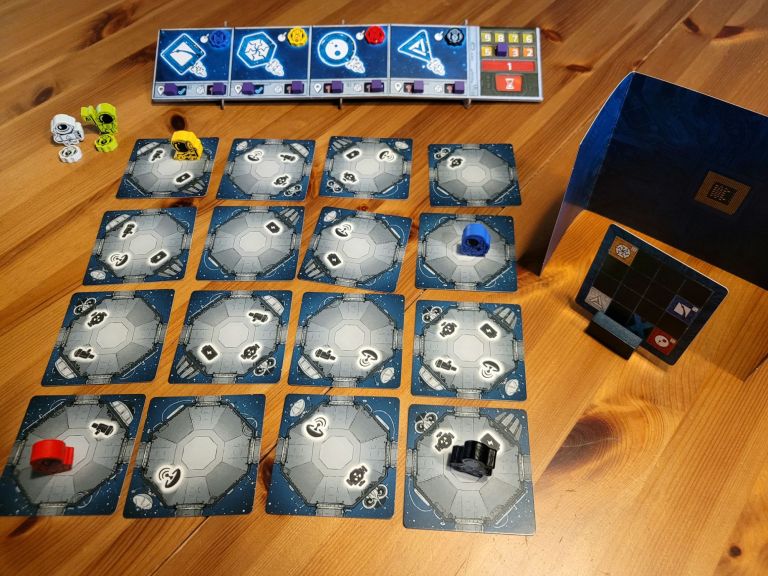
But AI Space Puzzle offers flexibility that the rules explicitly allow for. Aside from the symbols on the tiles themselves, the AI player may also arrange them cleverly to relay vital information to the astronauts. This lets the AI player make use of their own creativity and inventiveness to communicate with the other side. When the astronauts’ intuition helps them figure out that one clever clue the AI has placed, that’s when AI Space Puzzle really sings. These are the moments of success that feel particularly rewarding. Most of all, these are the moments when the game fully belongs to its players. The mission’s task fades into the background and all our attention and effort is focused on our interaction through the game. That’s what makes cooperative games stand out. And it’s also what makes games as a medium work: they’re tools and means with which we get to experience moments of community.
AI Space Puzzle is an unassuming game in many ways. Its components are perfectly acceptable, but if you’re used to the glitz and excess of other publishers, the cardboard console may feel cheap. Instead of a finely developed theme, the game’s narrative elements are solely a result of Tomasz Bolik’s art style. But the game’s rules design is robust enough, to still offer a captivating experience. AI Space Puzzle may get lost in the shuffle among other cooperative deduction releases this year. And that would be a shame.

