
The first half of the game’s title „The Fellowship of the Ring“ refers to the first volume of the book „The Lord of the Rings“. You may vaguely remember the films based on it, which are themselves already 20 years old. It’s obvious that time has passed, since the established illustrations by John Howe no longer serve as a guideline. Instead new artists are given the opportunity to interpret various characters from the book. The second half of the title (The Trick-taking Game) makes it clear that this is part of a fairly well-known card game genre. The hook of the game, which the title itself does not give away, is that it is a cooperative trick-taking game.
Cooperative? Trick-taking? There was another game like that. Correct! In 2020 The Crew was a cooperative trick-taking game, that won the Kennerspiel des Jahres award. This now is the elephant in the room. A comparison to The Crew is almost unavoidable. Particularly in a scene that likes to reduce games to their mechanisms, instead of comparing the experience they provide. It’s easy to render a quick and definitive judgement on this game.
The Fellowship of the Ring – The Trick-taking Game must clearly be a lazy cash grab. After all, there was been no other cooperative trick-taking game on the market before. (“Familiar’s Trouble/Trick’n’Trouble” would like a word.) Even if we look past the inherently absurd accusation of publishing a card game to make money; the question remains: do cooperative trick-taking games offer enough variance to be able to exist independently of The Crew?
It does apparently work in other genres. Not every roll’n’write game is a copy of Yahtzee. Not everybody who’s publishing a deckbuilding game is just stealing from Dominion.
In The Fellowship of the Ring – The Trick-taking Game you have to follow suit. It is a trick-taking game, after all. It becomes a cooperative game, because every player has an individual goal they all have to reach. Only when everyone succeeds, do you get to advance to the next chapter in the story. There you will meet new character and with them new goals. The more details of the game you take into account, the more obvious it becomes that the experience isn’t built on that of other trick-taking games.
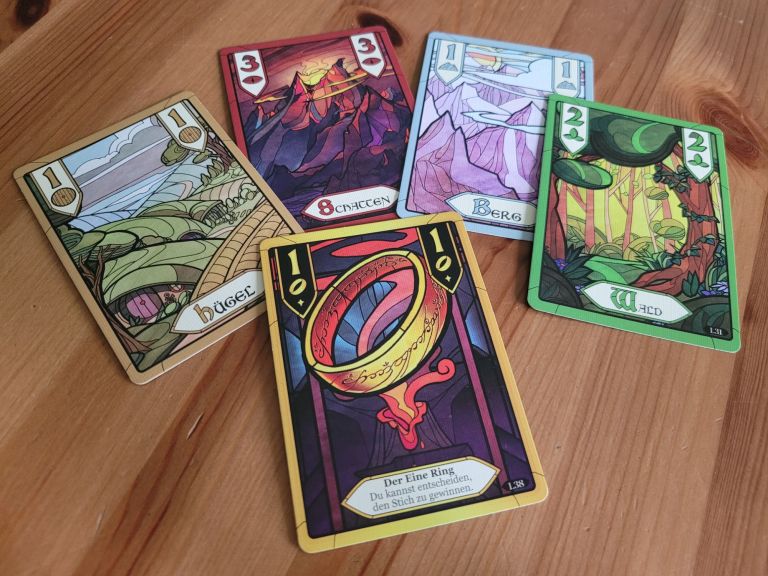
Goals are often tied to characters, chosen at the start of the game. The literal (or in a pinch cinematic) background of the game doesn’t simply pad out the deduction mechanisms of trick-taking games. It’s the thing that gives The Fellowship of the Ring – The Trick-taking Game an identity of its own. Trick-taking is simply the foundation of the (ideally familiar) story, we get to to play in short, selected excerpts. The game’s center shifts away from the mechanisms and towards its theme or story. This changes the experience, the “feel” of the game. We unlock the story chapter by chapter. To do so, we make use of trick-taking mechanisms.
Thanks to the references to names and scenes from The Lord of the Rings the game manages to detach itself from being welded to being a trick-taking game. Characters and moments from the history of Middle-Earth aren’t invoked by playing cards, gauging your hand or helping somebody else win a trick. It’s the goals manifested as characters and our success or failure in reaching them that create images in our minds. Our knowledge of The Lord of the Rings does the creative work of turning our goals into vivid mental pictures of the story.
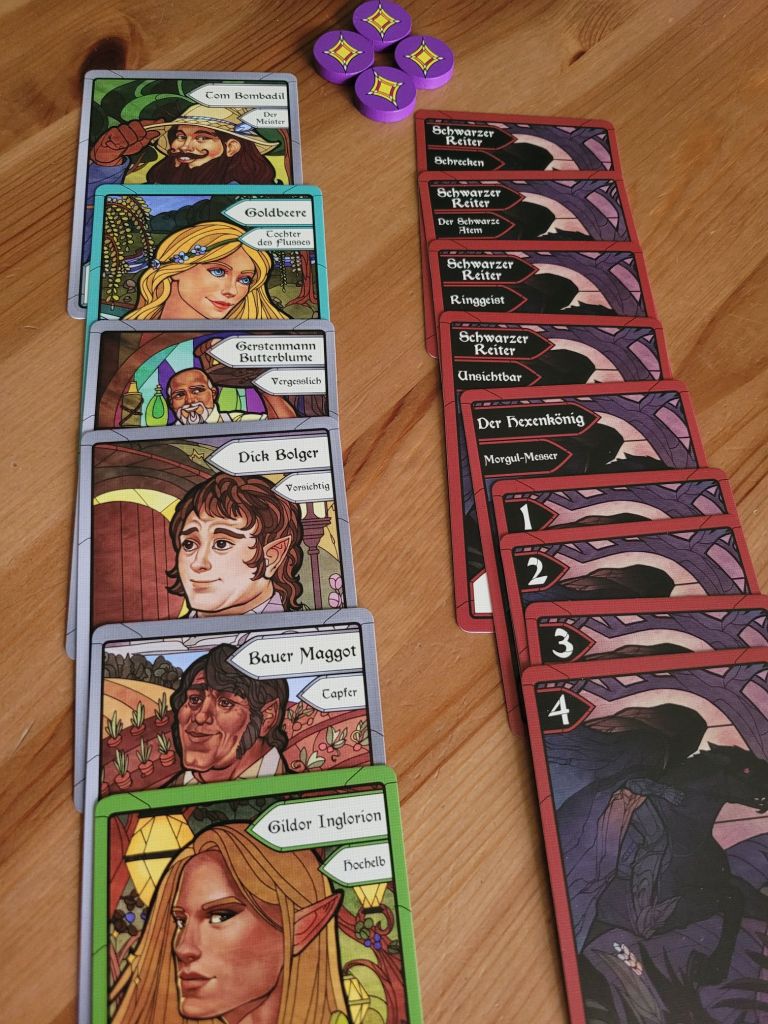
Like when Goldberry has to draw everyone’s attention to her three times in a row, or when Glorfindel saves some of the hobbits from the Nazgûl, only to the return to protect the rest of the fellowship from the shadows. We are offered these images, which rely on us playing our hand of cards just right, to become part of the story we go through together.
The gap between theme and mechanisms is often criticised, because of the fallacy that a “thematic” games needs to depict its theme through its rules. The approach is appealing, because it unburdens players’ creativity, so that they can fully concentrate on the mechanical challenge of the game. This is similar to how films unburden a reader’s imagination, so that they can fully concentrate on the plot.

The Fellowship of the Ring – The Trick-taking Game fits neatly into the group of licensed products that exist around Tolkien’s The Lord of the Rings. It uses short glimpses and moments to retrace the first volume’s narrative, with the help of the not quite unfamiliar mode of a cooperative trick-taking game.
Its presentation is colorful and atmospheric. The game’s challenge is finely tuned so that success and failure balance out nicely. This means you’re continuously motivated to start another round. The story, from which the game takes its title, forms the game’s center of gravity. It pulls all our actions in to give it an engaging and entertaining shape. Among trick-taking games this is definitely a mark of distinction.

