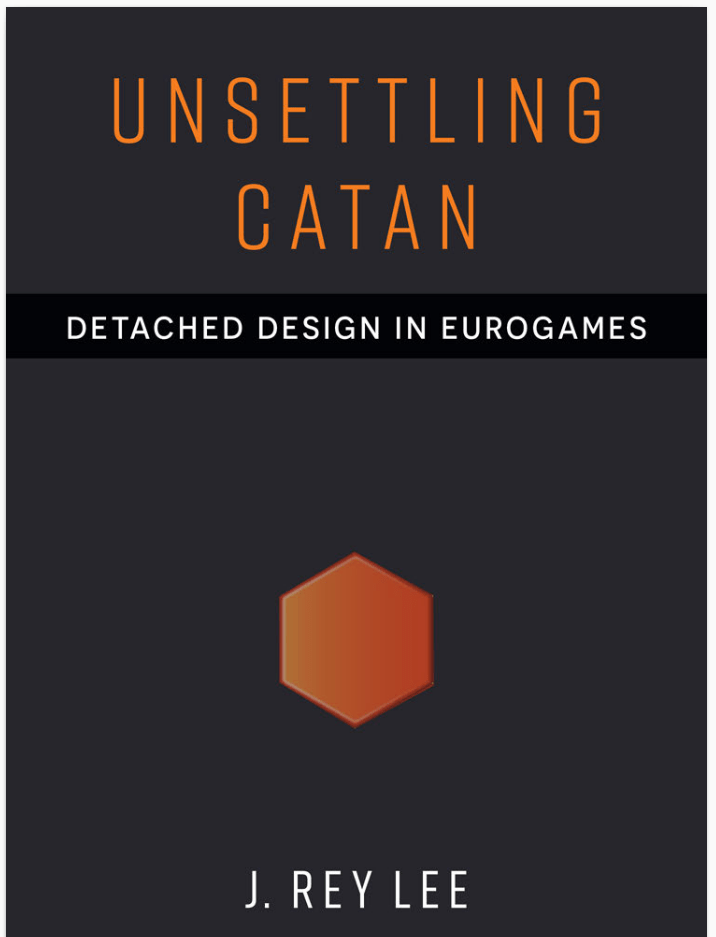
There are more than a few books about Catan out there. You can even find a couple of novels in the endless catalogue of ISBN lists. But in “Unsettling Catan” author J. Rey Lee doesn’t simply retrace his personal journey into the many-coloured world of modern board games. He also doesn’t give us a history of Catan’s development and success story, which – as some would argue – was the launch of the eurogame genre.
Instead Unsettling Catan looks at the game (and eurogames in general) from a media analytical perspective. It’s the first book in a series, that seeks to treat games not as the object of some other discipline in the humanities or social sciences (like history, pedagogy, etc). Instead the Tabletop Games Series treats board games as their own medium, with their own analytical models and arguments.
This book undoubtedly succeeds in this, making it worth a read for anyone who is interested in board games beyond their ability to be fun. One thing that‘s apparent right away is that there is an understanding at work here, which many similar texts seem to miss. Too often, it seems as if any attempt to talk seriously about board games first needs to address how “it’s not just a game”, before getting to the heart of the actual argument. As if every essay and paper first needs to justify why board games should be talked about as a cultural object (or as I would say a medium for cultural practice).
Catan, of course, offers a comparably large number of articles and essays written about it, which makes any such justification seem redundant. Fittingly, author J. Rey Lee starts off introducing new terms early on, which have a tangible relevance to games and play. These terms aren’t created ex nihilo, but in their explanations Lee finds meaningful uses for talking about board games.
At first, the distinction between the level of the game (“gameworld”) and the level of the players (“frameworld”) seems trivial, but as the text goes on its importance becomes more and more apparent. The first important connection between the two layers is how deeply interwoven they are. They function and exist in tandem. It’s their interconnectedness that turns making decisions and following rules into a shared experience.
It is the frameworld, the real-life context that exists around the board, which adds value and meaning to the game. At the same time, the gameworld is only important to us, because of what we’ve added to it in the frameworld. This idea, which I consider fundamental to understanding games, is unfortunately not followed through in a later chapter. (I will get back to this a little later.)
Two other important terms are “glimpse” and “glance”. Due to their closeness in sound and concept, they unfortunately run the risk of slipping into seeming overtly abstract and flimsy. Even though the ideas expressed in them are valuable.
A glimpse describes the individual details of the gameworld, that illustrations (but also components, game terms, etc.) offer us. Whereas the glance refers to our perception of the real-life situation we’re playing in. Who we are playing with, where we are playing, etc. shapes our experience, and we observe those as well during play.
A glimpse may be an illustration of a knight on a card. This might jump-start our imagination to expand this image with indirect or implied ideas. The knight doesn’t exist on his own in our imagination. Instead he may be seated on a horse, have squires following him or be on patrol around the city walls, etc. Whatever it is that we associate with this individual image, we are now going to add to our understanding of the gameworld. This is how we use individual visual impulses, glimpses, to derive a larger, more rounded gameworld as a direct function of our own imagination and knowledge. In these moments it is irrelevant, if our knowledge is superficial, build on pop culture tropes and of questionable veracity, or if it is profound, based on reputable sources and shaped by the current academic discourse.
The quality of our knowledge about the elements within the gameworld have no bearing on whether our imagination is triggered by the game’s glimpses. Most of all – and this is a point that the explanation of glimpses only manage to imply – these additions aren’t contained within the glimpses themselves. They are additions we make to the gameworld.
If our personal associations exist without contradiction to other facets of either gameworld or frameworld, we think of the experience as thematic. Lee describes these moments as having resonance. In particular, he mentions “ideological resonance”, when the processes and goals of the gameworld align with the players’ values in the frameworld.
[Edit:] Our experiences at the gaming table validate these observations. We are given glimpses that reasonate, and
It’s through these moments, that we soon get the impression, that we are not actively involved in creating the gameworld. That we are instead letting our imagination execute the instructions of the designer. From the image of a knight it “must follow”, that the gameworld must contain all the other elements, we immediately think of, when we see the image of a knight.
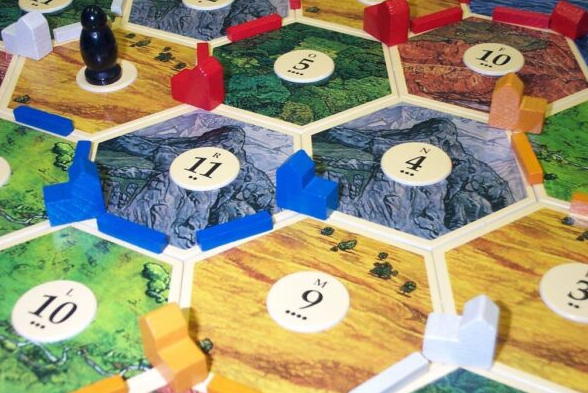
We believe that we are re-constructing a gameworld, that has an original state in how the game’s creators have imagined it. That there is an Ur-gameworld, which had to be broken down into abstractions and simplifications, in order to fit the medium of board games. As that medium only allows to depict a gameworld through glimpses. And it is those glimpses through which players are asked to re-construct the gameworld as it was originally intended.
But there are two moments in the book in which Lee’s arguments, perhaps unintentionally, don’t align with this belief. On one hand, there is reference to Teuber’s own words about Catan. According to his own design goals, Catan was supposed to create a pleasant, cosy feeling in its players. You were not supposed to think of violently fought conflicts, nor of the exploitation of natural resources, nor of the displacement of any indigenous people of Catan. So no such glimpses were developed to invoke these ideas. Catan’s gameworld didn’t exist first and was then translated into the game’s structure to be communicated through its glimpses. In fact, the impact on players was set first, and the corresponding glimpses were then developed to eventually create a more-or-less coherent image of Catan. There is no explanation given in the gameworld as to why Catan is uninhabited. Because the reason lies in the intended experience of playing Catan.
Another point in which Lee indirectly questions the idea of gameworld reconstruction is buried in a footnote. There, he notes that the perspective on the game and its gameworld expressed in his text is due to his own cultural background. He can only look at the game as a US-American and can’t adopt the cultural identity of another person, to access the game and extrapolate its gameworld.
This is an argument, which I consider foundational to understanding the way board games function. The cultural context in which every one of us exists, shapes our imagination. Which means, that the same board game will lead to different gameworlds, if the cultural background of its players differs significantly. This becomes most apparent – particularly to a German readership – when it comes to the chapter that addresses the colonialism narrative in Catan.
Here, Lee argues in a believable and conclusive manner how in the playthroughs he has observed, the various elements in Catan produced parallels and similarities to colonialist thinking and rhetoric. But it is the (not repeated again) premise, that Catan is placed and played in a US-American context, which is the reason why these explanations might garner disagreement from readers in Germany.
Because the gameworld constructed by German players has a different ambience, tonality and development to the one in the book. Lee rightfully rejects any claims of universality here, and emphasises his interest in the questions raised, when this perspective is adopted.
Considering the cultural context that the game is played in (or “frameworld” to use Lee’s terminology), I think the questions he arrives at are plausible, which makes them legitimate. Although I would add, that a historical reading of Catan and its impact, must look at the game in the cultural context of Germany in the 90s.
That said, my personal interest in this topic shouldn’t be seen as the book devoting a lot of chapters to it. But at least, Lee’s goal that the book would lead to discussion certainly worked with me.
There are far more important concepts in Unsettling Catan, such as “detached design” and the idea of “unsettling”. The former is used to describe a way of understanding board games, and by extension a way of playing and designing them. One in which there is a conscious and intended distance between the gameworld and its players. The goal being to minimize any negative associations, as well as negative feelings during play. This approach actually goes beyond merely constructing a cosy and pleasant gameworld. Detached designs also includes turning away from direct conflict at the table, as Klaus Teuber already expressed in his thoughts on Catan. It’s an approach that looks at indirect competition and the idea that personal achievements during the game can be a sufficiently satisfying alternative to not winning the game.
This emotional cushion of positive feelings may have contributed to making Catan (and the many games that followed Teuber’s example) more approachable, and thus more successful. But Lee notes that this cushion can also be deceptive. Highly competitive play is still a possibility in detached design. Highly ambitious playthroughs can still create tension, frustration, schadenfreude and make players want to marginalise their opponents. Emotional distance does little to mitigate that. In fact, it mostly leads to concealing and downplaying what players actually feel. It’s no coincidence that eurogames are often said to center passive-aggressiveness in their designs.
Even more than this emotional masking, detached designs lead players to not question their gameworld or look at design decisions from a critical perspective. At least one that goes beyond questions of balancing and the size of the game’s decision space. Lee’s criticism is that this detachment has led to boardgames stagnating as cultural objects or in fact as an art form.
The idea that a game could pose a question through its gameworld, seems to only slowly get back in fashion. Even the thought that players should critically reflect on their actions, and not simply legitimize them by how they generate victory points more efficiently, is only slowly re-entering our conversation about board games. As pleasant and inviting these games, that grew up in Catan’s shadow, may have been, they also had the unintended side effect of making us look at board games as a form of entertainment without any rough edges. As detached design rose to prominence our perspective on games narrowed, until the only question we could easily ask was whether we felt good playing the game, and if our decisions had been fun.
To that end, Lee encourages us to challenge entrenched patterns of thinking about games, and habitual approaches to play. The word “unsettling” in the book’s title isn’t just a play on Catan’s original name. It is also an encouragement to not settle for the familiar cosiness of eurogames. From unpleasant emotions at the gaming table, to uncomfortable settings of games up to the uncritical complicity, when we construct the gameworld at our table. “Unsettling Catan” is supposed to be an impulse to see the medium in its full breadth. This alone makes the book worth a read.
Publisher: University of Michigan Press
Author: J. Rey Lee
Language: English
Pages: 218
Released: November 2025


Hi Georgios, thanks for this thoughtful response to my book!
I love that you emphasized the footnote on my perspective being culturally relative and now I’m wishing I’d put that somewhere more visible. I was very much hoping to hear some non-US perspectives and I’m glad that you’re with me in resisting universalities and opening up space for more diverse perspectives on the topic.
I also like how you use this point to undermine the notion of authorial intent, but if I had to quibble I’d say that I never thought of the glimpse as an invitation to “execute the instructions of the designer” in the first place. I tend not to be too invested in authorial intent for any artform, but I think it’s often even more tenuous for boardgames, which ask players to do a lot of heavy lifting in co-creating the world.
This is partially because game designers often don’t micromanage artistic decisions, but the deeper issue is that the inherently fragmentary nature of the glimpse requires players to creatively piece together fragments to imagine a coherent world. So, I’d say that players always actively co-create gameworlds and that glimpses often function more like open-ended prompts than rigid instructions.
Anyways, I’m delighted you took the time to engage with and respond to my writing instead of merely summarizing or reviewing it. This is exactly what I hoped to see, and it makes all the time I put into this worth it!
J.
LikeLiked by 1 person
I have a dozen more threads I’d like to follow up on, but I need more people to read the book first. 😉
As for your quibble, I agree with you. I didn’t mean to suggest that “executing the instructions of the designer” was your stance, but one common belief I’ve seen players, critics and some designers make. I think I should have made that change in my perspective clearer in the text.
LikeLiked by 1 person
Got it, thanks for clarifying! I look forward to hearing more of your thoughts!
J.
LikeLike