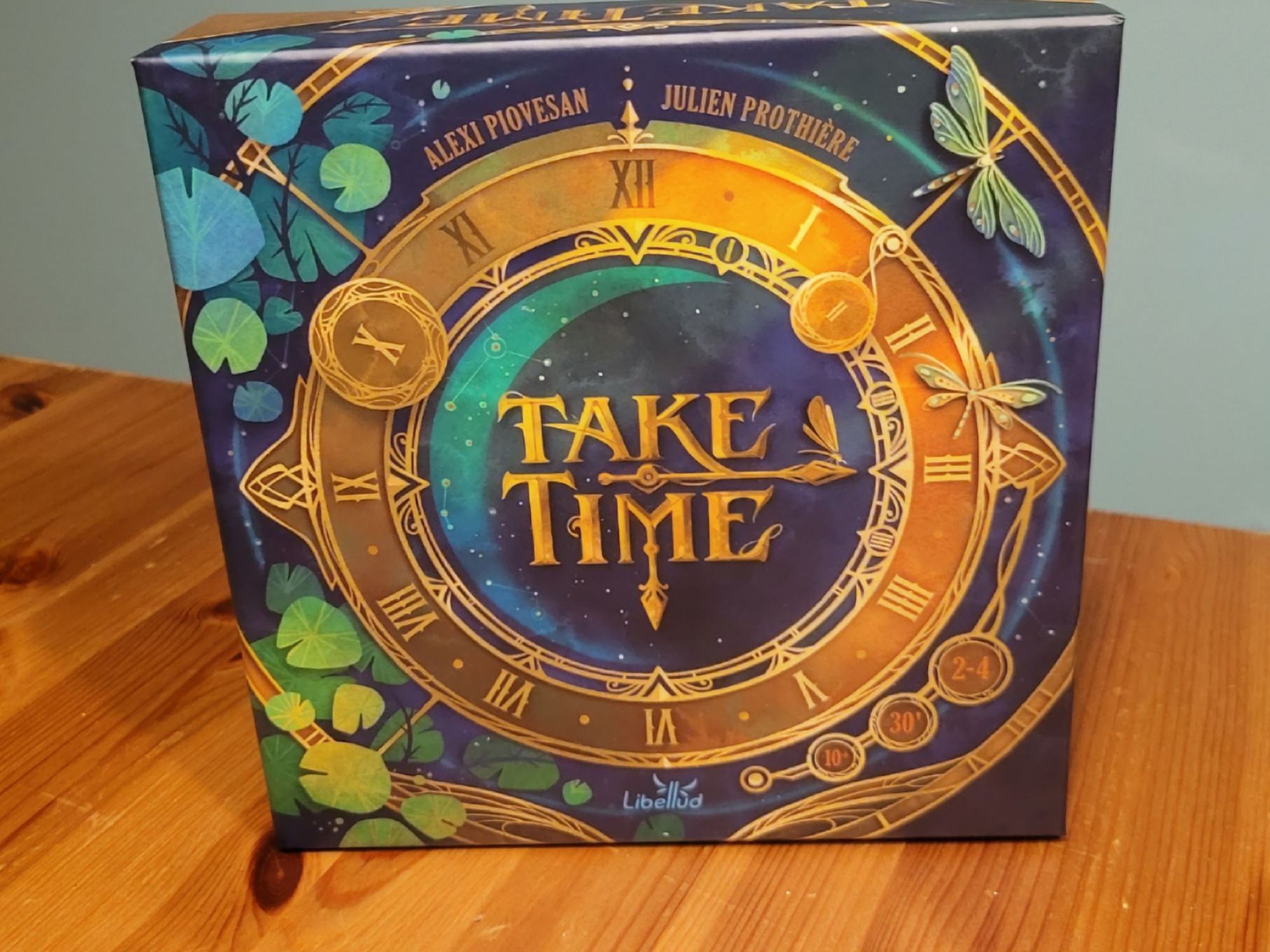
Cooperative card games haven’t been a niche genre in board gaming for quite some time now. Accordingly, people are unlikely to have their flabbers gasted, were you to introduce Take That as a card game in which we play together, as opposed to against each other. The cooperative connoisseurs among the gaming public, though, might have heard of co-designer Julien Prothière. The man responsible for such ambitious designs as Kreus, Precognition and Romeo & Juliet. The latter of which might still be remembered as a cleverly challenging design, that demanded quite a lot of player ingenuity to manage a win.
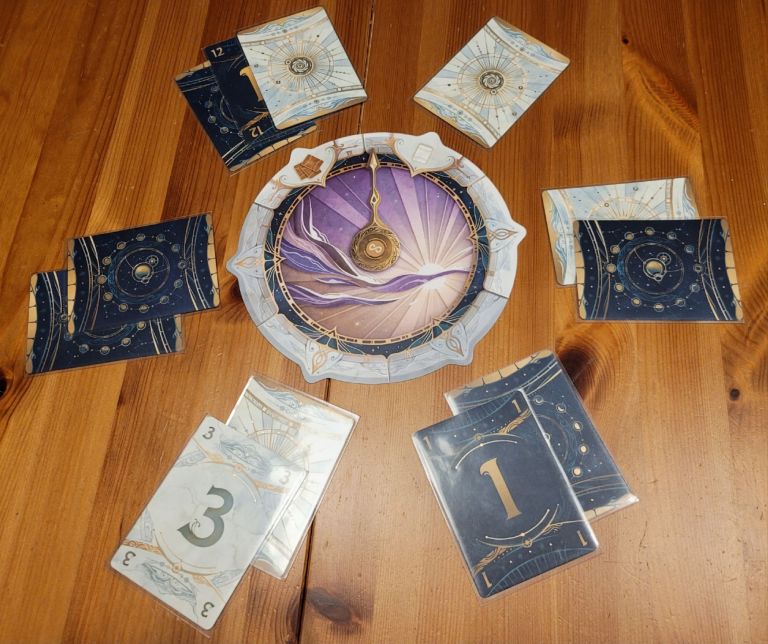
Take Time also has a few challenges up its sleeves, that will likely test a gaming group’s skills. Yet, the game’s core idea is surprisingly quick to explain and easy to grasp. In turn order we play cards face down around a circular game board (called “clock”). At the end of a round, these cards need to fulfil certain conditions, in order for us to win. During card play, we’re not allowed to talk to each other, so we have to carefully deduce or simply speculate, to place our own cards effectively.
What makes Take Time stand out aren’t necessarily the tasks themselves, or their variations carried through 40 distinct “clocks”. The more you play of them, the more you appreciate the creativity designers Alexi Piovesan and Julien Prothière put into them. But they shape the experience less than one would expect.
Take Time’s major twist is the strategic discussion, players engage in before they get to look at their hand of cards. This is where personalities, habits and tactical focus of players reveal themselves. They are the elements that set up the frame through which we will experience the game. From the micromanager qua alpha gamer, to the anxious “but-what-if”-worrier to the overconfident gambler, who trusts in his ability to immediately peg what somebody else has put down. The group comes up with a battle plan, that is as specific or as vague, as it matches the personalities around the table.
Despite all the fictions we come up with about how valuable and important winning is, playing cooperatively centres the people sitting together around the table. At the end of the day it’s about being your true self and having others see you. That’s what happens here, in an unexpected but very effective way. Our working together relies – as it does in many cooperative games – on being in dialogue with each other. Our success or failure is simply the pretence we need, to make cooperation necessary.
Our pre-play agreements become emergent rules that we apply to the current game. Importantly, we come up with them ourselves. With one eye on the clock’s constraints, we start reasoning with each other to make sure we’ll be able to reach our goal. Granted, a lot of cooperative games can be described this way. But Take That manages to get there with only a few, easily learned rules. It also has no need for explicit thematic markers to get its point across.
With the exception of calling the game boards clocks, Take Time has no strong thematic references. Still, the visual presentation of the game, courtesy of Maud Chalmel, should not go unmentioned. The elegantly curved flourishes on the cards, the golden lines and the subtle, gradient colours on the game board give Take Time a sense of distinguished elegance. It’s a game you can imagine playing with a quality red wine on the table, as opposed to a some half-empty beer cans and a salty bowl of dried out peanuts. Its presentation suggests an intellectual challenge, that requires both logic and empathy to solve. The game’s visuals add to an ambience that makes playe feel substantial, despite its core task being so easy to communicate. Take Time may just be a card game, but it is also a heady challenge. One in which bouts of silence speak volumes. Every player’s moment of hesitation when placing a card invites others to draw Holmesian-style deductions. Take Time is worth getting to the table simply for making you feel like you’re pushing your brain into its highest gear.
 Lest My Opinions Go Unheard