Gimmicks have a bad reputation among gamers. It’s considered a useless and wasteful addition, that’s supposed to distract from the game’s shortcomings. A gimmick is supposed to fool you. That’s the generally accepted wisdom. But a gimmick actually just has the purpose of drawing your attention and inviting your curiosity. In the best case scenario, they even elicit a sense of excitement.
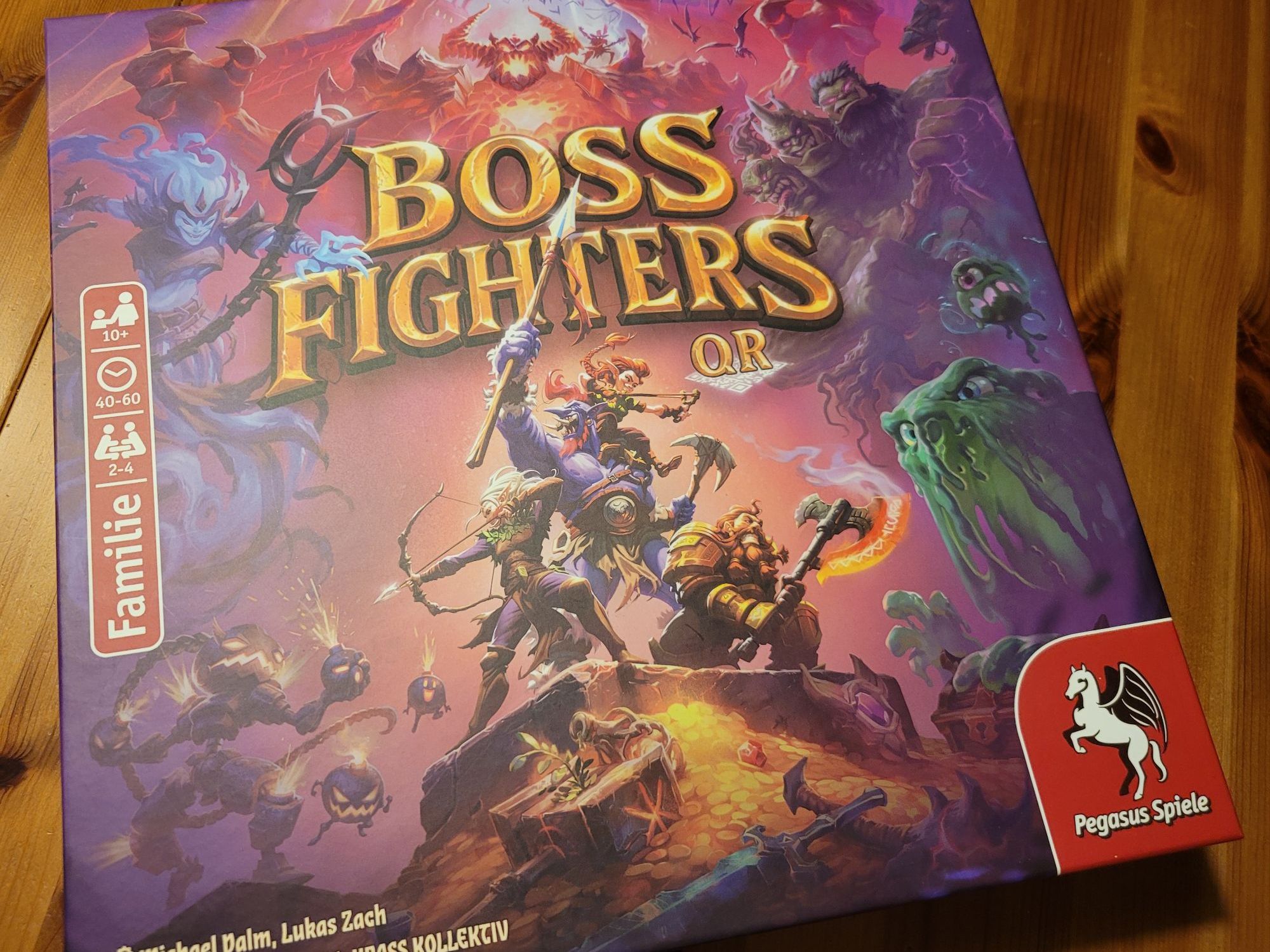
Boss Fighters QR is a game with such a gimmick. It incorporates a digital app which fulfils the role of a share game board. At its core Boss Fighters QR is a card game. Unlike other card games, though, you’re not focussed on your own hand of cards, but on the character values on the app.
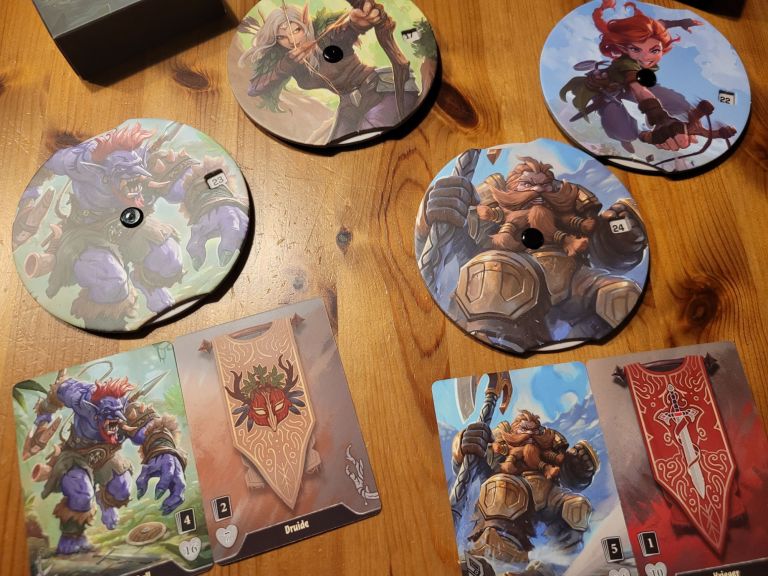
As the name suggests, in Boss Fighters QR you’re fighting bosses using QR codes. Up to four players get their individual card deck, consisting of character cards (troll, dwarf, elf, halfling) and role cards (fighter, magician, druid, rogue). Since all the cards are (at least in name) fundamentally different, everyone plays with similar but not identical cards.
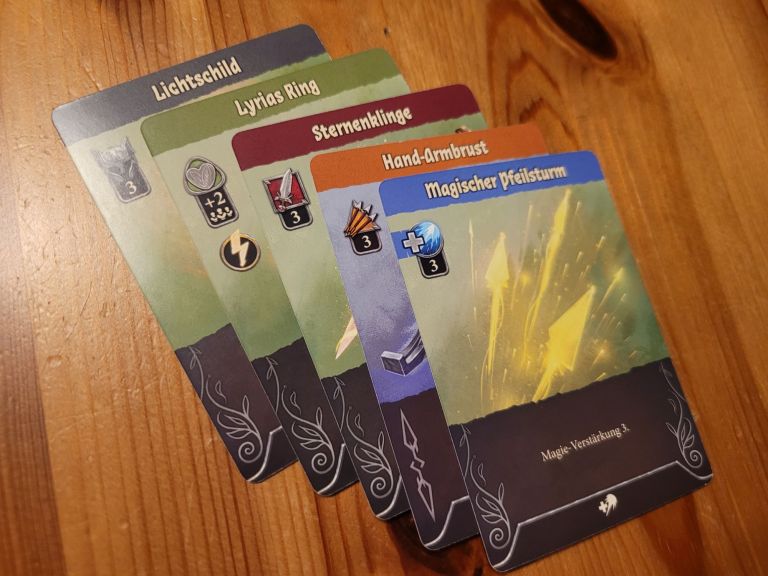
Among them are attack cards (ranged, melee and magic), defence cards as well as healing cards. If you’ve never player a fantasy role-pplaying game in your life, this variance might seem overwhelming. If you’ve played a Legend of Zelda game or Dungeons & Dragons before, you may be asking yourself, why I don’t also mention the pope’s religious affiliation while I’m at it. Three times a round we play such a card to hurt the boss, to defend ourselves or to regain lost health. Individual special abilities allow for card draws, additional card plays and other effects. This may sound a little convoluted, but in practice it just means this: pick a card from your hand based on the effect on it, scan the back of the card into the app and let the app execute the effect you’ve chosen.
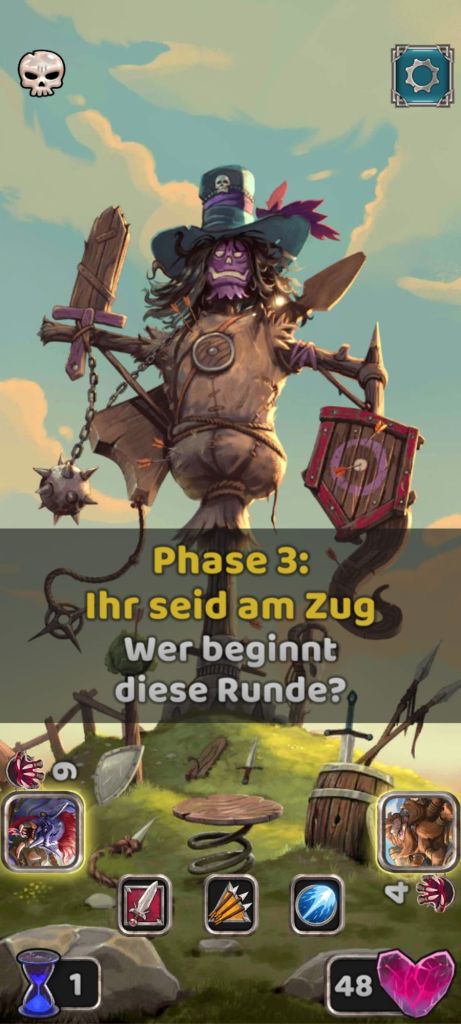
This is potentially very exciting, as the consequences of the card effect could be all kinds of things. After all, you can’t really tell what kind of calculations the app is running behind the screen. And it is this potential that a lot of the excitement of this game hinges on. The fact that you imagine what could possibly happen next, feeds our motivation to keep moving forward to fight the next boss.
Neither Boss Fighters QR, nor legacy games in general, are unique in this. The typical golden age detective novel thrives in the minds of its readers. As they read through the story, they speculate, suspect and theorise who the culprit may be. They keep different possible possible chains of events in mind, and enjoy every new piece of information that forces them to revise their original theory.
A similar dynamic can happen with groups playing Boss Fighters QR. You come up with theories what the new boss will bring to the table and how the fight against them will develop. Will we have to channel our attacks, or spread them out? Should we focus on defensive, offensive or support cards? These kinds of discussions only happen sporadically at first, and more of a side attraction. Only about halfway through the list of bosses, does the group rely on coordinating their card plays. It’s somewhat late when Boss Fighters QR opens itself up, in the sense that it becomes more challenging and complex. Not just because the bosses’ point values increase. But because the game introduces rules and more complex reactions from the bosses. This can be a source of excitement.
It just needs the unspoken assumption that surprising twists are going to come. It needs players to have faith in the game creators, that behind the colourful illustration and the numbers on the screen, there is more going on than is visible at first glance. A non-trivial part of the game’s enjoyment hinges on player faith.
If you’re a little more cynical about technology in a game, you will find yourself far less enthused about interacting with the app. Because we objectively do little more than scanning items at a supermarket self-checkout. Pick an effect, scan the card, the number on the screen changes. The banality of what we do shouldn’t distract from how smooth it is handled. After all we might have had to move a token on a track instead, to record the card’s effect. It’s hard to find the right words to express what this adds to the game’s overall flow. It’s much easier to express that scanning a card doesn’t match the tactility of moving your player piece, placing thick tokens or rolling some chunky dice. It’s functional but compared to other games of this type, it’s also quite sterile. The app removes an aura of playfulness from the game’s components.
What the app actually adds to the experience, can really only be measured in all the things players don’t have to do because of it. The app takes on the job of making sure that a round adheres to the rules as written. Players now also no longer need to track their enemy’s health, or how the boss will choose to attack them. The damage player characters receive from a boss attack still has to be adjusted on the character health tracker wheel by hand. The technology to record health points of player-controlled characters numerically is probably still decades away.
The app is a time-saves. That much is obvious. But the missing card decks, tokens and dice you’ll only notice, if you you that they should be there. Or at least, when you’re relieved that they’re not required. So when you would compare it to a game like Slay the Spire, or Too Many Bones, the small pile of components and the easy-to-read game state stands out. But that’s the kind of comparison the target group for Boss Fighters QR is unlikely to draw. The absences of complications just isn’t the same as overcoming those complications. If it were, the absence of bosses in the app would already register as a rousing success for the group, without having to play a single card.
What an app like this one can offer is secrets, tricks and surprises. It can offer situations or bosses, that run counter to our expectations. But for that to happen, we need to build up expectations first. We must be able to identify established patterns, that a later boss doesn’t follow. Even then we need these patterns to be implied, and our understanding of them only indirectly validated. To pick up on the detective novel again: a theory as to who the culprit is only remains interesting when the novel seems to indirectly confirm. Once the resolution arrives, the joy of developing your own theories evaporates.
Tragically, Boss Fighters QR is anything but guarded about this information. After the first fight with a boss all their attack patterns, damage types and reactions can be read up on. This is sure to quell any sense of frustration, but it also undoes whatever value the app gets to add to the game.
You’re left with the joy of using an app to play a card game. That in itself is fun. The success of millions of app games is proof of it. The game that exists surrounding this app is perfectly adequate in every area. Combining card effects is simple and functional. Coordinating your card plays with other players really only becomes a must in the second half of the campaign, but at least this turns the non-competitive Boss Fighters QR into a cooperative game.
Still it feels like this game falls short of its potential. Combining cards and apps can be done more creatively as Unlock has shown. Fighting against app-controlled enemies can include more twists and surprises as Descent Legends of the Dark has shown. And duelling bosses can be tense and tactical even without a digital companion as Regicide has shown us.
Boss Fighters QR is a game that thrives due to its gimmick and the hopes players put into it. It’s oddly reminiscent of the “mystery box storytelling” that TV shows like Lost were famous for. As long as you can still guess and speculate what might be coming, each round and each new boss is a tense experience. Whether what the app actually delivers will excite or disillusion players, is probably a question of faith.

