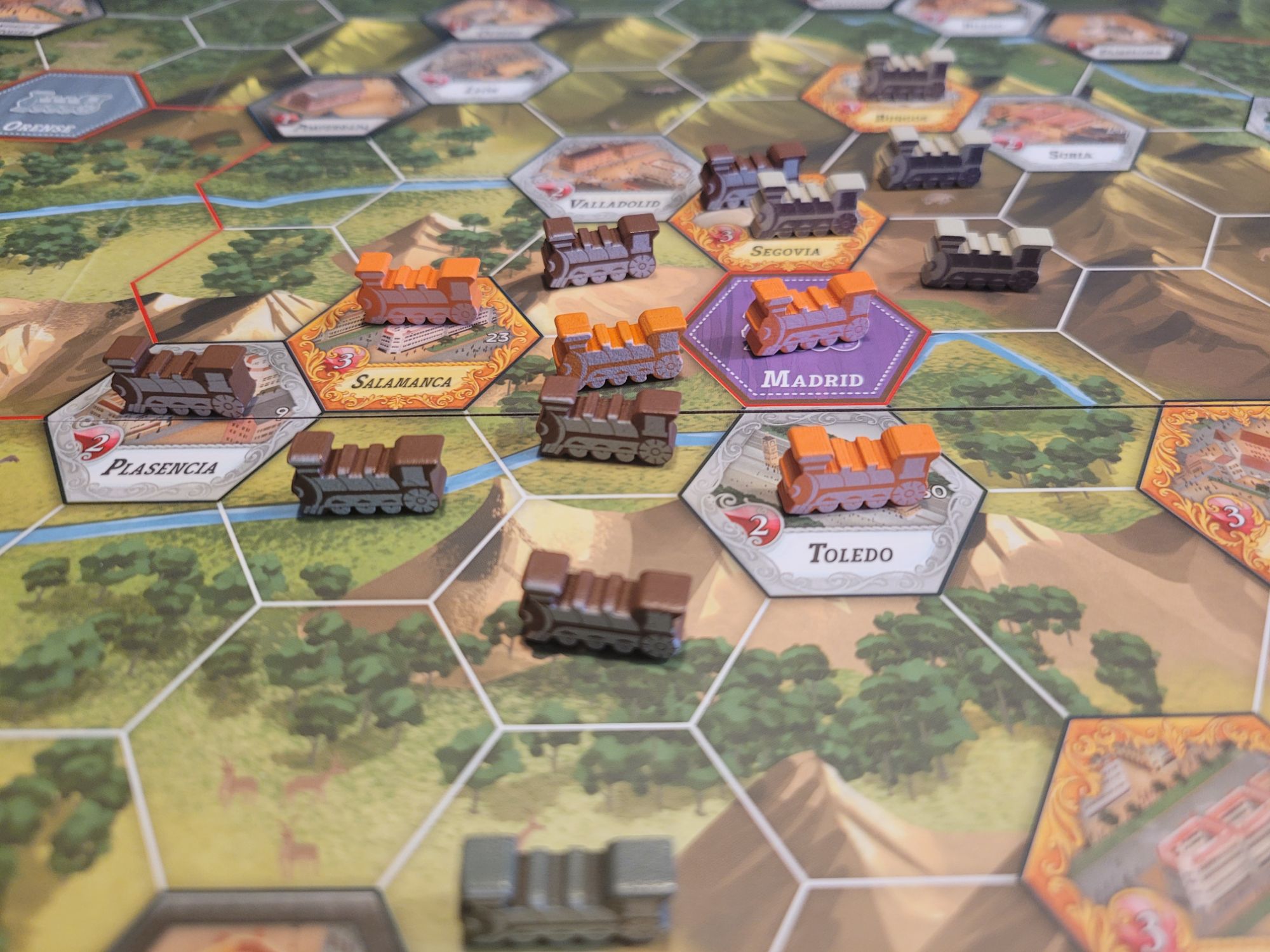
There are games in which time is a resource. You choose an action and have to move your player piece along a time track. It’s only when every other player has caught up to you, that you get to have another turn. It’s an easy-to-grasp mechanism, because it’s so true to life. You have to wait until others have finished their tasks, before you get to do something again.
It’s not fully recorded what inspired designers to come up with this mechanism. I’d posit the theory that it’s the experience of trying to schedule a game night. The further you move from the youthful years of having no personal responsibilities and take steps towards an increasing number of familial, social and work obligations – commonly euphemised as “growing up” – time becomes an increasingly inflexible resource.
Getting access to new board games used to be the biggest hurdle at the beginning of your board gaming journey. Now, you might realise that your own rigid weekly schedule has become the final boss in getting to play board games again. But the human need to play is quite adaptable. Most of us find a way to engage in play in some form. It doesn’t always have to be board games at full player count. Games that work well with only two or three players, already make scheduling so much easier. Finding just one or two more players – maybe even from your own household – is far easier to accomplish than trying to get four or five more people (from just as many households) together at the same time.
If you’re looking at this through the lens of market economics, you’ll quickly recognise a situation in which a demand has found a number of ways to be satisfied. A growing number of ageing players are looking for games they will “actually get to the table”. (The dream that one day our non-gaming obligations would become fewer, and allow us more time to simply play has become blatantly unrealistic for both our generation and those to come.)
So far, so obvious. What’s less obvious is the concurrent demand for games that not only allow for repeated, in-depth play; but seemingly require it, too. A high level of variability and a high level of replayability has become something like a mantra when evaluating new games. If you’ve “seen all it has to offer” after only a few plays, even the most enthusiastic praise will be presented with an asterisk. The inner circle of board game enthusiasts in particular value games that have something new to offer them even twenty-three plays in.
On the one hand games should work even with the smallest amount of players, to make scheduling easier. On the other, games should keep offering new surprises over multiple game nights. The overlap between the groups demanding these things, might be described as the hard core, or the epicentre of the modern board game scene. Small groups, who play the same game intensively and repeatedly until they’ve managed to squeeze out the last drop of gameplay potential from it.
This group is – by definition – not a big segment of the modern gaming scene. Most of the people who play games would identify as occasional gamers or even social gamers, i.e. people who don’t object to joining a game, but don’t seek out games themselves. The modern scene is primarily comprised of “casual players” and not a small number of habitual gamers.
(card taken from Judge Dredd – The Cursed Earth)
Yet they are the ones, whose criticism seems ever-present in online discourse, even without being spoken out loud. They are the ones whose preferences so many critics feel duty-bound to consider, when talking about games. They’re the ones whose demands and playstyles are used as a measure when reviewing board games.
As a consequence, their playstyles are treated as the norm of modern board gaming. This doesn’t simply change how the gaming scene sees itself. It also directly influences if and how we individually identify with modern gaming. Are we still part of the scene, if we don’t play individual games at least xy times? Are we still part of the gaming scene, if our game nights are more than a couple of weeks apart? Basically, did we grow out of board gaming, because family and work has fragmented what time we’ve put aside for playing games?
Trying to find an answer to this question already assumes, that such a question is legitimate. But it isn’t. Neither the frequency of our game nights, nor the time we dedicate to a single game makes a board gamer. Just as the number of books you’ve read or their page count doesn’t determine, if you’re a book reader.
Playing board games is an activity. The amount and length of which is mostly determined by external factors. When and where you get to play games, is something most people don’t get to decide freely. What matters is the value we attribute to playing games. If you don’t think of games as inherently trivial and inconsequential, you at least share the attitude that defines board games. This seems to be the actual hard core of it all.

