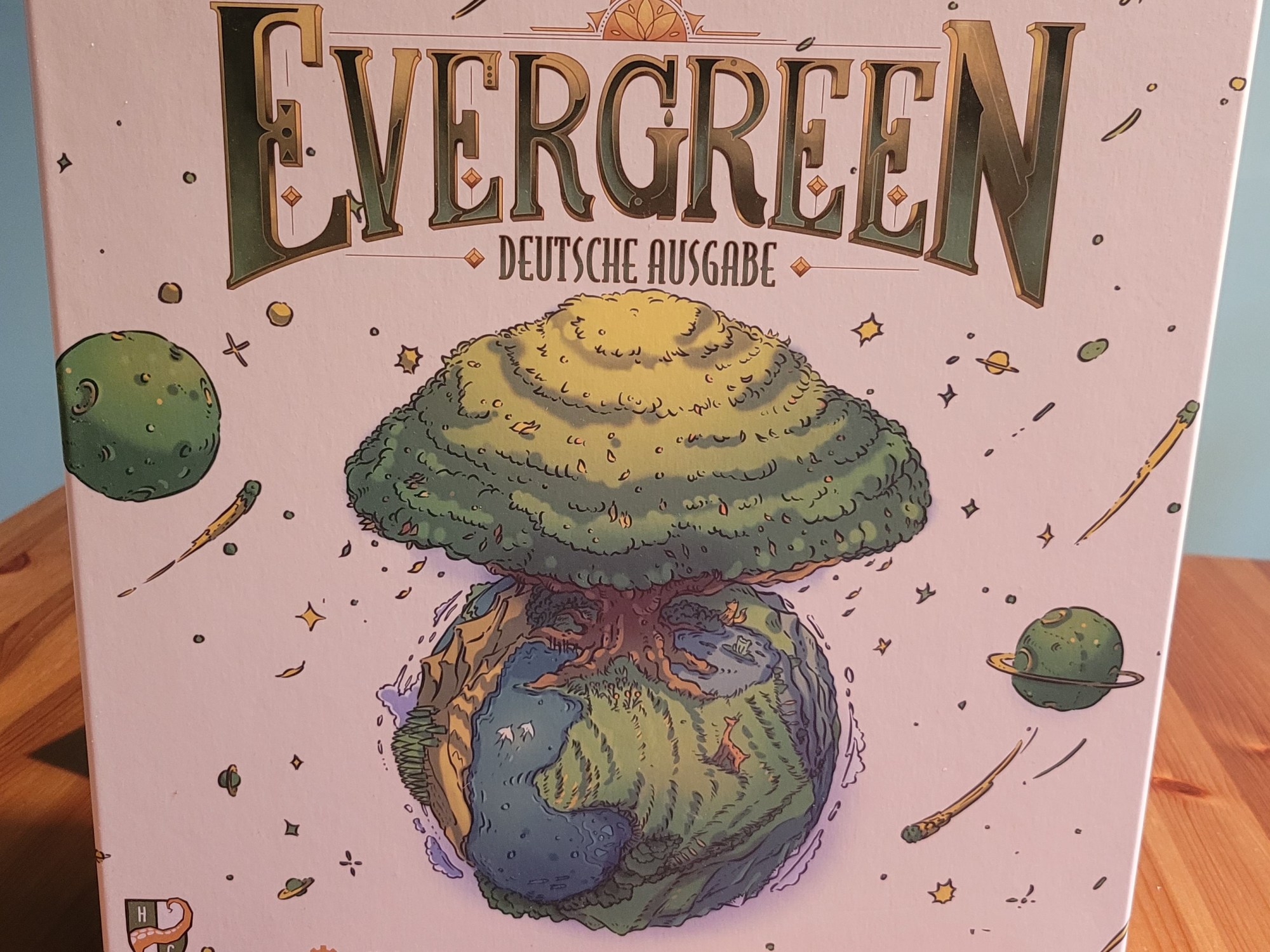
Both Evergreen’s game box and player boards feature an illustration of a charming little planet. But playing the game doesn’t evoke feelings of wielding god-like powers. Instead it feels like being the caretaker of a small, delicate garden. We sow, let the seeds prosper and thrive as we make use of changing score tracks to collect as many points as possible. At the same time, we look for the right time to use special abilities. Before long we find ourselves in the subtle, yet pleasant tension between short-term benefits and long-term goals.
Evergreen is a calming and relaxing game, while still putting a little bit of pressure on its players. It’s not unlike caring for a Bonsai, which also demands care and focus. But by keeping our attention so close to what we do, we discover a sense of soothing dedication to the work at hand.
According to the rules, we are chasing victory points that we then compare with each other, to determine a winner. But at times these elements feel like relics of some other design. This is most apparent in Evergreen’s first and only tie-breaker rule. It’s chosen in such a way as to be almost entirely random and unpredictable. Rolling a die might have been just as useful in figuring out who’s a pinch of a fraction of a point ahead. Because it isn’t the point chase that shapes our experience. At its heart, Evergreen offers the cozy, incremental and often very constructive caretaking of your own biome.
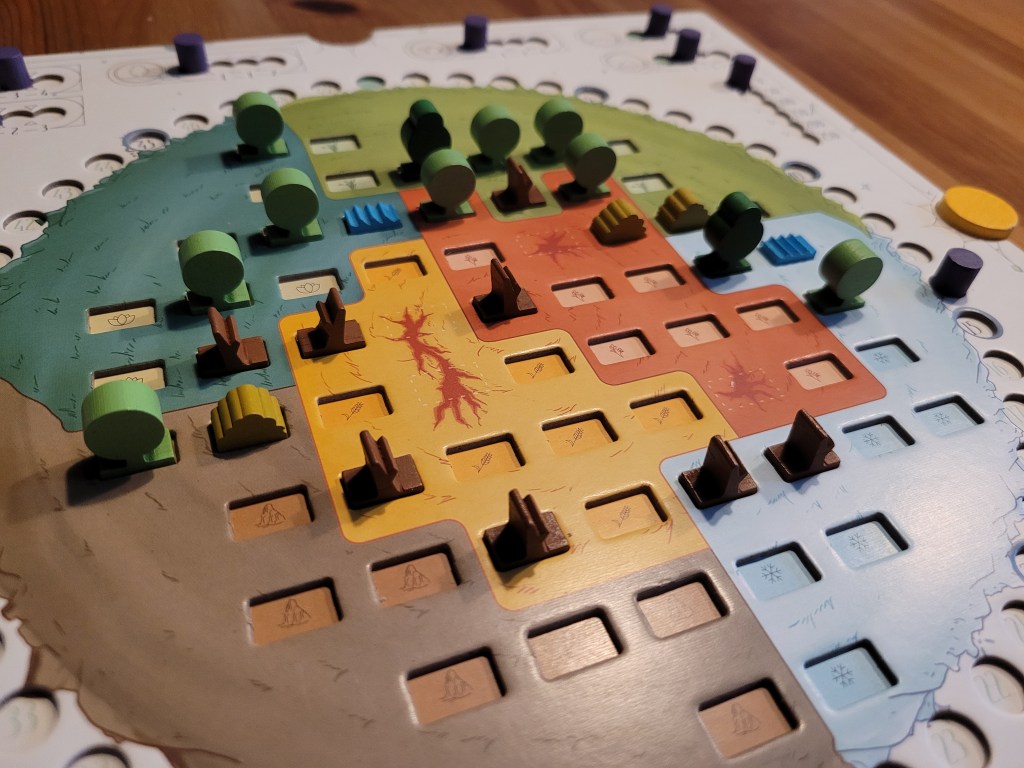
We carefully choose the cards that determine which part of our board we will take an action in, and slide the appropriate wooden tokens into their recesses on the board. The clever use of special abilities provides more opportunities to create the prettiest and most impressive garden right before our eyes.
Evergreen manages to turn the challenge of careful planning and action into a calming, almost relaxing task. That’s why I wasn’t all that interested in the point scores of the other players. I measured my success by consulting the inconspicuously placed point table of the rulebook’s solo mode. At least in part, this was due to what makes Evergreen different from its predecessor Photosynthesis and is arguably the reason why a traditional perspective on this game might find the entire design flawed. You can’t really affect your opponents all that much. At most, you might have an indirect influence in how fast they progress on their points track.
Your focus is almost entirely on your own board. Your head will inevitably be filled with plans, options and possibilities of the next few turns. All while trying to figure out which development of your garden might score you the most points. At best, you can choose a card that will limit the next player’s options. But thanks to the flexibility of players’ action selection, these small inconveniences barely leave an impact with experienced players.
In the sun, the rain, the snow
plant your seeds and let it grow
Because all of that is a sideshow to the actual game. You can use it to add some spice to the experience, but this friendly ribbing isn’t what Evergreen is about. If you want to get to the game’s heart, you can find it right under your nose, within your own biome and in your growing personal garden. The wandering sun puzzle, that lends high scores to your bigger trees while their long-casting shadows simultaneously cover up the points of smaller ones behind them, is both intriguing and fascinating.
Evergreen’s double-layered board proves to be a very elegant solution to give the game an even more tactile feel. Placing small wooden trees into the board’s recesses requires quite a bit more concentration than other games, not least of all due to the size of the pieces. You are subtly led to pay very close attention and adopt a sharp eye for details and the small connections that develop on your board.
That is why Evergreen isn’t a game of grand gestures and sudden upsets. Instead you’re building up your biome step by step. Its value doesn’t necessarily reveal itself in its colorful presentation or through pleasant aesthetics. When the game is over, the markers on your scoring track serve as proof of having taken on the game’s challenge. Sometimes proudly, sometimes full of good intentions. But always with a sense of having accomplished something. And maybe next time, you might even do it a little bit better.
 Lest My Opinions Go Unheard