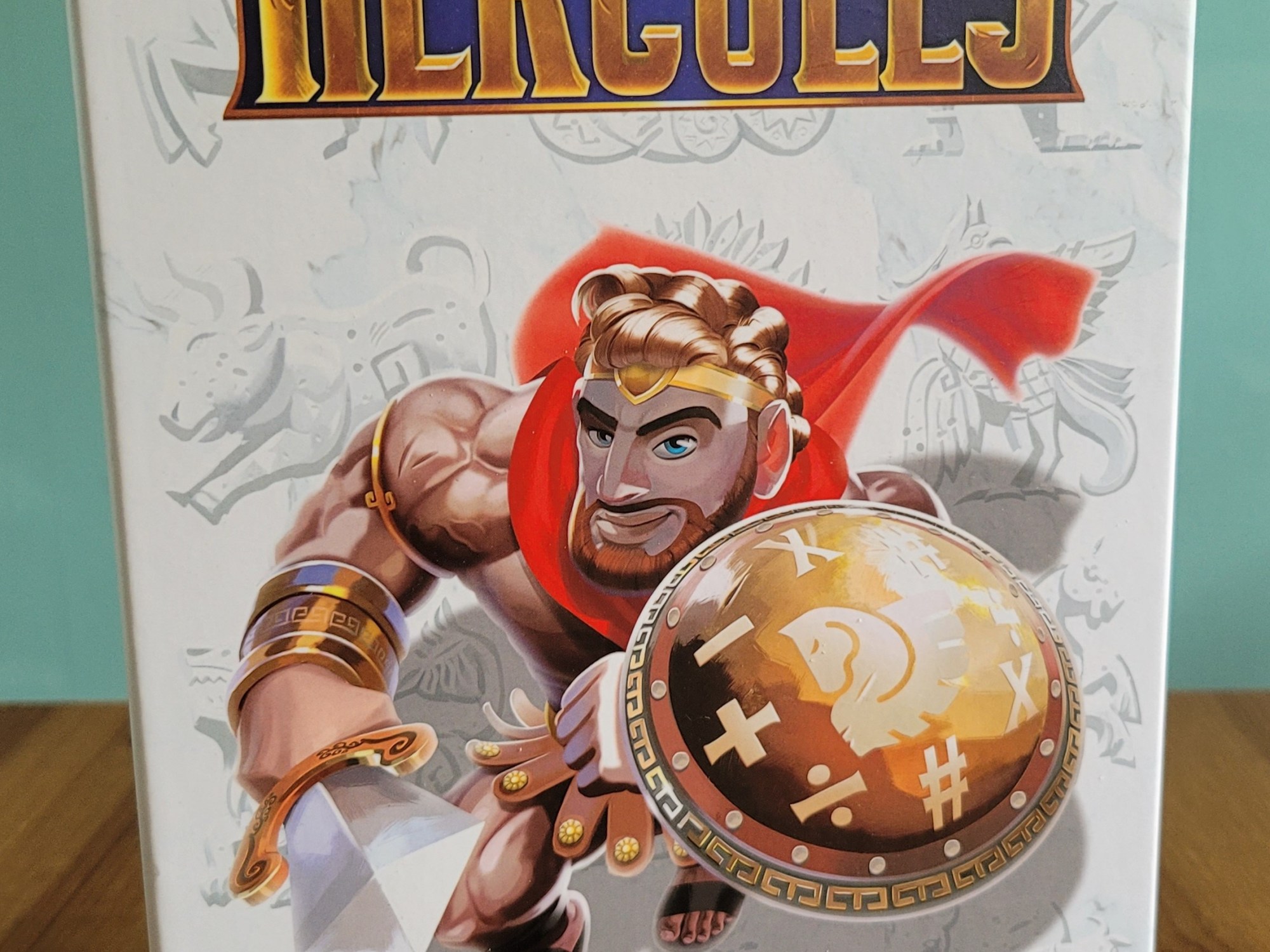
Hercules makes use of Greek mythology and its legends to present a dice-based racing game. The connection between its theme and concept isn’t particularly obvious, so at least some groups will likely be disappointed.
Instead the game’s presentation does communicate that it should be understood as somewhere between an advanced children’s game and a simple family game. Its illustrations are colorful and vibrant. The drawings of various gods and demigods and their oversized heads are reminiscent of family-friendly cartoons or comic strips. In addition to that, the core mechanisms are about basic arithmetic, ranging from 1 to 12. In other words, the game has a very low barrier of entry.

The path to Olympus
is littered with cubes
And if that was it, calling Hercules a children’s game would be uncontroversial. Particularly with it’s emphasis on chance, about on par with a game like Parcheesi, it would seem obvious who this game is for. But then there are some more mechanisms, which might not ratchet up the game’s complexity, but suggest that there is more to it than simply rolling dice well.
Because it’s not just about the race to the finish line. At the end of the game, you need to have collected sets of cards to score valuable bonus points. Your dice results coupled with one of the basic mathematical operations (turning your two dice into one result), lets you add cards to your collection. Those help you gain majorities and complete sets, earning you additional points. After a few games, maximizing your score by collecting cards is often the more promising path to victory, than simply rushing to the end and hoping for the best. Because the cards you pick also offer you the opportunity to adjust your dice roll later on.
Playing Hercules with children is quite thrilling. As the game progresses, they pick up on the options their collected cards provide them, which help to push back against the fickle luck of the dice. Smart combos and quick mental arithmetic are almost always rewarded with getting ahead. Adults tend to take a little longer to pick up this, usually because they’ve written off the game as an “overlong dice fest” once they’ve been hit with some unlucky rolls.
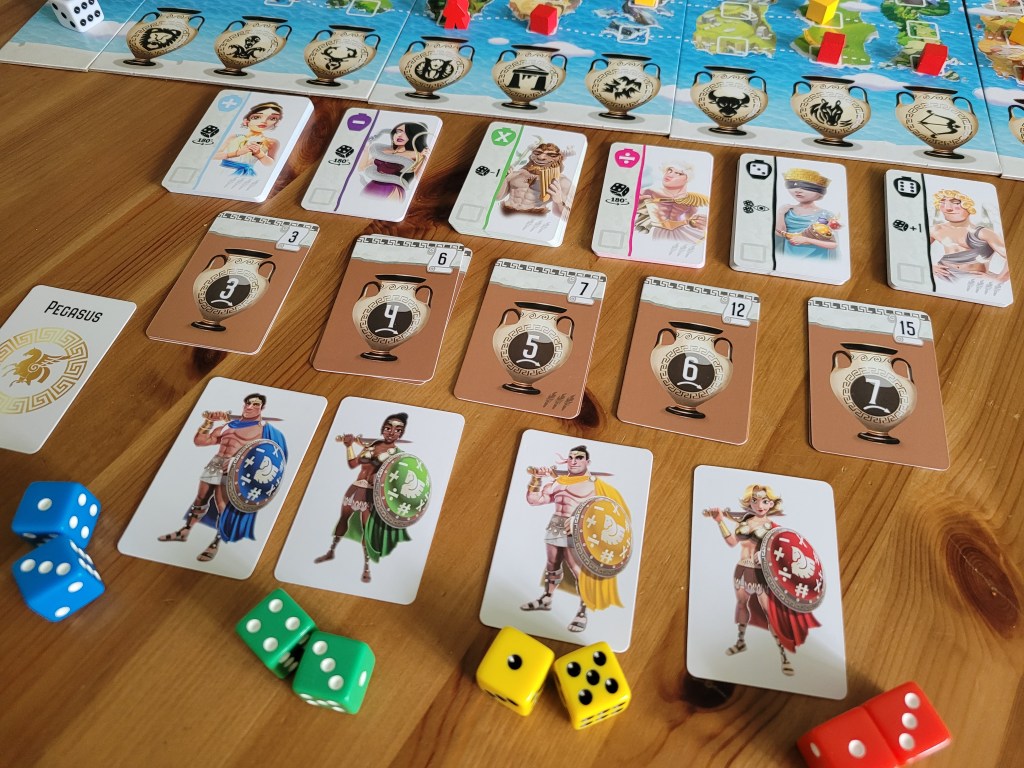
Fame and fortune
await our heroes
There is a lot of luck in Hercules, without a doubt. It can even end up keeping you from accessing those many card options, as you watch your opponents skate by. But then again, Hercules is another game by publisher Mebo, which doesn’t require elaborate strategies or complex tactical considerations to be played. The various options are meant as an invitation to experiment. But with experienced groups in particular, they lead to players trying to math out the optimal move. And as the game grows more unpredictable, player frustration increases exponentially.
After Carrossel and Caretos, Hercules might be Mebo’s best attempt to meld the approachability of a children’s game with the charm of a family game yet.

