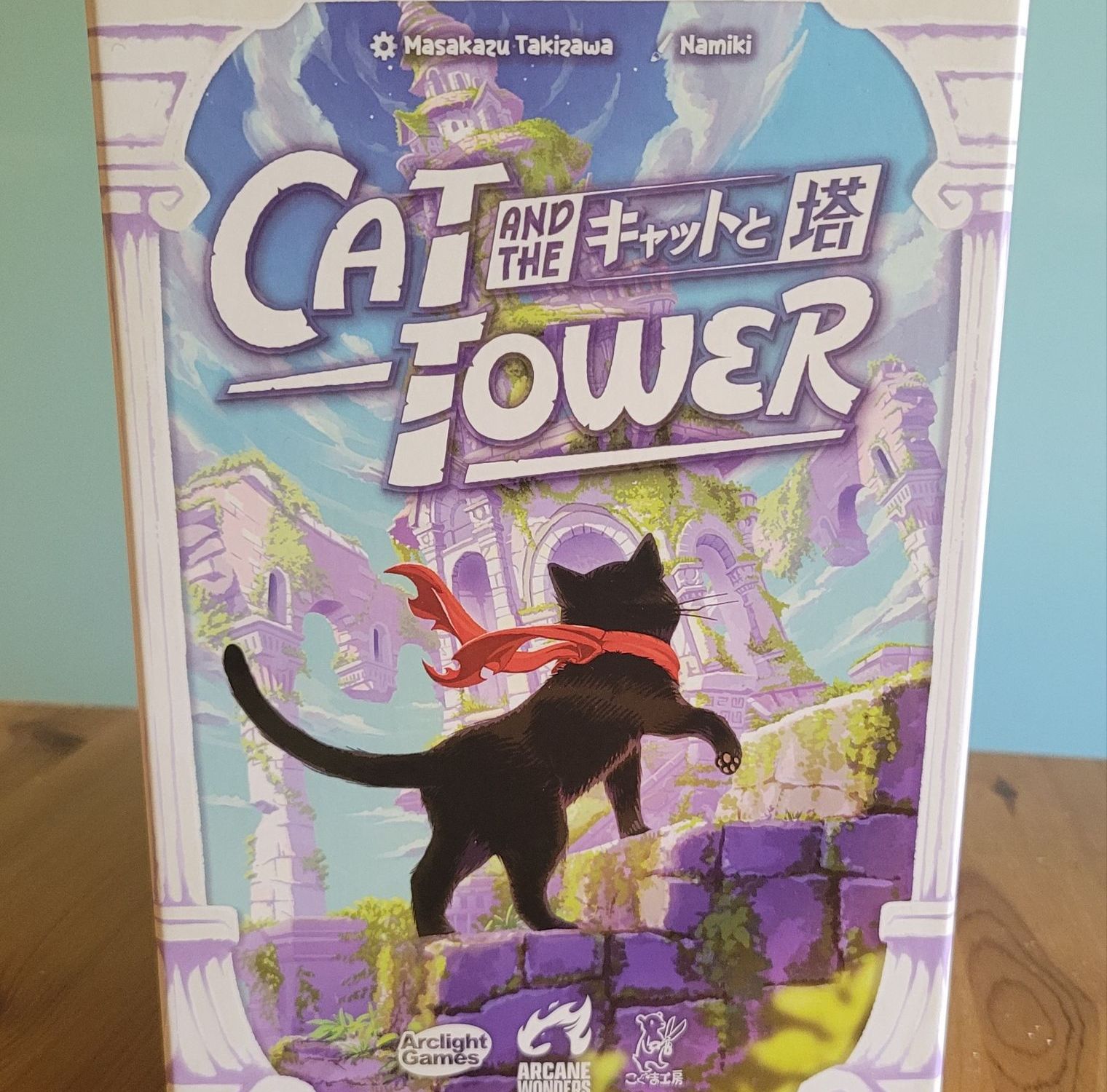
The phrase „this game is about…“ has seen varied use in game criticism. Sometimes it describes the game’s setting, sometimes its mechanisms and sometimes it just names the issue the game’s creators wanted to engage. But it doesn’t often happen, that it’s used to describe a game’s main idea. In the same way that critics talk of a leitmotif when talking about musical compositions.
Cat & the Tower isn’t about cats, even if they serve as the game’s main tokens. It’s also not about the careful construction of a wobbly cardboard tower, even though that is what we do when playing the game. Cat & the Tower is about dealing with death. Or to put it more accurately, it is about how to process the death of a loved one.
To that end Cat & the Tower doesn’t bother to inelegantly depict the realities of going through such an experience. There’s no inheritance to deal with, and the emotional trauma isn’t named directly. Instead the game moves into metaphor. The central character in the game is a cat called Toto. Naive, as young cats are, it only understands that its mother has left and is now a star in the sky. In an attempt to see its mother again, Toto tries to climb the highest tower it can find.
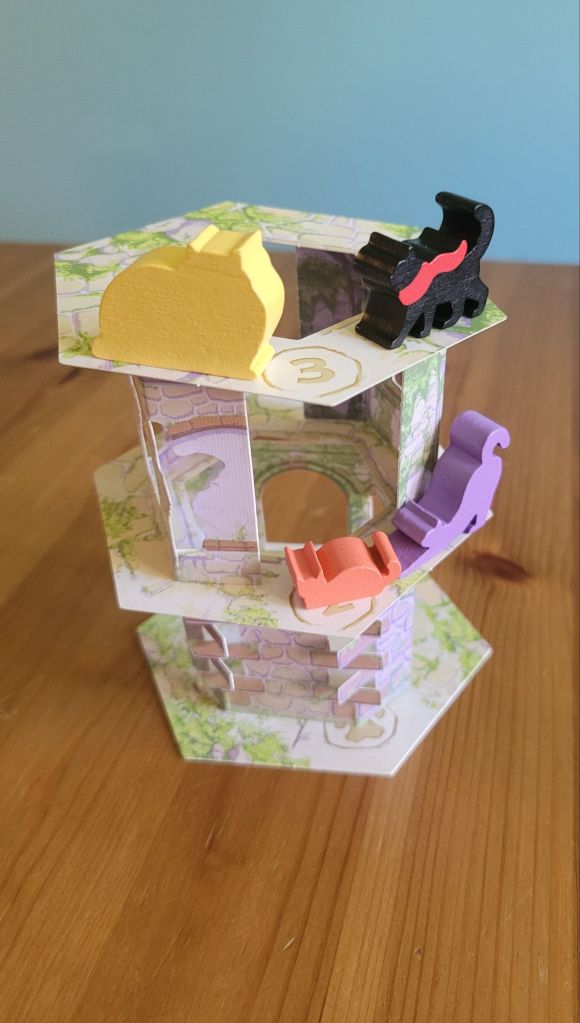
Gameplay consists of constructing said tower, while also providing the conditions that allow Toto to climb it. These preconditions are other cat tokens, which have to be placed a level above Toto. Once there’s enough of them, and they stand in correct relation to each other, Toto may be placed a little higher on the tower. Ruleswise building the tower is simpler than climbing it. We pick one of two action cards that show the kind of cardboard walls we may use to construct the next floor. Cleverly, these cardboard walls are of different height, which means that each floor of our newly constructed tower is slightly skewed.
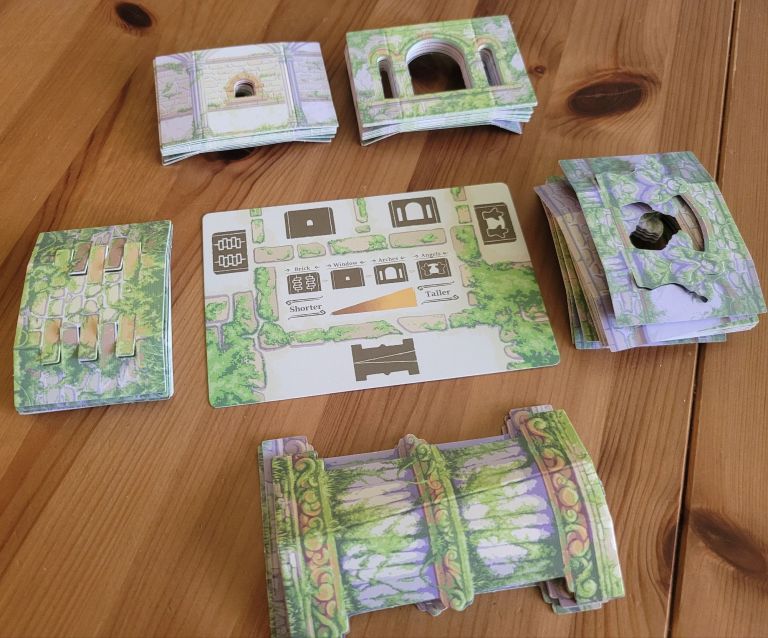
Our building is inherently unsteady, and should enough construction elements fall off it, we all lose the game. (Cat & the Tower is of course a cooperative game. The included competitive variant is a remnant of the design’s previous iteration: Babel.) Under these conditions we carefully, tensely and occasionally arduously construct the (preliminary) ten levels of the tower. Once they are build, or rather once Toto has reached the tenth floor, we can claim our first victory and optionally declare the game over. Or we could tackle the next chapter. There are five of them in total, and it’s only the final chapter (with its twentieth floor), that is the conclusive end of the game.
It makes sense to speak of chapters here, as the texts on the reverse side of our goal cards, form a little story. That written-out narrative explicitly addresses the game’s core theme. At least as explicit as a fable about talking cats can do such a thing. Each chapter describes a short vignette in which Toto takes the next step on his emotional journey. Accordingly, these chapters have titles such as “Friendship”, “Guidance” or “Gratitude”.
But this shouldn’t lead people to believe that Cat & the Tower is some kind of therapy game. It’s not some therapeutic tool with which you can learn to process a painful experience. It is and remains just a game. One that offers enjoyment, play and tension. But its presentation takes a page from Ghibli movies. It’s full of warm, pleasant colours, shapes and involves an entertaining activity, that make up the game. Yet at its core, there is a sincere, emotional moment, which can be very touching, in particular for adult players.
Art, much like beauty, lies in the eye of the beholder. Which is just another way of saying that as players our thoughts, insights and reactions invariably enhance a piece of art. Cat & the Tower allows for this kind of engagement. We can let the framing narrative affect us, and ponder if our “feline friends” might be more than just pretty, coloured wooden pieces. Or if the instability of the tower doesn’t also mirror the emotional state of a grieving person. Or if Toto’s friends are always one step above him, because its our friends who make it possible for us to get through difficult times.
There aren’t many games that manage to set a melancholic note as its foundation. Especially in a gaming scene, where a focus on light-hearted fun tends to brush other approaches aside, pushing sillier and wackier experiences to the foreground. If you consider yourself one of those “serious gamers”, you might highlight games that deal with war, marginalization and exploitation to “raise people’s awareness”.
Cat & the Tower doesn’t fit in either of these neat boxes. It avoids the didactic aspirations of a “serious game”, without trivializing its topic. (Players who would like to go for this kind of moral failure, will have to do it themselves.)
A designer’s relationship to their game is always fundamentally different to those of its players. You can’t look at a game and tell the motivations, considerations or even experiences that went into creating it. You only ever see the result of them.
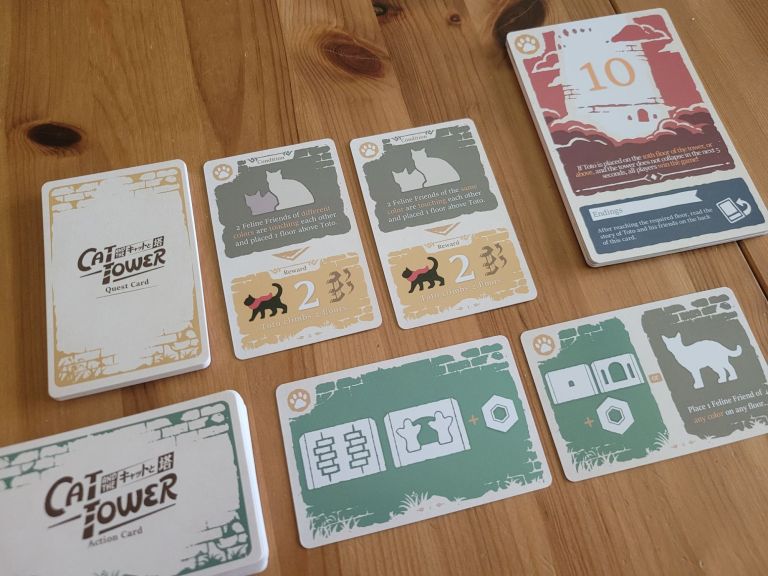
Out of that result, players use their own motivations, considerations and experiences to shape play into something meaningful to them. Components, player interactions and even the design decision which kind of situations the game should allow for, are only the building blocks, players use for this. The written narrative contained in Cat & the Tower’s cards, unsubtle as it may be, gives us an emotional framework and leaves it up to us to choose the perspective we want to inhabit.
This is in many ways something exceptional. Cat & the Tower hasn’t caused any big waves since its release. But it’s not the kind of game which is made for this kind of concentrated attention. It innocuously widens the emotional bandwidth of board games, and plays fluidly and without any hard edges.


One thought on “Game Night Verdicts #121 – Cat & the Tower”