One of the recurring debates in board games is about how thematic any given game actually is. It its theme presented convincingly? Does it feel like you’re “really” doing whatever it is you’re said to be doing? Or is it pasted on and interchangeable? Could the theme so awkwardly interwoven with the mechanisms, that changing it for something else wouldn’t affect gameplay at all? Personally, I’ve grown tired of these arguments. Because for the most part, the people arguing with each other rarely understand theme to mean the same thing. Even when they do, their understanding might differ significantly from what the designers and publishers had intended.
At this point I can see three distinct uses of theme, that are relevant to talking about board games. A theme can be a motif, a metaphor or a topic. Most of the times these three uses can be easily distinguished. But I’ve found that in conversation and in some critiques these distinctions tend to get ignored. Since all these ideas are covered by the same word, you can get easily persuaded to lump it all together. But that’s precisely why I think paying attention to the differences matters.
Theme as motif
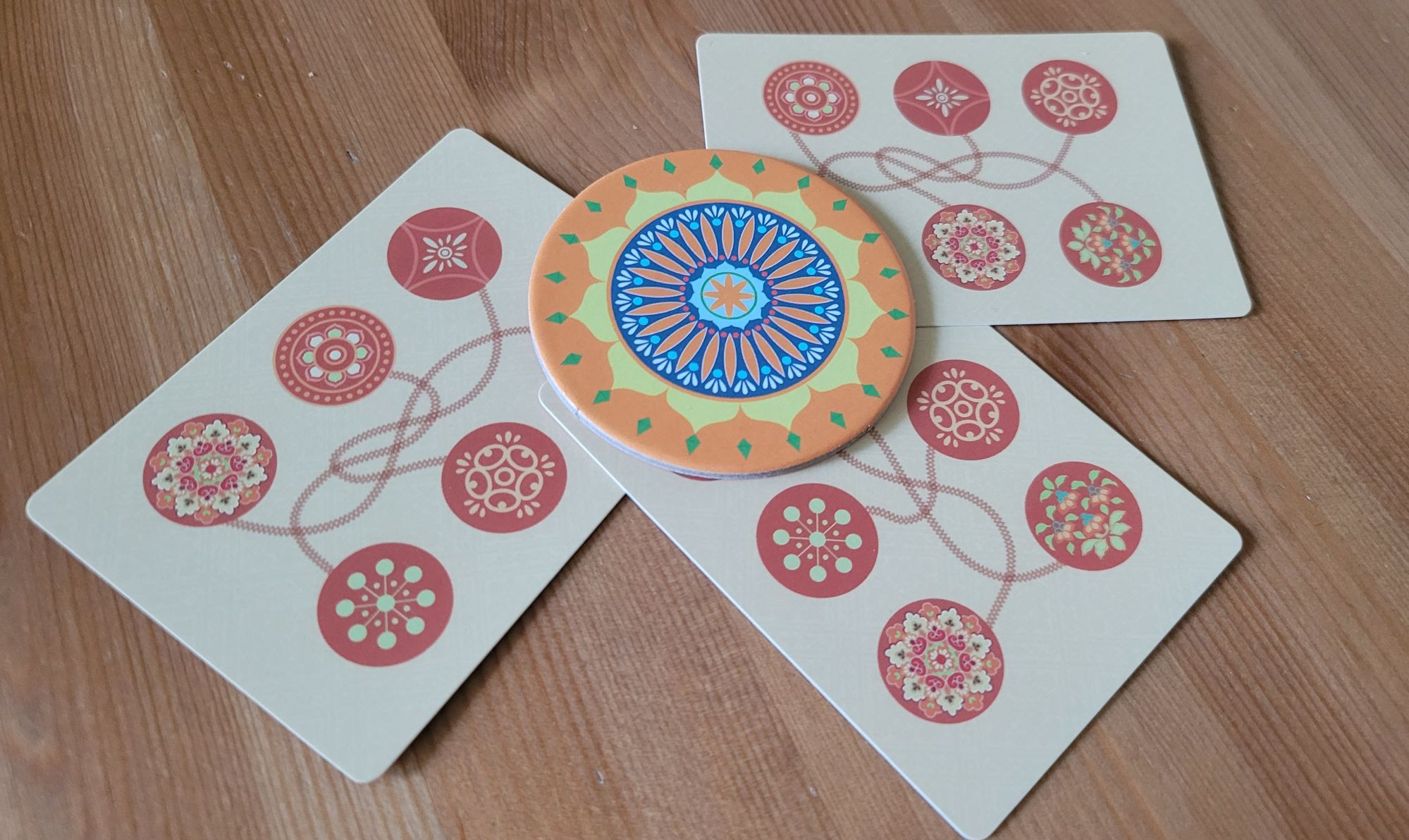
Some players like to mock eurogames, when they point out that theme only matters when it comes to what to call the pieces on the board. While this amuses self-proclaimed “thematic gamers” to no end, as it seems to validate their preference in games. But what gets overlooked is the valid observation that a theme isn’t merely an aesthetic choice, but also a matter of functionality. A theme, in particular colours, pictures and terms of the game, also work to turn abstract rules mechanisms into a coherent whole. If you’ve ever had to play a prototype that consisted solely of written post-it notes and some borrowed tokens from some other game, you learn to appreciate a clear thematic motif.
It works to ease players into learning the game’s rules. The motif lets you easily distinguish elements of the game from one another. Rules that only apply to certain components are more easily remembered, when the motif provides a visual memory aid. If the blue tokens are the only ones that can remove white tokens from the board, this is easily explained and justified by calling them “guards”.
This deceptively simply use seem so obvious, because it is practically mandatory once you go beyond simple number games. But even games that offer little more than numbers and symbols make use of a motif. It’s no coincidence that a game like Lama has an illustrator and editorial staff, to give the game colour. Motif is not just about giving context to make rules more tangible. It is also a visual concept that gives a game its character and sets a tone. If you look at Lama, you’re unlikely to expect a highly competitive, dead serious card game. A game like The Gang uses illustrations and graphic design to offer a certain tone and mood to players. One they can choose to adopt, if they feel like it. Theme as motif is important, even if it doesn’t serve to embellish our experience. For that you need….
Theme as metaphor.
I’d argue that the most common expectations of theme are that we get to use it as a metaphor. Its function is to transpose one situation into another for aesthetic reasons. Put simply, the metaphor of theme projects a different context onto the actual actions of players at the table – linguistically and visually. We do it to make shared play more entertaining to us. Instead of choosing actions and executing them according to the game’s rules, metaphor gives as the language (and the mental images) to give it an appealing sheen. Placing a token on the board becomes an investment into a new factory. Removing a cube from another place becomes the consumption of necessary resources. Flipping a tile turns into an earlier investment paying off and generating profits for us. These profits we can then invest into pushing the industrial revolution forward around Birmingham.
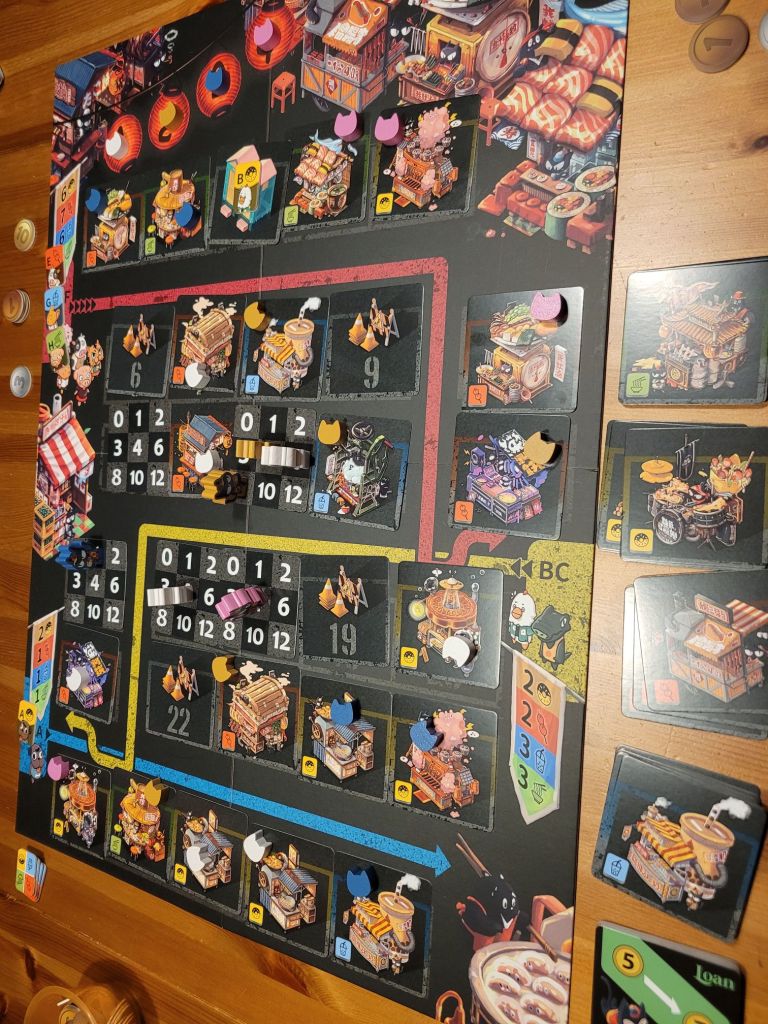
Thanks to game’s metaphor we conjure mental images of what happens. Some games only offer quick snapshots. You get to say a single sentence, and then the metaphor has been exhausted. Other designers and developers put a lot of effort into expanding this metaphor. With the goal of players being able to apply this metaphor to as many situations during play as possible. The easier it is for players to make use of the metaphor, and to expand on it whenever they make a game-relevant action, the more we talk about “immersion”. These are the games that are lauded for strongly interweaving rules and themes.
One thing that gets overlooked with this praise, is how much creativity and imagination is required from players to actively continue the game’s metaphor. The thematic depth of many games is often stopped by the glass wall of its players lack of imagination. The bigger the pool of images, words, ideas and plain knowledge, the more likely it is that a game with a sufficiently developed metaphor will end up “telling the best stories”.
Plainly put, theme as metaphor serves to make the game fun. Player interaction is embellished through a kind of visual vocabulary. This turns the mundane and often repetitive actions at the table into an interactive game world.
But there is another level we can elevate a game’s theme to.
Theme as topic
The question “What’s this game about?” can lead to serious misunderstandings in some circles. Do you mean the central experiences? Are you talking about the game’s goal? Should we list the most important rules? Ever since the question about games as art has attracted more attention and reasonable answers, another way to read this question has appeared: “What is this game’s topic?”
Art is often misunderstood as synonymous with high art. That’s why people come to the conclusion, that games must also function as high art. So when we play a game, we also engage with its topic. We interpret it. We are supposed to question it, and develop a critical eye for it. Play is no longer an end in itself (how ordinary!), but also a way to engage with history and cultures (or their appropriate representation). Or at the very least be exposed to them. Engaging with a game is meant to be an educational experience. We are supposed to learn something about the world. The use of a topic always assumes intent on part of the game’s creators. They are the ones, who want to show us something. They are the ones who want to communicate something. The game is a kind of treatise on its topic, with the goal to leave players with some kind of insight. When a game tackles a topic, it will – intentionally or not – make a statement about it.
Looking at games this way comes with a layer of imprecision. Even if the inspiration for a game might have been a specific theme or topic, it doesn’t necessarily follow that the game’s design is also a way to engage this topic.
A game like Sky Team might have been inspired by real-life professions and challenges, but it is difficult to see a meaningful engagement with either in the game. In contrast, a game like Daybreak isn’t simply inspired by its topic. It is also an actual attempt to engage with it. Players are encouraged to emotionally engage with the topic through Daybreak’s gameplay and even read up on it afterwards.
The difference between theme as motif or metaphor can often be made as we play the game. A theme is either present at the start and the recedes into the background (motif), or it accompanies us throughout the game (metaphor). Whereas a theme as topic can really just be identified with some certainty, when the creators have expressed such an intent. Just because a game can be interpreted as engaging with its topic and making a statement, doesn’t mean that any such intent exists.
It should be apparent that “theme” covers at least three distinct ideas. That’s why it’s so easy to end up talking past each other. My use of motif, metaphor and topic is just meant to explain these differences. I don’t think that these words are more familiar or easily understood. But they help me at least to get a better grasp on a game’s theme.

