
It used to be that when critics wanted to praise a game they would talk about how its “rules fade into the background”. These games were considered highly thematic, because you wouldn’t consciously apply and follow rules, but simply play the game. This appealing mix of representational rules, accessible language and a clearly outlined identity within the game, helped to create a coherent thematic metaphor. So when you were playing at the table, it felt like you were inside the game and not, you know, at a table.
Courtisans is a card game, played at a table and taking place around a table. Yet its rules still remain ever-present. This isn’t a problem though. Because not only are the rules few and easily understood. The game manages to be engaging and entertaining without a thematic fantasy woven through it.
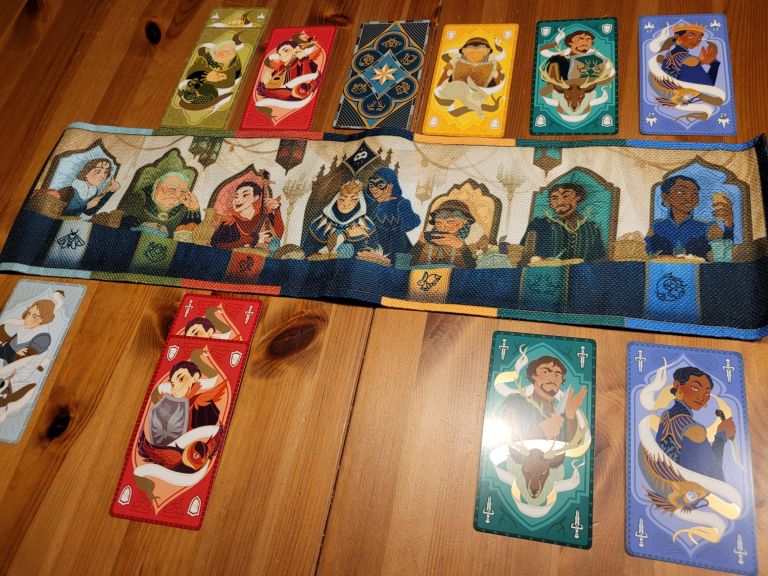
But it would be a mistake to reduce Courtisans to its rules. Because there are so few of them, it’s easy to grasp how they work together. Experienced groups will be able to dive into play right after getting the rules explained to them. While even gaming ingenues will know how to game the system by the end of their first, quick play at the latest. Instead, the rules do something that rules in modern game designs are rarely asked to do: they provide a clear structure and a stage for players. We don’t use our comprehensive understanding of the game’s rules, their possibilities and indeterminate factors to prove our gaming prowess. Victory and defeat is the inevitable sum of our decisions alone.
In Courtisans we find ourselves turning into strategists, gamblers, schemers or simply clueless agents of chaos. Some try to carefully weigh their options as they deal out their hand of cards, to slowly work towards scoring their goals. Some play by gut feeling and bet everything on drawing the right cards at the end to win the game. Others yet will try to talk everyone into which spot to place their cards. But you can just as well play Courtisans with the kind of innocent cluelessness that is bound to thwart even the best-laid plans.
The wider the range of roles we take on around the table, the more explosively emotional the game will play out. Curses abound as you draw your new hand of cards. You voice your indignation at the card somebody played into your area. Outrage spreads as points you once thought safe, are suddenly invalidated. Courtisans is a game that draws out emotions from its players, and that’s exactly why you get it to the table. It’s a game that features both moments of tension and moments of blatant injustice. Moments which – depending on your personality and charisma – might make you rant uncontrollably much to the entertainment of everyone at the table.

Outside of this wacky theatre of emotions you get to perform at the table, Courtisans also has room for subtler moves. Each turn you slide a card over to one of your opponents. At first, this action is little more than s simple “take that”: Here, have a negative point! Over time, though, this action can turn into a way to enter unspoken alliances. When two players have a lot of red cards in front of them, they’re both invested in making sure that the Red Nightingale family – in Courtisans each colour is tied to a noble family – adds points to their score.
It’s this combination of louder and quieter moments which gives Courtisans just enough spice, to become more than a simplistic take-that game. You leap from one small decision to the next, as making three decisions over how to deal out three cards in your hand is easily done. But it’s the consequences of these decisions, that are fun. From the curses and threats that suddenly burst out at the table, to the confident smile crossing your face when somebody else plays right into your hands. Courtisans manages to create this neat and small kaleidoscope of emotions in a breezy 20 minutes. Its cleverness is surprising and makes you want to give it another go. Which is also a form of praise, even when you feel the rules every step of the way.

