Last weekend I went to a gaming retreat with other critics and content creators of the German Beeple network. Despite the warm and sunny weather, we decided to lock ourselves into a cool, well-lit hall and play board games. Long ones, short ones, simple or complex. I want to list some of my impressions here. Most of all, because I’m not sure I will still remember them by the time I have the opportunity to talk about them in more detail.
In non-chronological order, this is an excerpt of games I played and what I took away from them.
Molly House – This game is considered, not without reason, to be in the sphere of design influence of Cole Wehrle, who is listed as co-designer along with original designer Jo Kelly. Still, you can see some similarities to other Wehrle designs. Primarily, how rules and theme are strongly interwoven. This has shown to be so intricate that I’ve heard the game described as particularly difficult to get into or even grasp. Multiple times. The rules don’t seem to “make sense” quite the same way we’re accustomed to from other games. The cards have different uses, depending on when they’re played and even how we play and handle them differs, depending on when we decide to do so.
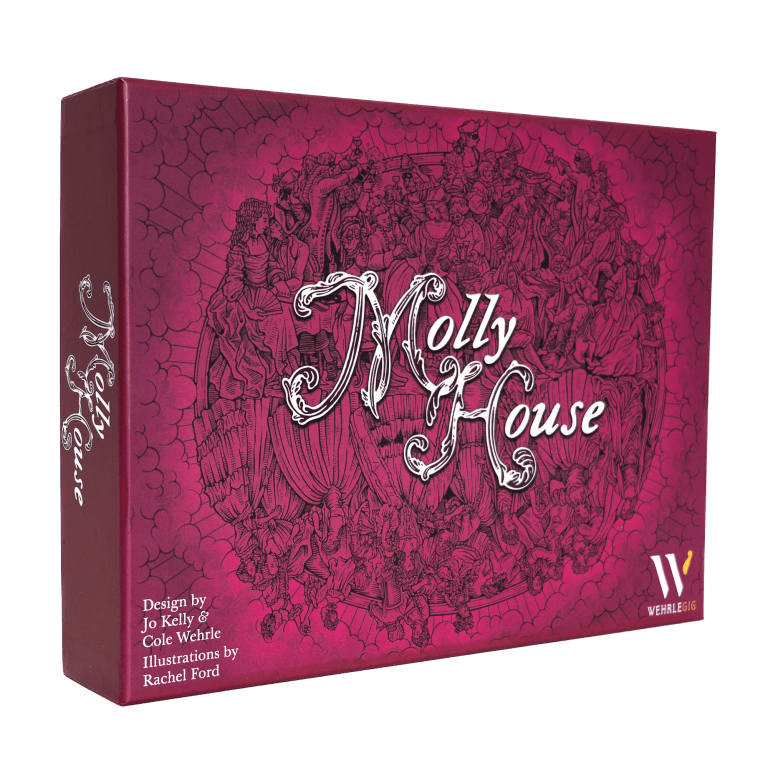
Which is why I chose to try to explain the game as much as I could by articulating its theme: a proto-queer community is forming in the 18th century, and we have to keep it alive through festivities while also trying to enjoy ourselves. All while informers and jealous conservatives try to rat us out to the authorities. This approach worked quite well at first, but old habits die hard. Both the questions of other players and my reflex to look up precise rules in the rulebook (instead of trying to find an answer by following the theme) quickly led to a very sputtering game flow. That said, this isn’t a question of which ‘method’ is right, but a matter of which facet of the game we prioritize.
But my attempt to centre the game’s theme made the game feel more dynamic, but also more interesting and tangible. With a little luck, I might be able to play it again soon, which will hopefully allow me to better grasp the game’s character. [EDIT: I did in fact play Molly House just before posting this, and my suspicions turned out to be correct. Centring theme both enhances the experience, while also making the rules feel more tangible.]
Morty Sorty Magic Shop (nominated for Spiel des Jahres 2026) – I gave this game multiple chances this weekend, and each time I was disappointed. It’s a solidly crafted game, with the absolute minimum of fresh ideas to not play like a relic of game design, the way Tower Up did. The best thing about the game is the editorial oversight that went into the components, but not its design. There’s no need to go into more detail, as the game is sure to be talked about and dissected elsewhere in the next couple of weeks. But then again, there’s simply not enough here to write about.
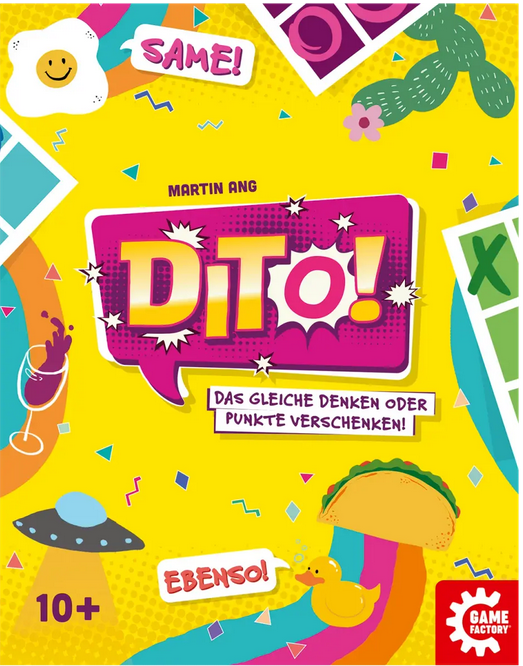
JinxO (nominated for Spiel des Jahres 2026) – I’ve also played Jinxo (Dito in Germany) multiple times, although not as often as others did over the weekend. I was less disappointed by this game. Jinxo is also a solid piece of designcraft, that doesn’t outstay its welcome. It’s a nice package to have a little fun with in a group of five or more players. If you’re particularly competitive, you’re trying to get into the minds of other players writing down their answers. If you find the reveal phase and the ensuing laughter-filled discussion more enticing, you’ll try to stretch your creative muscles instead. Both approaches seemed to resonate with players. Even if the groups generally preferred writing down the funny answer as opposed to the tactically sound one. But this remains the only twist, that puts Jinxo over other games like it. The design is familiar enough to allow a wide range of players to buy into it, but too commonplace to generate much excitement independent of the players who sit down to play it.
Rebirth (nominated for Spiel des Jahres 2026) – This game is exactly what you would expect from a Knizia design. It’s elegant, easy to play and with a slight tendency towards number-crunching at various points during the game. In 2026 Knizia’s designs continuously threaten to tip into the realm of feeling tired and repetitive. Rebirth brings up vague memories of Samurai, for example. But the game manages to find just the right balance between easy-going flow and enticing competition. Its production values give the game some heft without ever feeling flashy. And there is just enough sophistication under the hood to keep you engaged down to the last minute. The only thing that dims the overall craft on display here, is the fact that we already know that Reiner Knizia can create games like this.
Gibberers – This game continues to be my absolute highlight of the last few years. A game which couldn’t feel more fresh, entertaining and human. We invent a new language and then have to use it to explain new words and ideas to the other players. It’s a cooperative act of collectivism that expresses itself in the need for us to listen to each other, show empathy and sharpen our linguistic skills, as we try out new mental connections and perspectives. A German edition is set to release this year, and I’m very interested how and if there will be any changes. I’d be happy to stock up on the paper strips used for our made-up words. This time the game began a little too focused on optimising our starting vocabulary. But after a few turns it blossomed into the chaotic language mess, which defines this games and brings players together. Our group’s “prok-bahaa” is sure to replace “six-seven” in my vocabulary for the foreseeable future.
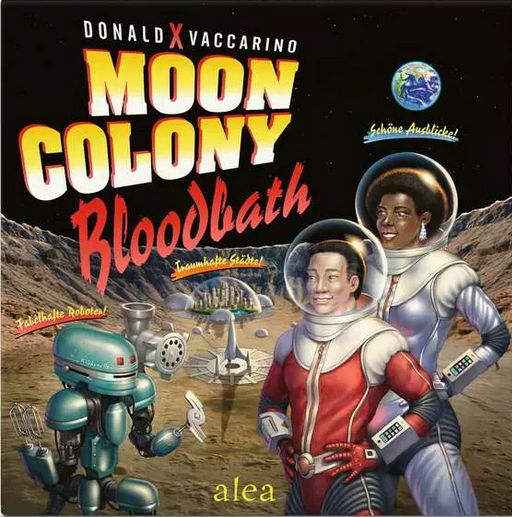
Moon Colony Bloodbath (nominated for Kennerspiel des Jahres 2026) – The first time I played this game, the experience left me cold. Now I got to play it again, with a different group, which also had little experience with the game, and what do you know? It still left me cold. Thematically it is at best a canvas to project your ideas onto. Mechanically it is as streamlined as we’ve become accustomed to from Vaccharino’s designs (similar to Kingdom Builder). But it also leaves little room to notice your fellow players (more so than Dominion base set did). The result is a game that has nearly zero friction during play. Except for its theme, which often slips into the grotesque and macabre. Something which is so unusual in this segment of games, that the sense-making parts of many gamers# brains quickly reach for an explanation. Is this maybe satire? If so, what’s being satirized? And what might this be a comment on? The game doesn’t provide answers, so you start to reach for reasons why the game would throw such bizarre narrative moments at you (“The helpful robot kills seven people on our bases, and then offers us a new building project.”)
That is all quite macabre, and difficult to align with the otherwise pleasantly smooth flow of play. If you were to read Moon Colony Bloodbath as a satirical social commentary, that dissonance disappears. But I’m not convinced that this reading is justified.
What we’re really dealing with here, is a common mismatch between theme and play, which in this case is read in favour of the designers, as opposed to criticizing them for it. Visually, this is a parody of utopian American science-fiction of the 1950s. Which doesn’t really have an equivalent in Germany. So the anachronistic references barely resonate, and players have to look for other connections to make the sci-fi pastiche of the game make sense. If it even registers, outside of the occasional card gag.
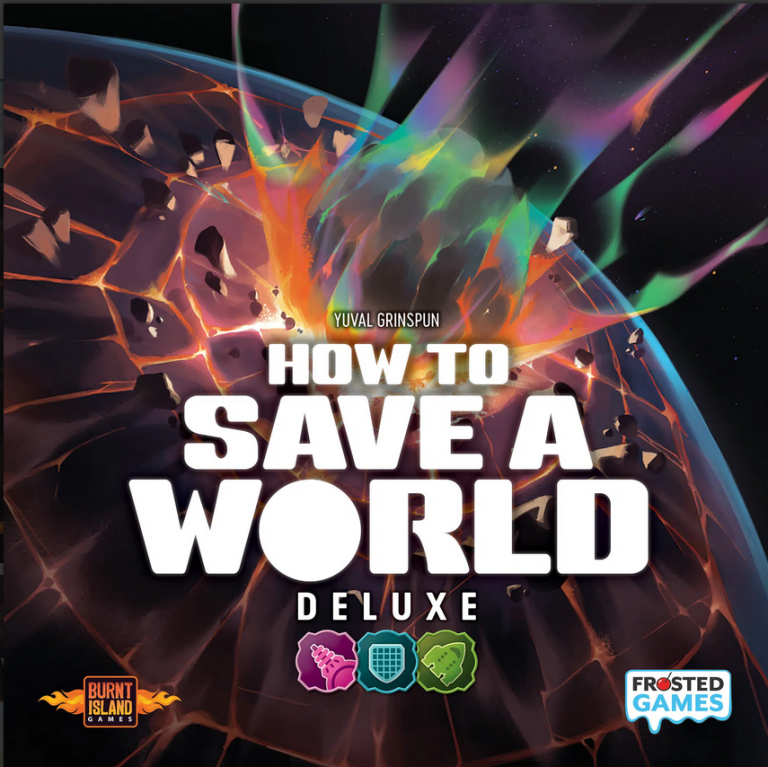
How to Save a World – Before I left for the gaming weekend, I was following along with a discussion about the term “eurogame”. Especially the difference between its beginnings (mid-90s/early 00s) and its interpretation today. A game like “How to Save a World” gets very close to embodying the modern understanding of the word “eurogame”. It’s a game in which we are given a task (“saving a world”), which we attempt to complete by combining card effects, action spaces on a board and the gaining, exchanging and spending of resources. A few numbered tracks on the board become the focus of all our plans. The game’s combinatorial puzzle culminates in a burst of victory points, which allows players to compare themselves to each other. Whether this feels appealing and fulfilling, arguably depends on three points.
First: the concluding comparison tickles our ambition, because proving that you are better than somebody else at the table feels gratifying.
Second: the challenge to pick the optimal combination of cards, rules effects and the current game state, just about pushes us to the edge of our ability and into the pleasant sphere of experiencing “flow”.
Third: the promise that we will eventually sufficiently grasp the complex web of effects and rules restrictions to increase the joy of experiencing agency (as it is sure to do in the first five or six plays), drives our intense engagement with the current game state. All this was true of my fellow players, whereas I observed the action with some emotional distance. Towards the end I, too, felt the pleasant increase of agency as the game wound down. Which was entertaining enough. Everything about the game worked well. But none of the three points mentioned differed significantly from other eurogames I already knew.
Railroad Tiles – A game, which is sure to get a proper review in due time. But until then I’d just mention this: the base game is an idyllic, soothing tile-laying game until played in the presence of ambitious expert gamers. They are likely to turn it into an accessible, albeit tricky optimization puzzle. This flexibility to adjust to player attitudes brought to mind Carcassone, but I’m sure there are many other games who offer a similar range. This was then followed up by adding a single expansion (Countryside) and with that, the calm pastoral vibe was gone. Instead we ended up with a tense puzzle that included a non-trivial amount of admin and rules knowledge. Both have their charms, but the rapid increase in comparison to the base game caught everyone at the table off-guard.
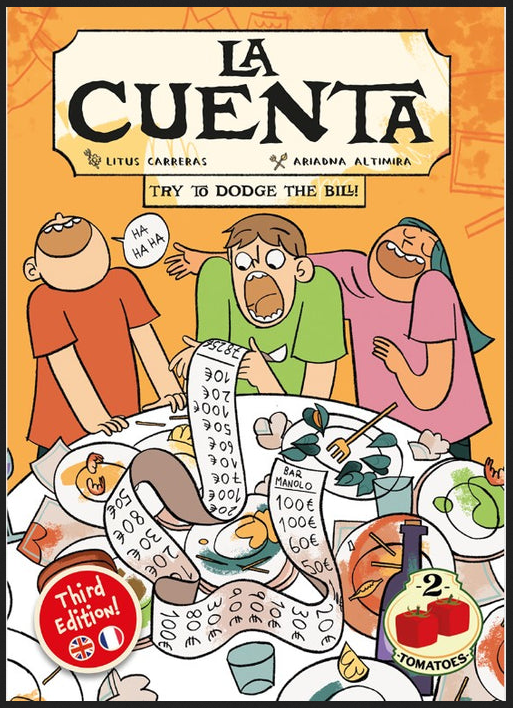
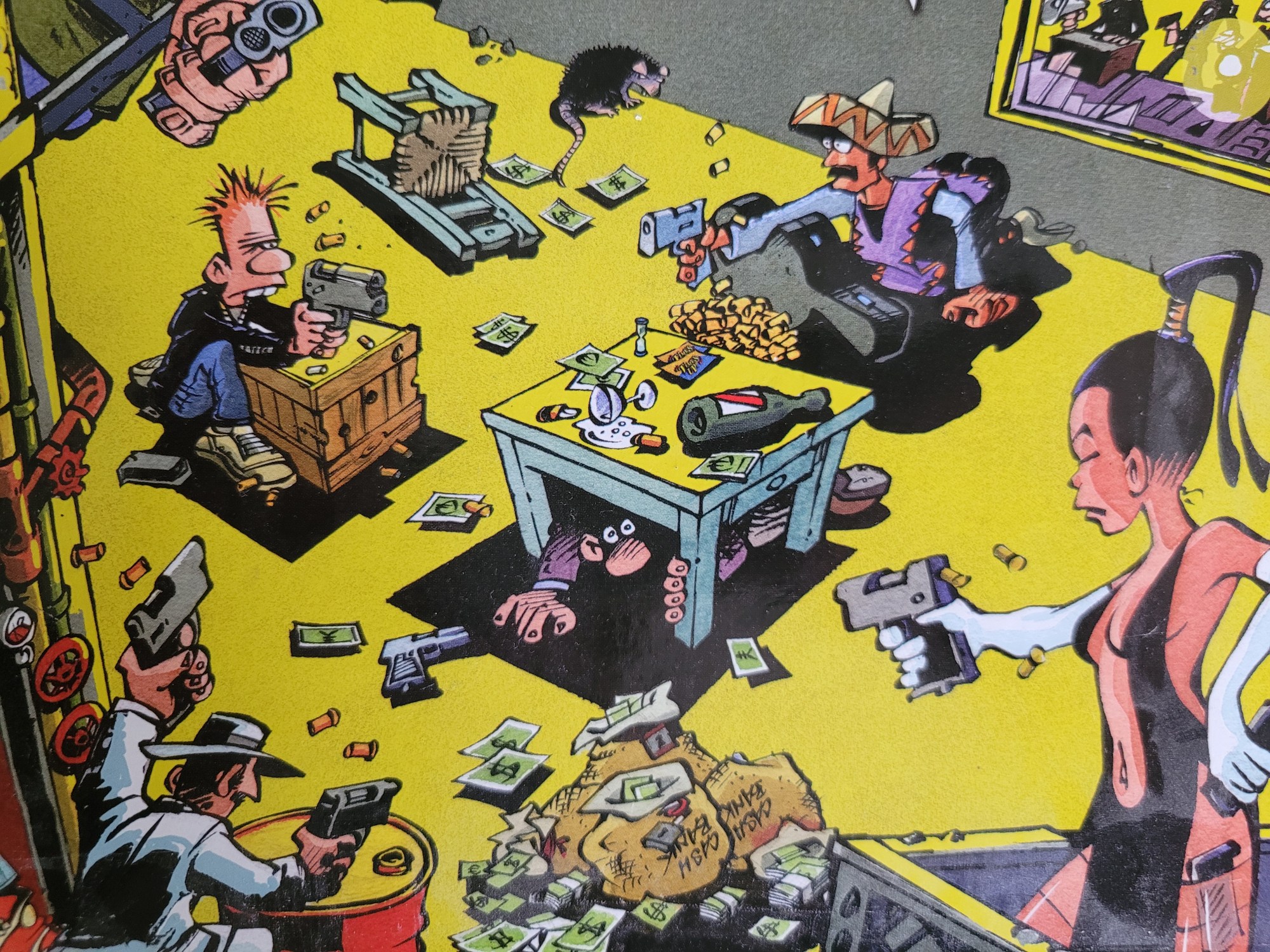
La cuenta – This game (along with Jinxo) may have been the most played game that weekend. Two of the players had managed to get their hands on prop money, i.e. realistic looking paper money, which is allegedly used as props on movie sets, to enhance the experience. I don’t know if it was worth the effort, but it at least gave us something to handle outside of the cards in our hand. Money is something like victory points in La cuenta. Something we want to make other players lose, while we really don’t want to do it ourselves. The tactility of the paper money we used seemed less impactful, than the fact that it drew our attention and brought the game’s theme into our interactions. Because on a purely mechanical level the game isn’t that unusual. We take turns playing cards until one person passes. That person then has to discard money based on the cards already played this round, and the next round begins. Evaluating your own hand of cards in order to force somebody else to pass, or figuring out the best moment to pass yourself to minimize your losses, is the core of La cuenta. You can think of it as an inverted Lama. The reason why it still kept getting brought to the table, though, was the theme’s narrative potential. The setting is relatable and easily grasped. You’re out eating and drinking with your friends, and don’t want to get stuck with the bill. At the same time you keep trying to one-up the orders, to really rub it in to whoever ends up paying. This shot of schadenfreude isn’t the game’s clever turn, though. It’s the easily narrated actions we take, that draws us into participating in a bit of gameplay theatre. Announcing what we do, play-acting as we put down cards, and doing a bit of gregariously ordering food and drinks for everyone. This bit of theatre is an experiential narrative, which the cards continue to feed with new impulses. That’s what makes it easy to intuitively adopt the role of protagonists. It’s how we ended up loudly ordering food and drinks, and blurting out excuses why we couldn’t pay (“I’m on the loo!”) and so and and so forth.
Collect – This game proves that the simplicity of a mechanism isn’t enough to hang an entire game on. Collect is a simple card game, in which we either place the first card we draw or the alternatively drawn card into our tableau. Cards have effects, which sometimes trigger and sometimes don’t. Sometimes we change our own tableau, sometimes those of other players. As soon as one player fulfills one of three possibly victory conditions, the game ends. Which is something that other players are keen to prevent, naturally. Unlike in La cuenta, which is of a vaguely similar complexity, there is no easy-to-grasp metaphor that makes card play feel coherent. The same is true for card effects, which are hard put into a narrative, making it hard for players to be invested in a bit of gameplay theatre. The cards are still played out of a desire for schadenfreude, but if you’re not in the mood to embellish your frustration and anger for everyone’s amusement, the game offers little to remember it by. It’s just not a good idea, to rely on a game finding “the right group of players” for it to work.
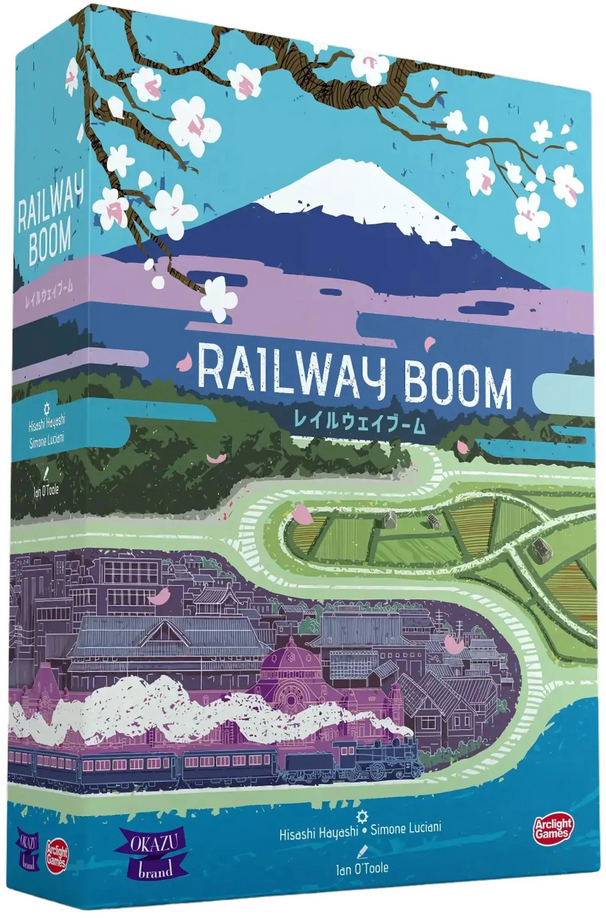
Railway Boom – This was the last game of the weekend for me. We began about an hour before midnight and wrapped a little after midnight. Mentally speaking, I was almost at capacity by that point. So only one quality of the game stuck with me. But I’m sure there are a number of smart ideas under the hood here. Railway Boom is about trains and train lines, which we spread out over a highly abstracted map of Japan. The game is held together not by its theme, but by an auction mechanism, that opens all but one six phases each round. Each auction is done using its own currency, which determines turn order for the rest of that phase. The most memorable part of this midnight game to me was the final phase each round. There, we handled the scoring criteria that would determine how the game would conclude. More accurately: we bid on our individual multiplier for fulfilling each goal. Doing so meant that we revealed to everyone at the table how important certain goals would be for us.
This way of externalising player intentions made the somewhat confusing game state on the board far more legible. It was easier to deduce another player’s plans based on the information available on the board, which we could then take into account when we planned our own turns. Whereas most games work with implied goals (“everyone wants victory points, but there are 3-5 ways to get them”), forcing you to guess if a player might go one way or another. Railway Boom at least gives you enough information to form a reasonable suspicion.
I’m sure the game has more clever bits of design in it. At least the way our networks expand based on each round’s starting station hints at more ways mechanisms play off of each other. But by that point I was too exhausted and tired to identify anything else. Maybe there’ll be an opportunity to play the game again in the near future.

