The Lord of the Rings is a story. That much everyone knows. What’s less known, is that this story is the product of the world, that Tolkien dreamt up. That is to say, the world in which The Lord of the Rings takes place, existed before the book and wasn’t made to purely serve as the story’s setting.
What might be even less known, is that this world was itself the result of Tolkien’s enthusiasm for languages. The languages he came up with were expressions of cultures that didn’t just come out of nowhere. They were the product of the history and the material conditions they were used in. Quenya, Sindarin and Khuzdûl are rooted in the historical events, that various peoples of Middle-Earth had lived through. Put differently: in the beginning was the word.
Even if The Lord of the Rings is a fiction, dreamt up by J.R.R. Tolkien, it is also to a significant extent a consequence of the conditions that the author has set up for himself. Which brings us to “The Lord of the Rings: The Fate of the Fellowship”: a board game by Matt Leacock.
In “The Lord of the Rings: The Fate of the Fellowship” the story is at the heart of the matter. That story is also the consequence of certain conditions. Now you might assume that these conditions are rules. That the rules of the game are the reason why it feels like you’re retelling The Lord of the Rings at your table. Just a little differently. But the rules are only a small part of it.
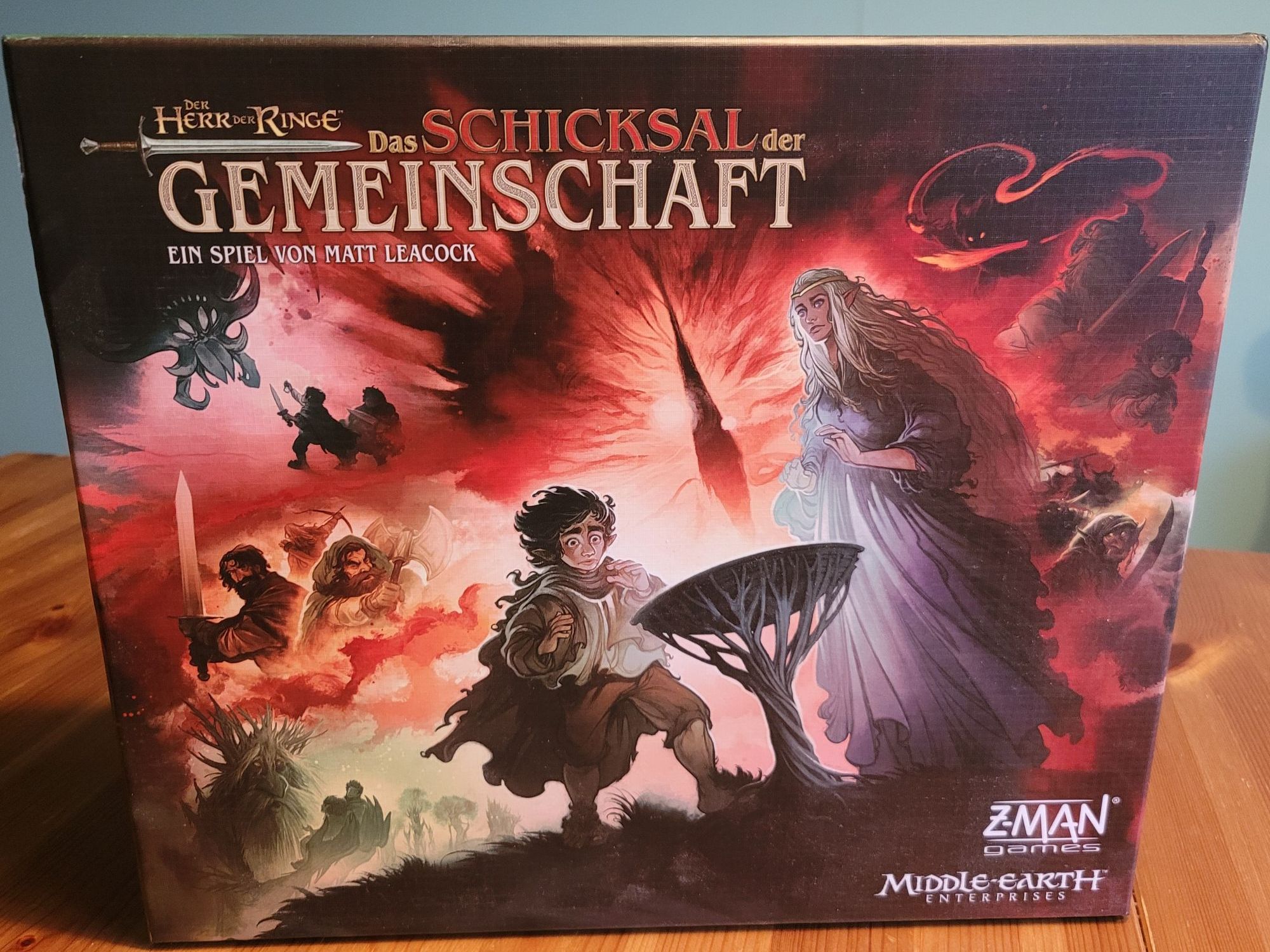
On the box, you’ll spot the publisher’s name (Z-Man Games) alongside the logo of the IP holders (Middle Earth Enterprises). You will also notice the “Pandemic System” logo on it. This is to make explicit that Matt Leacock is expanding on his already successful “Pandemic” rules set in this game. Some of its elements are easily spotted as well. There are four goals you have to fulfil. When it’s your turn, you get a limited number of actions. Some require you to play cards from your hand, before drawing two cards at the end of your turn. Finally, the cards of a different deck influence how the threats on the board (specifically: Sauron’s armies) change. Sometimes they grow, sometimes they move from one space to another. None of these elements strongly imply parallels to The Lord of the Rings. The rules, reminiscent of Pandemic, do not add much to convey the feel of the book (or films).
Comparisons between Pandemic and “The Lord of the Rings: Fate of the Fellowship” are superficial at best. At its core there is a significantly different experience and different focus here. Play feels thematically dense (which isn’t due the large number of arrows covering the game board’s map of Middle-Earth). It also feels narratively coherent. But we don’t just receive the story the game “tells us”. We intuitively understand that that we are the protagonists of the story.
This is, of course, in part due to the 13 characters we get to choose from. Characters who will try to thwart Sauron’s attempt to seize power. And it also shouldn’t go without mention, that only three of those characters are presented as female. On that matter this adaptation is tied to the limitations of the book itself. We are to some extent stuck with out-dated ideas of gender representation.
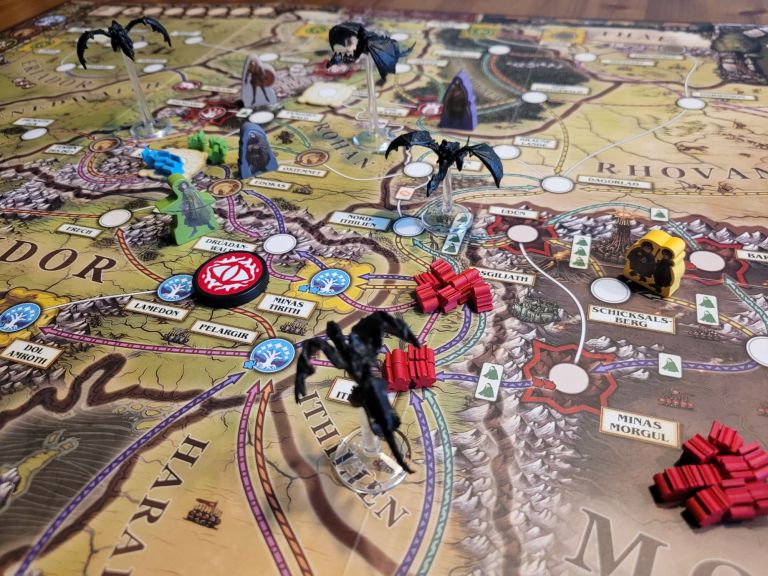
Once you look beyond that, it becomes obvious that the feeling like this story’s protagonist, isn’t merely due to character selection. There are four goals to fulfil. One of which – alongside its required characters (Frodo & Sam) – is fixed: the ring must be destroyed. All other goals are chosen from a set of 20 different tasks.
This is where it pays off to spell out mechanical goals in the words of specific moments from the book. An event of the story happens, because we did specific actions on chosen locations with the right characters. These connections between various conditions that we have to coordinate to make happen, draws most of our attention during play.
Fulfilling such a milestone has an effect similar to unlocking a new cutscene in a videogame. We took risks, weighed our options and carefully coordinated our turns. That’s why it feels earned and easy to claim ownership of. We, in fact, did it.
This is also because the rules are granular enough to make each goal mechanically distinct from another. “Saruman your staff is broken” is noticeably different in play from “Hobbits pledge their loyalty”. All while both goals are tied to the game’s narrative background. They simply slot in neatly.
Because this is the actual secret weapon that makes “The Lord of the Rings: The Fate of the Fellowship” feel like you’re experiencing the events of the book: the vibes of the game just line up. This lets players arrange and imagine the plot events of the game, i.e. the individual moments of the game, in a way that are in line with how we imagine Middle-Earth. That is because the game is centred on an idea, which was just as important in the book. That’s what makes Tolkien’s story and playing this game feel related in spirit.
The key word Leacock uses here is: hope. When characters fail, they are not eliminated from the game – i.e. killed. They also do not carry over physical injuries, wounds or the like. They lose hope. They lose faith that good can triumph over evil. This is where Leacock lifts out a central motif of the book and uses mechanisms to put it at the core of his game. Our perception of the events in the game happen through this lens. We interpret them with this concept in mind.
A mere prosaic depiction of the book’s plot couldn’t have done the same. If we had been talking about “power” or “vitality”, the game would have taken on a far more martial tone. It would have invoked associations with wargames (and by doing so maybe emphasised the ideas taken from Pandemic: Fall of Rome”),
The chosen words aren’t just labels to differentiate one track from another. They give us a conceptual frame that our imagination gets to play with during the game. Put differently: in the beginning was the word.
What we experience during play, and what our decisions make happen, always ties back to the question whether it makes the characters gain or lose hope. Because this question so effortlessly resonates with the emotional journey of the characters in the book (and the films), if not authentically transposes them to the game, “The Lord of the Rings: The Fate of the Fellowship” feels authentic.
The game feels thematic, because the game manages to articulate the original text’s tone. There is little resistance and no contradictions we have to overcome, to let the events of the game slot into our mental image of Middle-Earth.
If we have such a mental image, that is. Without prior knowledge of the setting “The Lord of the Rings: The Fate of the Fellowship” loses a lot of its thematic depth. Which shouldn’t come as a surprise. If Legolas makes you think of a Danish island, and Gimli sounds like an alcoholic drink to you, you’ll most likely experience “The Lord of the Rings: The Fate of the Fellowship” from a certain emotional distance. The game’s thematic resonance assumes that players not only see the words and images before them, but they can also connect them to a larger story and background.
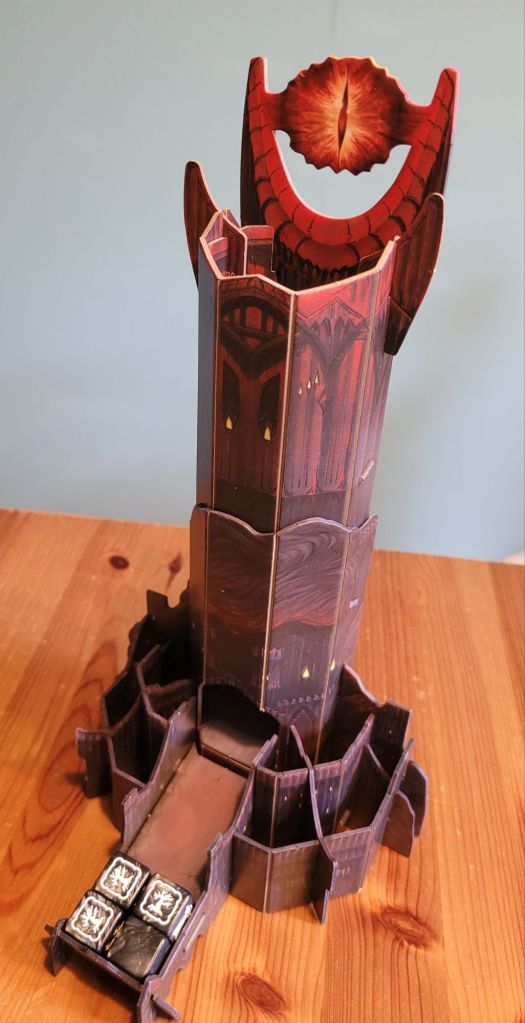
If you are familiar with the Lord of the Rings setting (literally or cinematically), you’ll find it difficult to resist the impact that the language of the game has on you. The game’s presentation and rules volume feels appropriately large and detailed for such a story. Sauron’s armies march on Minas Tirith. The Nazgûl, his servants, hunt the ring-bearer relentlessly. The Eye of Sauron looks down from its (cardboard) tower of Barad-Dûr. The vibes are immaculate.
This makes “The Lord of the Rings: The Fate of the Fellowship” a worthy, maybe even one of the most authentic adaptations of the book to a boardgame. The solidarity between players, the struggle to hold on to hope and optimism in the face of ever-growing threats, brings to mind the original without ever overshadowing your own experience. For one evening The Lord of the Rings is not just a story, it is above all our story.

