If taken literally the phrase “reading between the lines” is funny. After all, there is explicitly nothing printed between lines in a book. It takes some contextual knowledge, and linguistic skill to pick up on references, double meanings and nuances to identify some meaning in a text that goes beyond what the printed words say. If we apply this idea to board games, we might speak of “reading between the actions” to express something similar. Using contextual knowledge and our skill to pick up on references and nuances, we can identify some meaning in the game(play) that goes beyond the obvious.
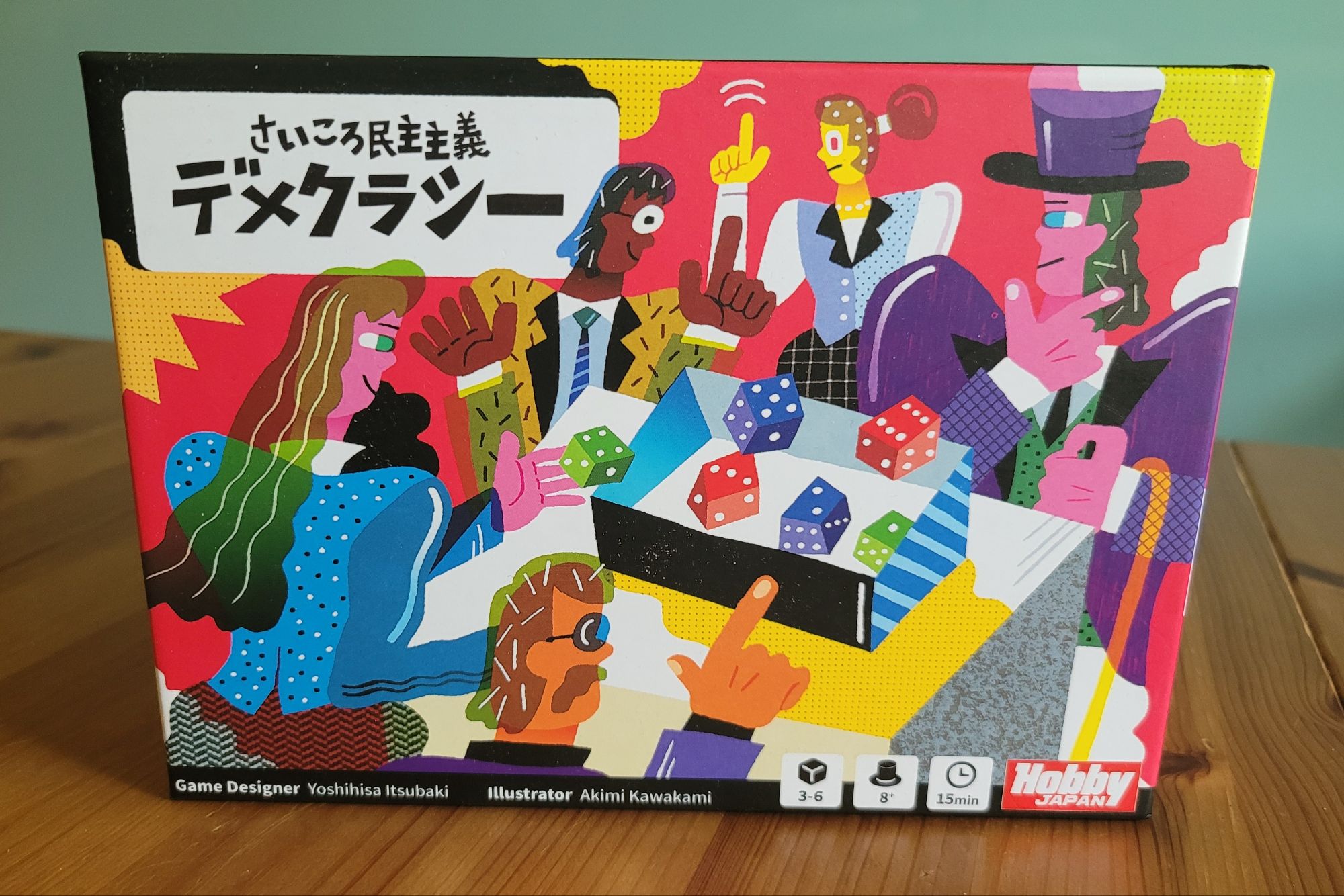
Dice Democracy (the literal translation of its original title) is a game that is obviously and by admission a party game about voting. To wit, we will vote on which number the dice we rolled into the game’s box show the most and the least of. These all-important dice are only visible for a few seconds (I.e. less than three), before they are immediately covered up again.
Then we get to vote on which number we saw most and least often. And that’s basically the game. It’s a quick pastime for people with good eyesight and quick reflexes.
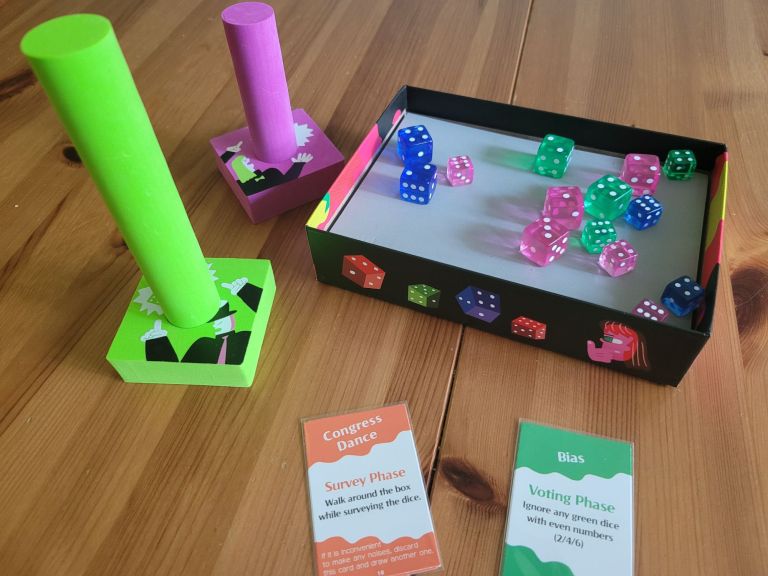
If it weren’t for that majority vote thing: the “democracy” mentioned in the game’s title. Because in Dice Democracy it is the majority opinion that gets the last word. Which means the larger number of players in agreement, score points. If you happen to hold the minority view, you get nothing. Then we start the next round, shaking the box thoroughly before taking out the dice and rolling them.
If you were to stick with the obvious, you might ask yourself how you’d be able to find out who is “right”, and who actually deserved to score points. For these players, the option to challenge majority opinion is an obligatory part of each round. How else would we make sure we’re playing fairly? Thanks to an immaculate sense for drama and theatrics, the game also includes two foam sticks (in garish-green and purple-juice-purple). You can grab those – with whatever sense of decorum you consider appropriate – to add political weight to your deeply held belief in objecting. Because only then do you reveal the dice to all again, awarding or revoking victory points as appropriate. But that step isn’t mandatory, and will cost you victory points, should you be wrong.
If you start to “read between the lines”, you might identify the game’s potential to be more political, funnier and satirical. Because as is the case for all democratic processes, verifiable facts and majority opinion aren’t necessarily the same. Some rhetorical skill and a strong projection of confidence often play as big a role as what people saw with their own eyes. To score points, you need to be part of the majority. That is the majority around the table, the political movers and shakers so to speak. It’s not the majority of dice rolls that you have at most three seconds to survey. In case your fellow players’ eyes and reflexes are too sharp to be fooled, Dice Democracy offers some optional rules. With these you also have to consider dice color and size to survey “correctly”. This way, we’re quickly pushed to our limits and have to rely on what the others around the table believe to have seen.
Accordingly, you have to “read between the actions” in Dice Democracy. Because that is where the actual game takes place. A cleverly placed rhetorical maneuver can outsmart the strict formality of rulebound players. Strongly opinionated positions argue over who gets to decide what the objective truth is. The result is a game, which – at least among those who still have the mental resilience to follow the news – invokes such strong comparisons, that it will either make you laugh out loud or raise your eyebrows at the sheer audacity of this game. When majority opinion is routinely manipulated by ambitiously arguing over it, it can hit a little too close to home.
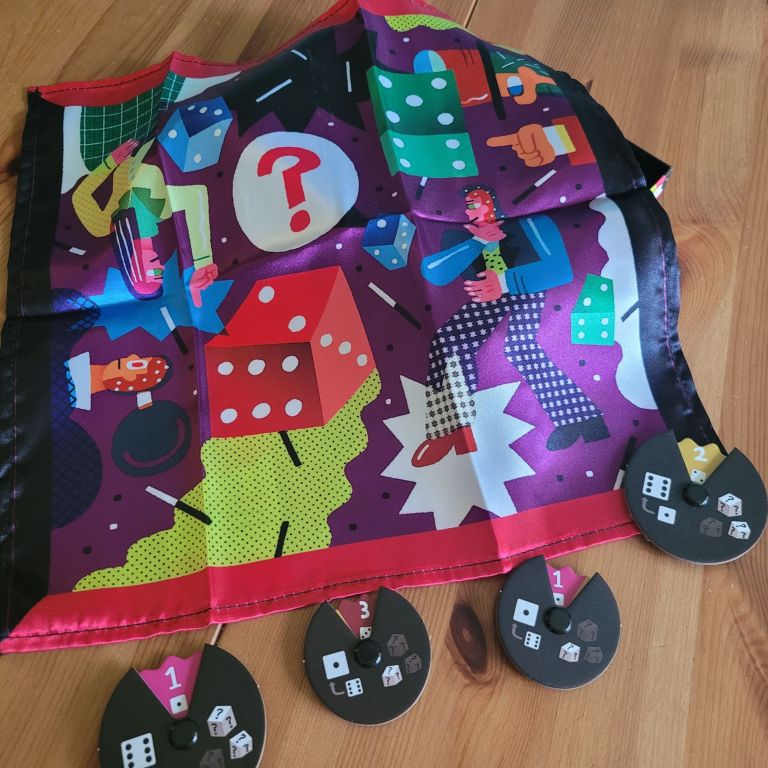
But it’s those moments that make Dice Democracy such a memorable experience. Like the best games, its events reach beyond the game table and feel like a squeaky echo of real situations, moments and attitudes. You recognise a kernel of truth in the things you do for fun, and nod along with a sheepish grin on your face. Just like you would in a good piece of political comedy. Dice Democracy manages to feel like political satire, while still retaining its identity as a light-hearted party game.
One which, thanks to its winking nuances and layers, can easily keep adults engaged.
 Lest My Opinions Go Unheard