The Spiel des Jahres award is a tradtion in the German board gaming scene. Since its inception in 1979 it has changed and grown alongside its jurors. More than that that, it has itself established a sense of tradition which is still felt in 2026. The jury often has to provide guidance to people who are turning to board games for the first time. But they also have to elect the game of the year (which is the literal translation of Spiel des Jahres).
And while the jury repeatedly reassures us that they choose the best game for a specific audience, and that said game it is the best game to promote the cultural practice of play this year, at the end of the day, the expectation has to be that one single game will be lifted above all others. That one game which is exceptional in a way the others are not.
Naturally, it has also become tradition that in the weeks leading up to the ceremony many smart, experienced and simply opinionated voices try to predict, guess or simply explain why the jury (here seen as one collective block) will or won’t award one game or the other.
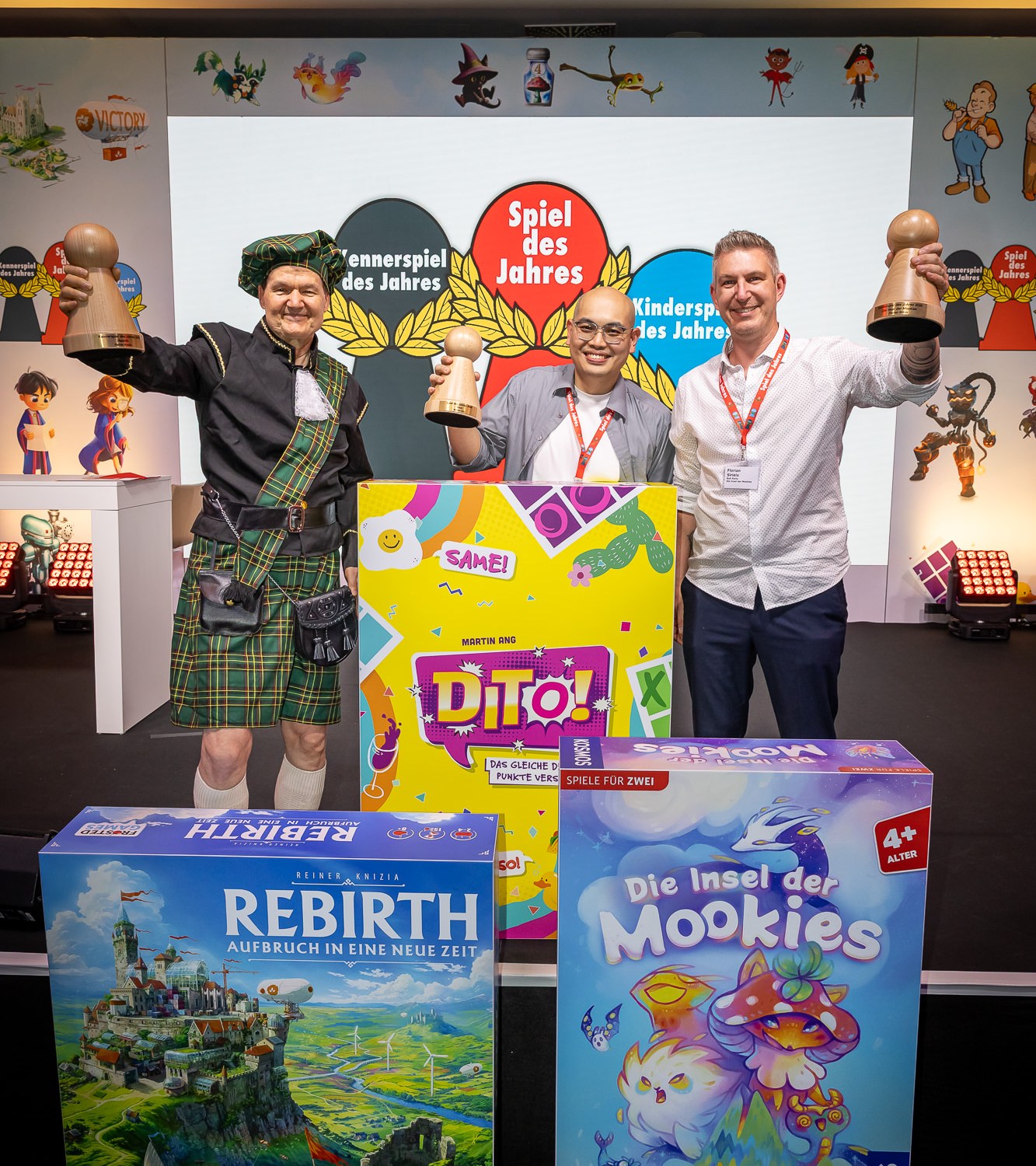
All of these steps have been dutily taken. And of course, following the ceremony there will again be comments and reactions to the games named. This year it was Dito!/Jinxo!, Rebirth and Die Insel der Mookies/Mooki Island. As a critic, you’re inexorably tied to your scene’s culture, so it’s hardly surprising that this award provokes some kind of contextualisation and evaluation. All this is part of the traditional back-and-forth of online discourse.
And yet, Kennerspiel-winner Reiner Knizia has already found the right words to make this part easier. Each of the nominated and recommended games is worth playing. They shouldn’t be forgotten, even if the jury had the thankless and often contentious task of picking one game for each category.
In short: the difference in quality between Cozy Stickerville and Jinxo, between Take Time and Hot Streak, between Rebirth and Moon Colony Bloodbath is miniscule. They are all worth playing, or at least trying.
Still, I want to add a few words to Jinxo, which – at least to me – only occured to me after talking to other critics. Next to the higher player count, Jinxo offers a ludo-aesthetic effect that makes the game stand out. (If you’re grumbling over my word choice, rest assured that I am aware that ‘appeal’ would have sufficed as well, but strikes me as an unprecise synonym here.) In Jinxo, picking the right word leads to the group reaffirming our inclusion among them. It’s a validation of us belonging with this group of players. “Tasty breakfast items” evokes the same image in my head as it does in my fellow players. On an emotional level this affirmation feels good. It gives us the sense of being among equals; a sense of being part of the group. This mirrors something Harald Schrapers said during the ceremony: games bring people together and helps us overcome our differences.
Admittedly, a similar, community-supporting explanation could have been found for Cozy Stickerville as well, had it been awarded the Spiel des Jahres. But that doesn’t mean that these explanations are arbitrary and flimsy. Far from it: each game nudges players to act or think one way or another. Jinxo does this through how it’s played, other games use their themes instead. The decision to award Jinxo isn’t arbitrary. But there are far fewer considerations on a macro-level here, than others often seem to assume. If “hard to peel stickers” is considered a valid point of criticism, there’s only so much room for the artistic vision and cultural impact on the scene in how the game of the year is chosen. Again, each of the games named is worth trying out. Which of them will have a lasting shelf-life, istn’t really up the jury or the views of any critic or influencer. It’s down to the people who play these games solely for their own sake.
Similar things could be said about the Kennerspiel des Jahres. Still, I want to include an addendum here. Most of all because the comparison between the three nominated games in this category is both more distinct and less obvious. Boss Fighters QR stands out because of its integrated app. Especially among elder millenials and those even older, it stoked hopes of roping new players into board gaming. Particularly those fidgety youngsters who are heavily into “digital” and “online”.
The Kennerspiel presenters (Maren Hoffmann and Steph Kessler) praised the game’s app, for taking “pesky admin work” off of players’ hands. Which strikes me as an argument that is representative of this moment, but no less misguided. The same jury that in past years praised the tactility of board games, the physical presence on the table and the inviting presentation of a game, now seemed to indulge in the joy of using an app that reduced the game to selecting (coordinating actions with other players) and entering prompts (QR codes). Something that echoes somewhat unpleasantly into today.
The end result might hardly differ from other games of the type. But just as with pictures, texts or other ‘human-generated content’ it is the process that makes it all come alive, and gives the experience of playing a game its value. What makes games special isn’t just player decisions and the complexity of our thoughts leading up to them. It’s the effort it takes, to move within the game that gives it substance and makes play feel like something we share with others. (Which is also why I suggest that with most games, getting rid of the “pesky sorting of player pieces” by way of plastic baggies isn’t a good substitute for doing it together as a group.) It’s only when it reaches extremes, that admin work becomes a problem. Which is why the low barrier of entry to this game comes at the cost of qualities that bring people together in a Kennerspiel.
Especially since the other nominee (Moon Colony Bloodbath) nicely proved, that a low barrier of entry with a pretty reasonable level of admin work, can turn a “very silly theme” into an entertaining and memorable experience. The nerd faction among gamers may have hoped for the game’s morbid and grotesque humour to score a similar prank win as Lordi did back at Eurovision 2006. It didn’t turn out this way, but there’s an off-chance that games with a similar ease of play will start looking at the kind of odd themes that used to be the identifying mark of indie releases and crowdfunded games.
The game that did get the nod in the end was Rebirth by Reiner Knizia. Whose award hattrick (winning Spiel des Jahres, Kinderspiel des Jahres and Kennerspiel des Jahres) has long been been expected by many. Rebirth is a traditional design in the truest sense of the word. And according to the designer, that is intentional. The game’s post-apocalyptic setting of rebuilding civilization is supposed to express a critique of modern society. Something which may have been almost impossible to pick up on, if it hadn’t been for Knizia’s explanation. A return to community, to nature and far away from over-bureaucratisation. But ultimately this only goes to show that a game’s theme is a highly inadequate way to articulate subtle and detailed social criticism. Not to mention the challenges that come with trying to decipher authorial intent from a board game. Because even here, as was echoed multiple times by people on stage that evening, a game is too much the concetrated team effort, as opposed to an auteur’s singular vision.
The evening ended, as it traditionally does, with an open buffet in the lobby next door. The food was surprisingly traditional as well (“Curry mit Pommes, rot-weiß”, i.e. sausage in spiced tomato sauce and fries, with ketchup and mayonnaise). Which in turn served as a nice stylistic counterpoint to the increasing seriousness, which many members of the board game media have started to bring to the event. Conversations and discussions developed among people who are enthusiastic about games, play styles, experiences and potential projects and among people who consider networking and content creation the primary purpose of this evening. Small groups formed, cliques clicked and people made sure to be seen by others.

But in truth, looking back, I’ve found the most honest and fitting moments of the evening to have been the ones where serious professionalism and earnestness met human imperfection and fallability. Whether it was Christoph Schlewinski’s ironically cheap attempt at drawing a compliment from the mouth a child juror only to be met with a phenomenally honest answer. (“Would you rather have an additional hour at school for German, Math or Playing Board Games?” – “German!”); or Schraper’s fumbling his words when it came to declaring this year’s winner (“The Spiel des Jahres 2024 is….”). They underline the essence of play and with it the foundation of an event, dedicated to naming the Spiel des Jahres.
Play is, at heart, a humorous, imprecise and deeply self-deprecating activity. You can’t play, if you’re not willing to laugh at yourself, and most of all, if you’re not willing to accept the faults and inadequacies in yourself and others. The best game can’t bring people together, if they will use that time to put themselves above others. After all, communities can only exist among equals. Perhaps that is the kind of play tradition that is worth promoting as cultural practice.

