After a prolonged absence, a solo game made it onto my table again. It’s a game I had found difficult and quite random in the past. One of the reasons for the long pause, was the simple effort it took, to think your way into the game. There were too many uncertainties, you had to keep in mind, to even make a decision. This was quite an appealing challenge in the first few plays of the game. But with each new playthrough and defeat, the game felt increasingly cumbersome to play. Naturally, this meant the game languished on my shelf.
The reasons why it returned to my table aren’t relevant here. What’s far more interesting is the player aid I had stumbled upon when I was looking up a rules question online. As with all solo games there were mechanisms, that created complications and challenges to ensure the outcome of the game didn’t become trivial. In this case it was a deck of 16 cards, which would determine which areas of the game board were blocked. Once blocked an area would no longer be available for the rest of the turn. If the path to a spot was blocked this way, you might have to discard one of your playing pieces. Simply put: you might quickly lose the game, if the deck ended up removing too many of your pieces.
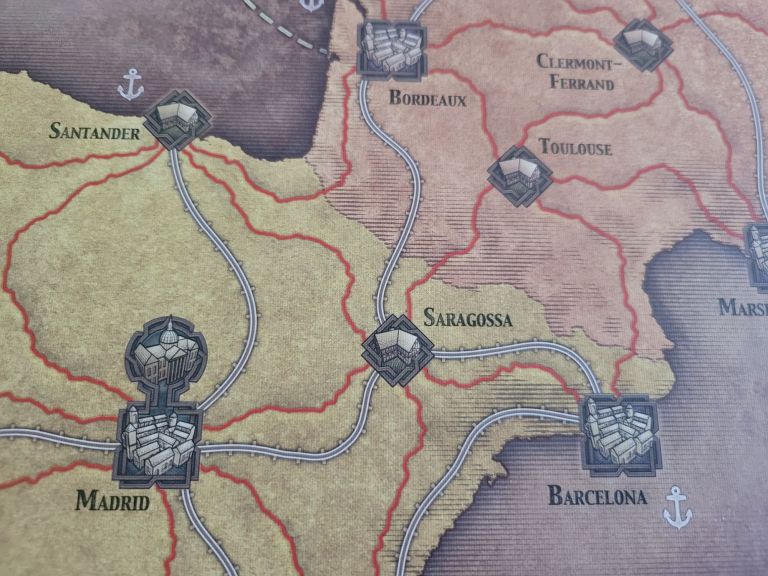
Memorizing 16 places isn’t all that difficult. Especially when they keep coming up as part of the game. One of the great strengths of (board) games is that they can engage our memory so effectively. They do so by connecting game terms to game states, actions and also emotions. I know now, for example, where Saragossa is located, because I’d often made a stop there playing Fury of Dracula. I’ve never been to the actual place myself, and I wouldn’t even be able to tell you what it looked like either. But I know where it is, roughly. In the afore mentioned solo game, on the other hand, these 16 spaces have become a little more difficult to memorize due to rather clever algorithm, making their appearances less calculable. Each card features three different places on the board, and should the first one be occupied already, the next one is blocked instead and so on.
It was at this point that I found the game become too cumbersome and complicated. As mentioned, I could have relied on eventually internalising all the cards by simply playing the game often enough. But to be honest, I had neither the time nor the desire to do so. It was just a simple solo game after all. The result was a game that felt difficult and quite random. Enter the player aid, that conveniently summed up the contents of the card deck in an easy to read table. This way I could always look up which cards had been played already, and more importantly which cards were still in the deck. This meant I could take into account which spaces could still be blocked in the current round, and which spaces I should block with my own markers.
The difference in experience was immense. I no longer reacted passively to each surprise a new revealed card from the deck sprang on me. Instead I could make tactical decisions, develop a strategy and intentionally take risks, when necessary. The game now offered me a path to actual player agency. This isn’t just worth an article, because I could now tell the world, that I can win this solo game on its lowest difficulty setting. It’s above all interesting, because this addition of available information, helped me experience the game fully. Once I felt I was able to make informed decisions, I was able to immerse myself in playing the game.
I’d go so far as to say, that the moment you move past this threshold of experiencing your decisions as informed and intentional, is when the actual game begins. It only follows from here that a game’s design (and I’d include the rules, its presentation and the rulebook here) should aim to get players as close to that threshold as possible. All the knowledge necessary to let players make an informed decision should be made available to them.
The closer you look at this point, the more apparent it becomes that it is also necessary to understand the limitations placed on this knowledge. Decisions in games are often defined by all the information that is deliberately kept from players. Some analysis paralysis-prone players make the mistake of attributing this lack of information to their own incompetence. They stare at the game board hoping, that eventually that missing bit of information will reveal itself to them, enabling them to make an informed decision.
This can lead to a lot of frustration (not just among those who are waiting for that player to take their turn), when it’s not immediately obvious which bits of information are meant to be inaccessible. Especially when it’s simply a lack of practice with the game, these missing pieces can lead to a very negative experience. Such games can came across as needlessly complicated, random or simply very “mean”.
A player aid, like the one I used for the previously mentioned solo game, closed this gap for me. I finally knew everything I needed to have a sense of agency. Instead of investing countless playthroughs to memorise the card deck, this simple player aid helped me play the game, instead of simply toying around with it. The question is: what means can creators and players use to quickly move to the point where players feel like they have agency?

